
The Fiscal Realities of the Jones Library Renovation and Expansion Project
by Ginny Hamilton
Tonight, the Amherst Town Council will take up a familiar topic: funding for the Jones Library Building Project. Tonight’s discussion will focus on increasing the borrowing cap for the Library renovation and expansion project. The Finance Committee also will discuss the borrowing cap this week and the Town Council is expected to vote at its meeting on December 4 or December 18.
Didn’t we already decide this? You may be asking. And you are right! Two years ago, 65% of voters approved our Town Council’s April 2021 decision to authorize funds to renovate and expand the Jones Library. However, the MA Board of Library Commissioners (MBLC) requires our Town to authorize total cost for the project, not simply the Town’s share. (It is worth noting that the MBLC requirement that the Town approve the full amount does not mean Amherst will borrow the full amount. In fact, the first payment from the MBLC to the Town is currently earning interest, not accruing interest.)
With the cost increase from Summer 2022, Town Council needs to approve a higher borrowing cap. The Town’s share of the project cost, $15.8 million, has not changed and will not change even with the cost increase.
Public-private funding partnership remains key to the project’s success
The Library Trustees and non-profit Friends of the Jones have launched a robust capital campaign to raise the additional funds from public and private sources, with over $9 million committed to date. Sen. Jo Comerford and Rep. Mindy Domb have secured an additional $1.7 million from the MBLC, and U.S. Congressman McGovern obtained $1.1 million in federal funds for sustainability measures within the project. The National Endowment for the Humanities (NEH) and Amherst College have each committed $1 million to the project, recognizing the Library’s central role as an important civic institution.
As of November 1, 2023, we have secured over $38.7 million from all sources, representing more than 84% of the estimated cost of $46.1 million. And fundraising efforts continue. For instance, the approval process is underway to secure $2 million in historic tax credits to help cover the cost of restoring the original 1928 building. The NEH Challenge Grant is helping to leverage additional funds from other donors. Individual donors have pledged over $2.7 million towards the vision of an accessible and sustainable library.
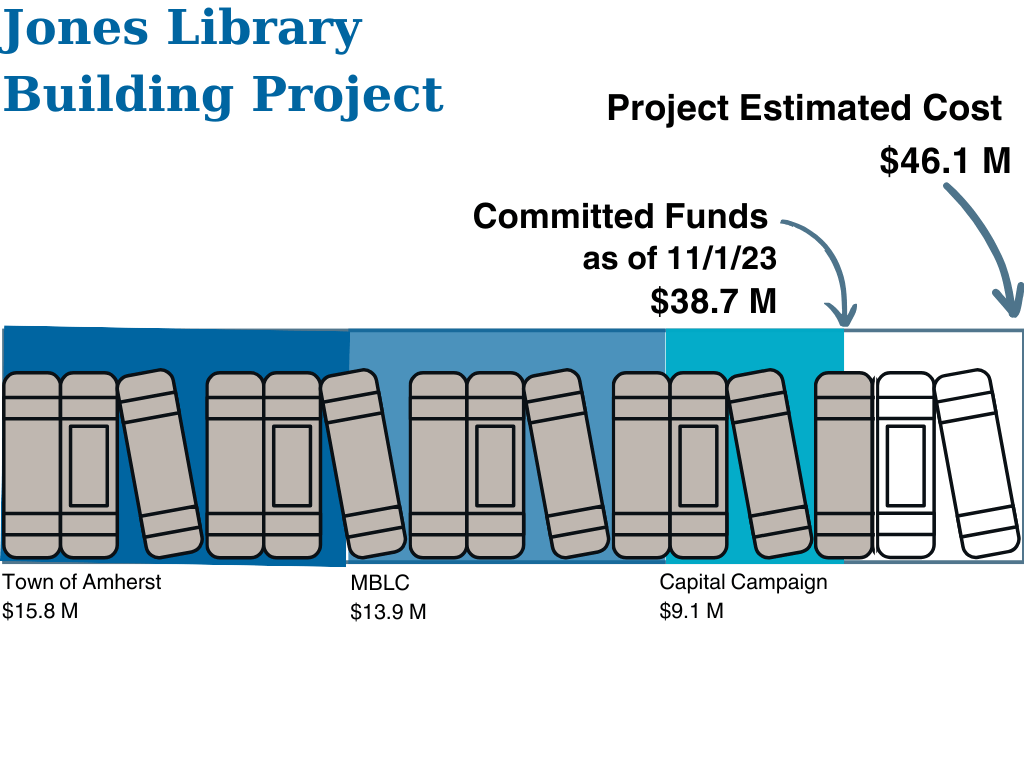
Costs have risen. The Town of Amherst’s share remains the same
Dating back to 2017, when Town Meeting approved the Library’s application to the MBLC construction program, the total project cost was estimated to be $36.3 million. Due to delays and COVID-related cost spikes, Summer 2022 project estimates jumped a startling $11 million. Town and Library officials re-assessed the feasibility of moving forward: the Building Committee and architects identified more than $2 million in cuts; the Trustees assessed the strength of the endowment to cover part of the gap if necessary; and the Capital Campaign committee expanded our fundraising efforts. In September 2022, the Town Council and the Trustees agreed to move forward. Subsequent estimates have stabilized at the current project cost of $46.1 million.
Repairs alone would cost our Town more
Postponing or canceling this Library renovation and expansion would not free up Town funds for other uses. In 2020, renovation and construction experts estimated that 30 years of deferred maintenance would require $14 – $16 million in repairs. Escalated for inflation, this repair cost estimate has jumped to $19 – $21 million just for the minimum repairs for public safety and building integrity. And, this is without addressing climate goals or community program needs.
Furthermore, federal, state, and private funding commitments are not available for repairs alone. We cannot repurpose these funding commitments for a project that addresses just repairs. Were we to not move forward, Amherst would forfeit over $23 million in funding commitments, yet remain responsible for millions in urgent repairs needed just to keep the building operational.
After over a decade of thorough planning and deliberation, it is time to address the urgent physical needs of the Library building. Once our Town Council approves the borrowing cap, the Building Committee can continue with the bidding process and begin construction this coming spring.
When complete, the renovation and expansion will make the Jones Library one of the most climate-friendly buildings in Amherst, restoring most of the original 1928 building, expanding programming space to meet current and emerging needs, and improving the layout to be fully accessible and welcoming for everyone.
For more information and answers to Frequently Asked Questions, please visit www.JonesLibraryCapitalCampaign.org
Currently employed by the Friends of the Jones Libraries to manage the Capital Campaign fundraising efforts, Ginny Hamilton (she/they) has worked in campaign organizing and advocacy for social change for over 30 years. Ginny lives in South Amherst with spouse and teen, two parakeets, and too many mice to count.
Editor’s Note: this post was updated to include a link to the repair cost estimate presented on 11/13/2023 to the Amherst Town Council. This post was updated again on 11/20/2023 to revise the date on which the Town Council is expected to vote on the increased debt authorization.
Discover more from THE AMHERST CURRENT
Subscribe to get the latest posts sent to your email.
 THE AMHERST CURRENT
Is the Jones Library offering to pay the interest on the additional $9.9 million that the Town is being asked to borrow? With interest rates near a 20-year high, this added cost could be significant. My opinion is that we should abandon the costly and arguably unnecessary 15000 sq. ft. addition. This will mean turning back the $13.8 million grant from the Mass. Board of Library Commissioners as eleven other public libraries in the state have done. Let’s put the remaining funds that the Library Capital Campaign has worked hard to land into library improvements and save town funds for more critical priorities.
LikeLike
Hi Jeff,
We can’t “put the remaining funds into library improvements” as you suggest. Funds raised for the renovation and expansion cannot be transferred to pay for repairs. The funding commitments are specific to details of the renovation and expansion project:
– the HUD grant secured by Rep. McGovern is for sustainability measures;
– the NEH grant is for more meeting space, improvements to Special Collections, and a permanent home for the Civil War tablets;
– The same is true for foundation and corporate grants.
Might a fraction of individuals be willing to contribute for repairs? Perhaps. But to suggest that we could simply apply funds to repairs is not only misleading and inaccurate but would be unethical and in violation of funding agreements.
If we don’t proceed with the approved project, we forfeit commitments totaling $23 million.
LikeLike
It’s about time Amherst moves forward with this very important project for our town. Public libraries are among the most democratic institutions in the US, and we need to improve ours.
LikeLike
I had a similar question. If more money will be borrowed, why won’t that cost the town more money in interest? Thank you.
LikeLike
In this article it claims that “When complete, the renovation and expansion will make the Jones Library one of the most climate-friendly buildings in Amherst” and the Daily Hampshire Gazette described the building project as “net-zero” in an article surrounding the Jones Library Building Project. I respect the efforts of folks working to advance this project, and understand that some fluff is part of selling the package, however, to claim that the new building is net zero or one of the most climate friendly buildings is false. The process of demolishing, and rebuilding already is carbon intensive, and although the building is planned to be net zero ready, that is not to be confused as net zero, as significant additions on top of the 46 million dollar project would still have to be made to achieve this state. The Hitchcock Center, multiple buildings at all three educational institutions and the three other capital building projects (DPW, Fire and Elementary School) are planned to be or are all net zero, unlike the Jones Project, meaning that the Jones likely will not even be in the top ten most climate friendly buildings in Amherst. Although the project does have climate gains that are laudable, it also has drawbacks, one of which is the demolition and expansion. As has been said by many climate researches and scientists, usually, the most sustainable building (or car for that matter) is the one that is already there. It is almost always better to keep what you have rather than engage in toxic consumerism and buy new from an environmental perspective. This is why poor and middle class people have significantly lower carbon footprints even if they can’t afford to own solar or a Tesla. The town should look more into this philosophy when considering the Jones Project, as well as vehicle purchases (we buy new police cars every 4 years!) and new buildings going up downtown such as 11 East Pleasant Street. Learn more about this here: https://www.sciencedaily.com/releases/2019/10/191008155716.htm
I would kindly ask the writer or editors of this blog to make a correction, changing “When complete, the renovation and expansion will make the Jones Library one of the most climate-friendly buildings in Amherst” to more accurately reflect the project’s current standing. Something such as “The project will increase energy efficiency at the Jones, making the building closer aligned to town climate goals” would be more informative to the reader, and probably present a better argument given that it would be based in fact and have information the reader can verify and trust.
LikeLike
Hi Julian –
Buildings are a huge contributor to climate change – 42 % of global greenhouse gas emissions come from the built environment. Of that 42 %, 2/3 of those emissions come from operating buildings – directly from the combustion of fossil fuels for heating and cooking and indirectly through purchased electricity. The remaining 1/3 come from the embodied emission in materials and the construction industry (Source: https://www.architecture2030.org/why-the-built-environment/) There are four ways to decarbonize buildings – 1) make them as energy efficient as possible 2) take them off fossil fuels 2) use renewable electricity and 3) leverage low carbon building materials for renovations and new builds. The Jones renovation project is taking a really carbon-intensive building, immediately addressing 3 out of 4 decarbonization tactics, and is poised to quickly do the last.
As you know because Sunrise is a key player in this movement, getting off fossil fuels is the single biggest impact we can have to address climate change. The current Jones Library uses a staggering amount of methane (natural gas) to provide heat to the building. Although not required at all by the MBLC or the town (as you rightly point out, the library is not covered by the net zero bylaw), we are lucky to have library trustees that take climate action seriously and as a result, are taking the opportunity with these state funds to move the library off fossil fuels and onto electric heat pumps. To do this in a way that is cost effective to operate, we must do extensive work to improve the envelope and energy efficiency. If we don’t move forward with this project, the current repair – only option will not have funding for the needed energy efficiency work and therefore will have us replacing 31-year-old fossil fuel boilers with new fossil fuel boilers. This means that future Amherst residents will be stuck with these stranded fossil fuel assets.
In addition to getting off fossil fuels and improving energy efficiency, the updated library will be solar ready, will use the most climate-friendly materials possible in the new constructure, and will recycling materials during the renovation. In fact, the sustainability committee for this project did the calculations to make sure that the improved energy performance of the new construction would outweigh the carbon impact of demolition. As a result of the Inflation Reduction Act, tax-exempt buildings like libraries, schools, religious locations, etc. now have access to direct payment for solar that they didn’t have when this project was being developed. I am confident that we will move quickly to put solar on this building, cutting the operating costs even more than the updates alone will do and moving this building to be completely net zero.
So while you are right that the library is not “net zero” by the town bylaw definition it will certainly be one of the more climate friendly buildings in town and perhaps the most climate friendly renovation – although I hope it doesn’t stay that way for long because we need to quickly make progress on renovating the rest of our buildings if we are going to meet our climate goals.
And, while I respect the adage that the most sustainable building is an old building, it can’t be applied as a blanket statement especially when we are trying to decarbonize. In fact – all of the buildings you are referencing as good examples of net zero – Hitchcock, the academic buildings like the new Science Center at Amherst College, the Kern Center at Hampshire, and the upcoming new elementary school, DPW and fire station– are all new buildings that replaced or will replace old buildings. So I am not sure how you can only apply a strict “no new” rule to a part of one project when praising other new builds. In fact, the library is better because we are reusing much of the old building – if we plan to reuse the other buildings we move out of, we need to invest the money to update all of them to get off fossil fuels or else we are not addressing the climate crisis, but that is a discussion for another time.
As offered in the past, I would be more than happy to speak with you and your group any time – either personally to share my expertise as a climate activist or to collaborate together on town projects through ECAC. Please reach out!
Laura Draucker
LikeLike
Hi Jeff & Gerry,
Like all municipal borrowing, the Town will borrow only as needed for project cash flow. If it helps to visualize, you can think of the borrowing authorization as a credit limit specifically for this project. There is no intent or expectation to borrow $46.1 million, just as there was none to borrow $36.3 million when project costs were lower.
As he shared at last night’s Council meeting, the Town Manager is working on the updated cash flow projection for discussion by the Finance committee later this week. It is my understanding that this projection will take into account the MBLC payment schedule as well as payment schedules from capital campaign fundraising commitments, current interest earnings as well as projected borrowing costs.
It’s worth noting that the MBLC pays pre-set amounts each year. Currently, the town is earning interest on Library building project funds already received and not yet spent.
LikeLike
Thanks for that explanation. I actually understand that. And I know as a former SB member, I should understand this better than I do. It just seems to me that having the authorization to borrow more money means more borrowing could be necessary and could happen. And if that does happen, it will cost the town more money. So, if that is wrong, please tell me why it is a wrong assumption.
LikeLike
Hi again, has anyone been able to respond to my question as well as Jeff’s about increased borrowing? Having been a TM member for the “sloped roofs” ploy foisted on TM to get us to OK 5 story buildings, it’s not good trust hygiene to ask for the ability to borrow more money for a project while guaranteeing it won’t be needed. What am I missing here?
LikeLike
Hi Gerry,
Thanks for your patience with my slow response. I thought I’d get notified about new comments, but apparently I don’t have it set up correctly. Kudos to Allison for bringing your additional comments to my attention.
Now, to substance.
The guarantee that the higher project cost won’t fall to the Town comes from the Library Trustees. The Trustees & the Town Manager have MOAs to this effect* agreeing that any costs beyond the MBLC and Town commitments are the responsibility of the Trustees.
If fundraising falls short, it is the responsibility of the Trustees to make up the difference. The Trustees have secured loan commitments from area banks if a loan proves to be wiser than drawing from the endowment. And the Trustees would be responsible for interest on such a loan.
Its worth noting that borrowing from an endowment is common practice in capital campaigns. It’s how we got our historic Amity St. building in the first place a century ago.
This TC vote should simply be a technicality. The State requires the Town to authorize borrowing for the whole amount. If Council does not approve the full amount, the project cannot move forward and we forfeit over $23 million already secured for the project, none of which could be applied to repair costs despite wishful thinking otherwise.
* Here’s the link to the amended MOA signed in October 2022, after project costs jumped to $43-50 million. http://www.joneslibrary.org/DocumentCenter/View/8702/Amendment-to-Memorandum-of-Agreement—Between-the-Town-and-the-Library-October-27-2022-PDF
Both MOAs are included in the packet for the Finance Committee meeting on 11/17/23, as well: https://www.amherstma.gov/DocumentCenter/Index/3501
LikeLike
Sorry that I missed this but for the record I sent the following reply to Ginnie’s excellent explanation: ” Thank you Ginny, that is the clearest explanation I’ve seen! “
LikeLike
However, following the public hearing on the increased borrowing proposal, I’m confused once again. The Town must authorize the borrowing to go forward. I get that. And the Town will be the borrowers, thus that borrowing will be on the Town’s books and be part of the debt limit. And we are told not to worry about that number, even though borrowing for a new DPW building and Fire Station are certainly in our future. But the Library Trustees are on the hook to pay for an increase in library building borrowing. Now there is a suggestion that stabilization funds (SF) be used to offset at least some of that increased borrowing (which we are being assured won’t be needed) even though the same people were aghast at the thought of using SF to help lower the tax debt for the new school building.
LikeLike
Hi Gerry.
At last week’s finance committee meeting, Councilor Walker asked specifically about the potential negative effects on the DPW & Fire Station related to any borrowing for the Library. Council Schoen shared her own spreadsheet and stated clearly that by current projections, borrowing for the DPW won’t begin until after the Library expenses are settled.
I’m paraphrasing, but you can watch the recording for their exact conversation at approx. 1:15:30 – 1:17:00 of the Finance Committee on Nov 28, 2023. https://www.youtube.com/watch?v=cMd1B1abk6w
Some borrowing for the Library has always been part of the plan. As Councilor Schoen references, these details are in the 10 year capital plan, which you can read here: https://www.amherstma.gov/DocumentCenter/View/66883/FY24-Capital-Improvement-Program-Final
As I understand it, Councilor Schoen’s current concern is about the short term borrowing costs (BANS) since interest rates are higher now than if we’d been able to start the project a few years ago when originally approved. The current question on the table is how to manage the cash flow for the short term. Council & the Trustees are discussing possible solutions.
None of this is because of the requested increase in the borrowing cap.
To be clear, I’m not sure who “the same people” are & what you are referencing about the school building. My comments are about the current discussion
regarding borrowing for the library.
LikeLike
[…] the current discussion about raising the borrowing cap for the Jones Library Building Project, many questions and claims […]
LikeLike