
By Nick Grabbe
Undergraduate rowdiness is a smaller problem in Amherst than it used to be, but it still irks some neighbors of student houses. Some of their proposed solutions, however, are impractical and possibly illegal. I want to explain why and suggest some more promising approaches.
I remember when the Amherst police had to regularly break up enormous student gatherings, sometimes riots, and North Pleasant Street was impassable on late weekend nights because of the swarm of young people outside Antonio’s. The Amherst Police Department and UMass officials deserve credit for addressing the problem cooperatively.
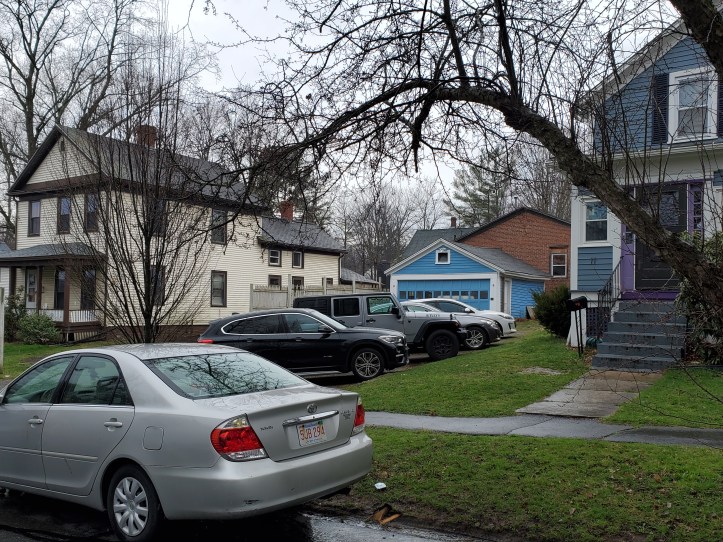
But that’s cold comfort to long-term residents who are awakened late at night by students’ carousing. On some streets, such as Fearing, Grantwood and South Whitney, student houses have proliferated.
John Varner has invoked a dystopia of lost sleep, cars and plastic cups on lawns, urination on neighbors’ property, and neglected maintenance. He has even used a cancer metaphor to describe the conversion of houses to student rentals, writing that they are “metastasizing.”
(Last year, George Ryan and I wrote a post on this blog about these problems.)
Undergraduates and longtime residents often keep different hours, can have different levels of respect for others, and may not have the same regard for neatness. Many are experiencing their first taste of freedom from their parents.
But students are the lifeblood of Amherst. The presence of three college campuses helps us remain a financially stable, intellectually and artistically vibrant, and politically liberal town with an international edge. The vast majority of students do not cause problems. It makes no more sense to resent their presence than it does for Cape Cod residents to bad-mouth summer visitors.
I have lived for almost 40 years in a house a mile north of downtown, and there are three student houses within 200 feet of me. I have no problem with the current tenants, and haven’t had any problems for years. I’m more irritated by the daily drone of landscapers and the beep-beep-beep of buses backing up at the middle school.
I want to offer some tips for residents who are concerned about their student neighbors. But first, let me address some of the suggested policy solutions.
Alex Kent and Ira Bryck have advocated for enforcement of the bylaw limiting to four the number of unrelated people who can live in a house, or even reducing the limit to three. The town’s housing inspectors are already overworked, and we may soon be asking them to do even more. They have trouble proving that the fifth student in a house is not “just visiting,” and compiling evidence of violations is time-consuming..
Varner’s proposal is to require a minimum distance between student rentals, and he cites a similar provision in State College, Pa. I spoke to an Amherst lawyer and a housing inspector, and they both doubted the legality of his suggestion. The lawyer said that a town can’t distinguish between students and residents in housing policy. “The law does not and cannot make such a distinction,” he said.
Another perennial suggestion is for UMass to house more students on campus. First, Amherst can’t just tell UMass what to do. Second, UMass has created 3,500 extra beds since 2006, and just completed construction on over 800 units of housing just off campus. Third, on-campus housing doesn’t provide Amherst with any tax revenue to help pay for our schools and public safety. Fourth, UMass already houses over 60 percent of students on campus, including all freshmen, which is more than most other state universities.

So what can be done?
Varner’s minimum distances proposal could be legal if it focused on non-owner-occupied houses (the real source of the noise problem) rather than student houses. And this approach could discourage investors from buying houses and renting them to students, a serious problem that makes it difficult for young families to afford to live here.
Here are some ideas for Amherst residents who live near student houses.
Talk to your student neighbors, ideally at the beginning of a semester. Consider bringing them coffee and bagels on a weekend morning. Ask if there’s anything you can do to help them adjust to life off campus. Exchange phone numbers. Be clear about your expectations for noise and other possible irritations.
We have a white-noise machine that we turn on every night before we go to bed. It muffles minor noises like car doors closing and driveway conversations.
Angry neighbors can file noise complaints with the Police Department. There’s a form for this on the town’s website that can also be used for other complaints. Student houses that are deemed a “nuisance” can be liable for $300 fines.
The presence of three college campuses is a net plus for long-term residents of Amherst. Undergraduate misbehavior is never going to go away completely, but there are ways we can cope with it to achieve peaceful co-existence.
Nick Grabbe is a co-founder of The Amherst Current. He has been a resident of Amherst for nearly 40 years and served as writer and editor for the Amherst Bulletin and the Daily Hampshire Gazette 1980-2013.
Editor’s Note: this post has been updated. An earlier version of this post included a statement about the constitutionality of the town’s unrelated-housemates bylaw, when this is in fact unclear.
Discover more from THE AMHERST CURRENT
Subscribe to get the latest posts sent to your email.
 THE AMHERST CURRENT
Thanks for a well-researched column that offers good advice and valuable perspective on a perennial towngown challenge.
LikeLike