
By Stephen Schreiber
Almost three decades ago, I wrote the following article for Designer Builder, a Santa Fe, NM, magazine. The issues in this piece remain largely relevant today. In 2021, when I was on the Town Council, Amherst approved changes to its zoning bylaw to increase the maximum square footage of accessory dwelling units (ADUs), to create a more streamlined permitting pathway for ADUs, and to add additional design guidelines. These changes more or less rendered single-family zoning obsolete in Amherst, because ADUs are allowed by right in all residential districts.
Is Single Family Zoning Obsolete?
(Stephen Schreiber, Designer Builder, November 1995)
Among the most enduring images of the United States are the enormous tracts of suburban single-family detached houses that blanket almost every urban edge. These ubiquitous developments, outside of traditional city centers, have proven to be among the most socially, economically, and environmentally destructive land use patterns ever invented.
Yet, zoning codes, subdivision laws, banking policies, and developer habits continue to encourage suburban growth. Furthermore, until recently, planners and architects have been ineffective at presenting alternatives to sprawl. The problem is particularly severe in suburban communities, which grew primarily as automobile cities. The low density of post-World War II neighborhoods makes many such communities “suburbs in search of a city.”
A related issue in low-density towns and cities is housing affordability. The single-family dwelling is by far the most common housing type in many communities. But the typical residence has been priced out of many potential buyers’ ranges, primarily because of land costs and available house types. Furthermore, these suburban communities generally force a typical family to own and use at least two cars.
One of the hallmarks of American suburbs is the zoning laws that allow only one family to occupy a dwelling on a particular site. These codes also typically forbid roommates (over a certain number), separate living quarters, and home offices. Furthermore, the regulations control setbacks, lot sizes, and many other issues.
A report on “Housing and Affordability,” edited by Doug Kelbaugh, notes that the ubiquitous zoning laws, which permit only single-family detached houses, have stymied efforts in many urban areas to make city neighborhoods denser, more efficient, and more sustainable. Kelbaugh argues that states should pass ordinances which allow every owner of a detached house to establish a rental apartment in that home or attached to its garage. He concludes that, “This is probably the single most cost effective way to quickly and broadly provide affordable housing units.”
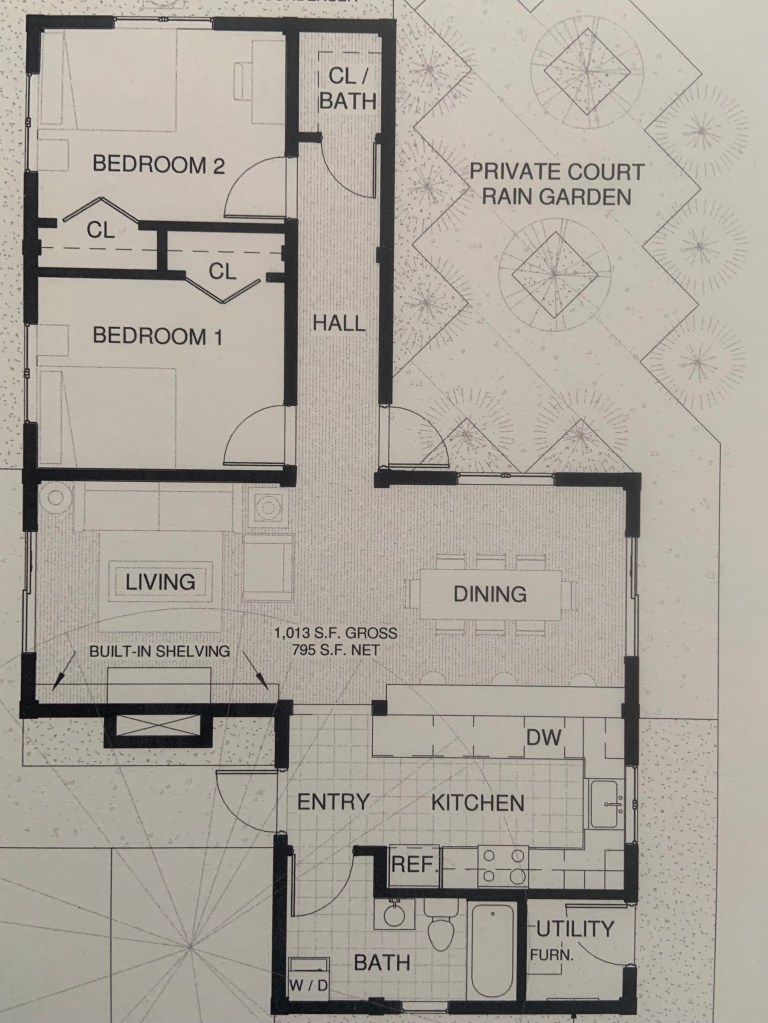


These types of accessory living quarters have flourished for years. Many of these structures were built before they were banned by zoning codes, while many were made legal only through a laborious zoning permitting process. Others, of course, were constructed without permits.
The supply of affordable rental housing would greatly increase, particularly in desirable areas (near employment centers). Home owning would become accessible to many more people because of the additional income from the rental units. Existing neighborhoods could accommodate a more diverse matrix of household types, social groups, and incomes.
Extended families could stay together more easily. By densifying, the city could substantially grow with almost no expansion of urban infrastructure and city services. In fact, it would make some services (such as public buses, sewers, and fire stations) much more efficient.
James Kunstler argues in his book, Geography of Nowhere, that American cities lost a significant richness to civic life when governments began to ban auxiliary apartments. This ban led to significant economic segregation and contributed to sprawl. By allowing ADUs, cities can take major steps in improving housing affordability and arresting sprawl.
Stephen Schreiber is an architect and chair of the Department of Architecture at UMass Amherst. He was an elected Town Councilor in Amherst from 2018-2022.
Discover more from THE AMHERST CURRENT
Subscribe to get the latest posts sent to your email.
 THE AMHERST CURRENT
Amherst has long had mother-in-law apartments. When we lived on Strong Street, our neighbor came to us asking us to sign an agreement to have an apartment in his house for their mother and we signed. But few years later, his family outgrew the house and they moved, renting out the house next door. Suddenly, there were eight cars parked their (four each for the two units) and traffic at all times of the day (and night). Not what we had imagined.
I can see why neighbors would be up in arms over by-right accessory dwellings. While I applaud Stephen and his efforts, Amherst needs much more robust housing policies besides this. While ADU’s may fill in a few gaps, there is only one way to go and that is UP. Until 5-story buildings are allowed (the minimum that developers say they need to consider building new housing), we will continue to suffer high taxes and have to lay-off teachers. You can’t have it both ways.
Would like to see some ADU’s designed for Amherst, though. Stephen’s beautiful designs would be perfect somewhere else. What would fit here? With parking.
My $0,000,000.02 worth.
LikeLike
I support the idea of Accessory Dwelling Units, and can imagine even living in one. I also support that in Amherst a property with an ADU needs to have an owner occupying one of the 2 buildings. But it would certainly be a decent investment for many homeowners, and create a type of housing that could accommodate people in many situations. It would also prevent the alternative, of a half acre property with multiple dwellings, easily hitting a dozen people and cars. I wonder why Amherst has not had more interest – I don’t know anyone who has an ADU. I also have no idea how much they cost and what the payback period would be, on average. All that kind of info could be promoted by the town, as a way to encourage this by-right type of housing.
LikeLike
Hi Ira
There’s a fairly new (modern) free standing ADU right across the street from your house. It’s not visible from road.
Steve
LikeLike
Good article Stephen and I agree with Ira…….There must be an owner occupied component.
LikeLike
Amherst abandoned singe family zoning decades ago, allowing multi family units in all residential districts. The number of units depends on the type of residential district and the size of the property. ADUs were allowed well before 2021. So please let’s stop railing against single family zoning in Amherst.
LikeLike
Hi Janet
The key phrase is “by-right” (ie, no special permit; no variance).
That was one of the major changes in 2021
Steve
LikeLike
From the Planning Board minutes of July 21, 2021, regarding proposed ADU by-law:
“Planning Board member Janet McGowan noted that the change in the bylaw involves a change in who is deciding on the approval, and that is a big difference”
LikeLike
[…] – small, independent dwellings that are accessory to a primary residence – are having a moment. As others have noted on this blog, many towns and cities in Western Massachusetts have recently revised their zoning ordinances to […]
LikeLike