
By Nick Grabbe
I can see Wildwood School from my kitchen window. And I have started to speculate about what could happen to the 14-acre site after the new Fort River School is built and Wildwood shuts down, as soon as 2026.
I’d like to see the school building torn down and affordable housing built there. I guess that makes me a YIMBY (Yes In My Back Yard).
We can expect a robust debate over what will happen at the Wildwood site. Already, ideas are flowing in: a youth empowerment center, a Senior Center, a YMCA-type building, an ESL program headquarters and more.
Estimates for renovating the building, which was built in 1970, run between $20 million and $40 million. It needs a new roof, a new HVAC system, and asbestos abatement, at the very least. It probably makes sense to demolish the building and focus on what could happen there.
I believe the Wildwood site would be a good place to put much-needed affordable housing. It’s within walking distance of downtown and UMass, and it’s close to the middle school, a child care center, playing fields, tennis courts, and a swimming pool. It has water and sewer connections.

Like many communities, Amherst has not built enough new housing to accommodate all the people who want to live here. That’s one reason why the average price of a single-family home has soared to over $500,000. A big increase in construction costs over the past five years has made new homes much more expensive.
This is a statewide problem. The typical Massachusetts house once sold for three times the median income; now it sells for eight times, according to the Boston Globe.
My house is now worth seven times what I paid for it 40 years ago. That’s great for my net worth, but this crazy price escalation has negative consequences for us as a community.
Those with moderate incomes have been mostly shut out, creating a problem for employers seeking capable workers. Our social stratification has widened, as homeowners have gotten richer and renters have faced higher monthly payments while not building up equity. Many public employees can’t afford Amherst houses or rents, and that could be one reason why they push for higher salaries that our municipal and school budgets can’t always accommodate.
Advocates of building a senior center at the Wildwood site may need to get in line behind longer-overdue projects – a new fire station in South Amherst and a new Department of Public Works building. The Wildwood site is not thought to be big enough for a DPW headquarters.
The Town owns 5.86 acres just to the west of the Wildwood site, known as “Hawthorne Meadow.” This land was bought with $500,000 in money from the Community Preservation Act in 2010. Two years later, a plan was developed for an athletic field, walking paths, picnic area and community gardens there.

Building housing that’s affordable to those of modest means requires subsidies or density, or both. A good example of what’s possible is a projected 30 units on nine acres at the corner of Montague and Pulpit Hill Roads, called Amherst Community Homes, with construction slated to start next year.
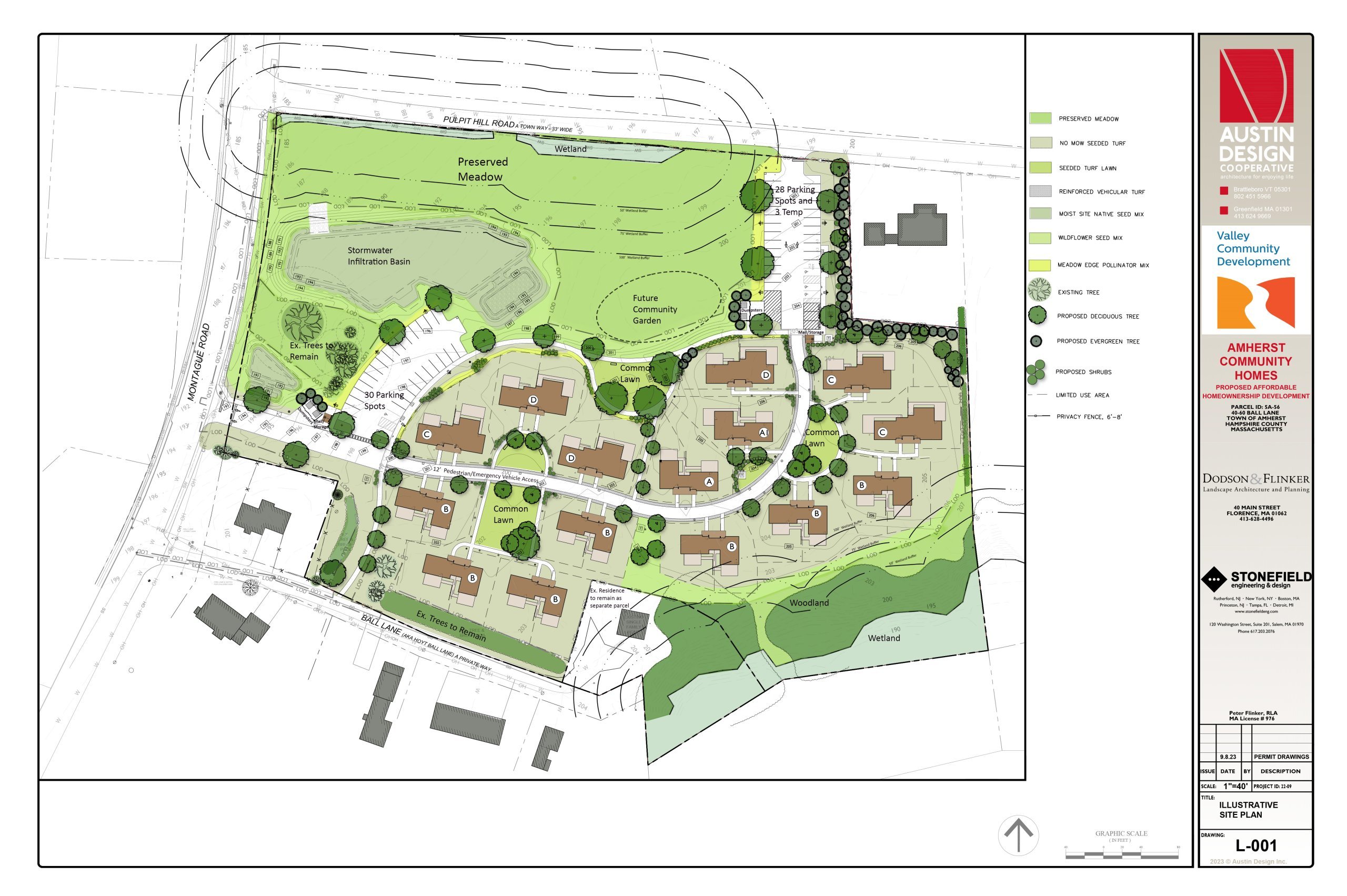
It will feature two- and three-bedroom duplex condominiums of 995 to 1,273 square feet, with deeds that restrict ownership to low- and moderate-income first-time home-buyers (80 to 100 percent of annual area median income, or $63,000 to $92,000). The low prices, expected to run from $150,000 to $225,000, are possible only through state and local subsidies, including $750,000 in local money from the CPA tax surcharge.
The most pressing need I see is for affordable housing for young parents and service workers. But I will welcome a debate about what type of housing is both needed and feasible. One Town Council member I mentioned this idea to sees a demand for senior housing.
Amherst has a development option that could be helpful: a Planned Unit Residential Development or PURD. Amity Place is an example of a PURD. According to the Zoning Bylaw, housing in a PURD does not have to conform to the typical frontage or lot-size requirements, and can have greater density that would normally be allowed.
A PURD allows a mixture of housing types. There could be duplexes, semi-detached houses, townhouses, multiple-family dwellings, public educational uses, and government buildings, according to Section 4.42 of the Zoning Bylaw.
The creation of a PURD would require a two-thirds vote on the Town Council. If Gov. Maura Healey’s housing proposal is approved by the Legislature, that margin could decrease to a majority vote.
Amherst needs housing for the “missing middle,” those people who can’t afford a single-family home and don’t want to rent in an apartment complex. A PURD at the Wildwood site could be a way to address this problem.
Town officials are developing a revised process for the disposal of surplus land, and this will guide the debate over the Wildwood site. I would like to look out my kitchen window in five years and see housing that is occupied by people who have little chance of home ownership now.
Nick Grabbe is a co-founder of The Amherst Current. He has been a resident of Amherst for nearly 40 years and served as writer and editor for the Amherst Bulletin and the Daily Hampshire Gazette 1980-2013.
Discover more from THE AMHERST CURRENT
Subscribe to get the latest posts sent to your email.
 THE AMHERST CURRENT
I endorse Nick’s views, and I live on Wildwood Lane, which makes me, more or less, an abutter. If/as the possibility he’s proposing continues, so will my support. Lee Edwards
LikeLike
Here’s to YIMBYism, Nick! In the almost 14 years my family and I have lived in Amherst, it took a good chunk of that time to understand why folks here are so often bitterly divided on issue after issue even though most of us claim to be “progressive.” A basic tendency toward YIMBYism versus NIMBYism explains a lot of that division. Whether the issue be schools, libraries, new housing, or attracting new businesses to downtown, we in Amherst tend to cleave between those who are open to change and those who are not. YIMBYs tend to be forward-looking and optimistic about using government authority and aid (federal, state, and local) to improve the lives of citizens. NIMBYs tend toward pessimism, skepticism about government action, and fear of change in general. When push comes to shove, I’ll take optimism any day.
LikeLike