
By Stephen Schreiber
No private buildings taller than three stories were built in Amherst’s central business district between 1885 and 2010. During that 125-year period, many one-story and two-story strip malls and small commercial buildings were built in the area between the common and the growing University of Massachusetts. That changed when the five-story mixed-use Boltwood Place was built in 2010, the first of five similarly-sized buildings together which impacted the Amherst downtown economically and aesthetically.
Between 2010 and 2024, Boltwood Place, adjacent to the town’s garage, and four other five-story mixed-use buildings were built in the downtown area. Spurred by changes to the building and zoning codes, a pent up demand for housing, and clever developers (Archipelago), these buildings have added about 350 new housing units downtown and thousands of square feet of street level commercial space.
Three of the buildings—One East Pleasant, Kendrick Place, and Eleven East Pleasant have forever altered the appearance of the eastern edge of Kendrick Park. That area once was the edge of town, with blacksmith shops and liveries that were replaced by auto dealerships, repair shops, gas stations, and motels. The modern buildings are closer aesthetically to new structures on the nearby UMass campus than the historic buildings on the town common.

Eleven East Pleasant Street, which just opened, is a five-story contemporary building designed by award-winning Modus Studio of Fayetteville, Arkansas. It is clad primarily in vertical cedar wood siding, with accents of zinc metal panels, black composite window frames, an aluminum storefront facing East Pleasant Street, and gray brick at the base along the east, north and south facades. It is adjacent to One East Pleasant, a long brick building designed by Holst architects from Portland, Oregon, with DiMella Shaeffer. Holst also designed the brick, wedge-shaped Kendrick Place.
When first built, these structures were jolting as they appeared in a sea of one story buildings and parking lots. Also, as mentioned earlier, nothing new has been constructed downtown in more than a century, except for the three-story commercial building next to the fire station.
Eleven East Pleasant is seen under construction and Kendrick Place is in the distance.
The structures form a robust urban boundary around Kendrick Park, enhancing the ambiance of the newly installed playground, much like how three- and four-story buildings define the Town Common. Eleven East Pleasant innovatively reimagines local architecture with a contemporary touch. The developers have thoughtfully incorporated expansive open spaces at ground level, along with enhancements to the public right-of-way. In a contextual nod to downtown’s existing structures, One East Pleasant integrates red brick and cedar. The brick facade is subdivided into smaller bays, mirroring the town’s smaller building modules.
I was on the Planning Board for ten years, and I recognize that my opinions about the buildings might be skewed because the board approved four of the five buildings on my watch. So I recently asked two architecture historians who live in Amherst to talk about the buildings.
Timothy Rohan, professor and chair of the department of the history of art + architecture at UMass Amherst writes: “These types of buildings have proliferated because of financial forces, demographics, and changes in the ways people want to live. Difficult to limit for many reasons, they seem the inevitable result of market forces. What do they offer Amherst? On the plus side, the new buildings provide much needed living accommodations. Their density helps prevent sprawl and closeness can foster community. But who are these buildings for and how affordable are they?”
Nick Camerlenghi, professor of art history at Dartmouth College notes: “I really appreciate the higher density of residential and commercial use that these new buildings bring to the center of our town. It is nice that our downtown is growing to be more than just a handful of buildings. I also like how the sidewalk mediates between building and street, without the need of a lawn or set-back. After all, the park in front of the structures offers ample green space. Of course, with this new square footage and expanded tax base comes the responsibility to provide appropriate services like public transportation, parking, shops and eateries. Ideally these services would both help the new residents and improve conditions for the existing community.”
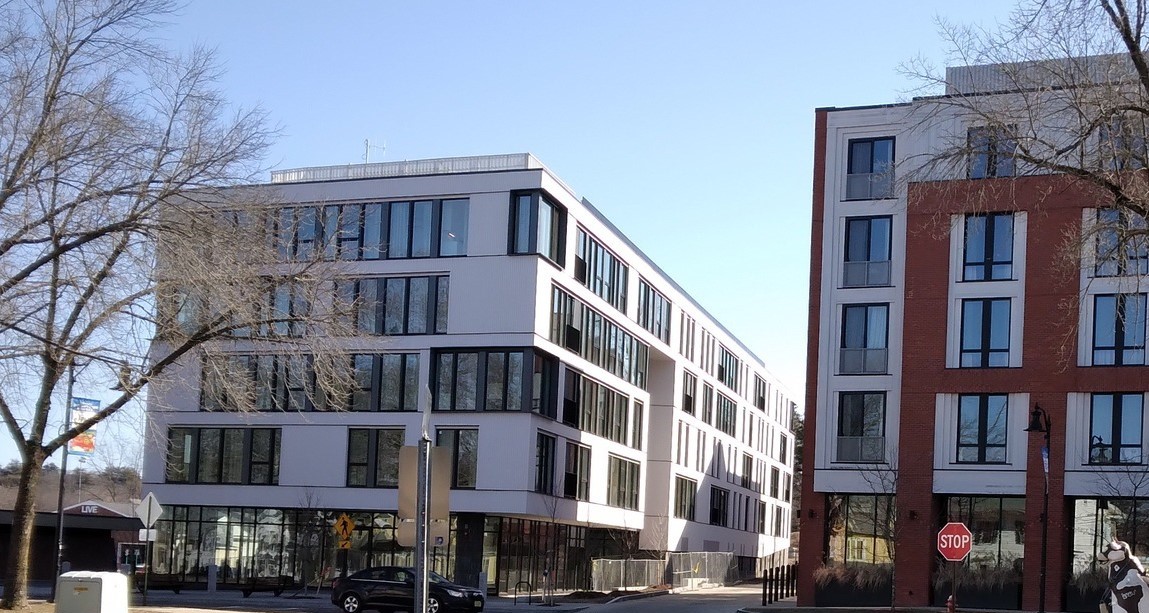
However, Dr. Rohan and Dr. Camerlenghi also have concerns. Tim Rohan: “Despite claims about sustainability, they do not seem intended to be long-lasting. They can pose social problems by being alienating. Whether modern or traditional, among the last considerations in the design of these new buildings is appearance and how they relate to their surroundings.” Nick Camerlenghi: “There is nothing inspiring or exciting, nothing iconic or recognizable, and, worse, nothing that responds to the existing context—these buildings would be adequate just about anywhere. Alas, this anodyne architecture ignores the excitement and consequentiality that comes with adding a new building to a historic town like Amherst.”
Both architecture historians are hopeful. Rohan: “Amherst can rise to the occasion and take steps to improve the design of large-scale, rental buildings while addressing the genuine need for new housing? Such an accomplishment would make Amherst’s housing policies a model for the rest of the country.” Camerlenghi: “I would welcome future construction, but hope that it can offer not just a place to live and shop, but also a point of pride that responds to the built fabric into which these buildings were grafted.”
Had Amherst grown organically over the last century, our opinion of the new buildings would likely be different. But with nothing built in more than 100 years, five new buildings in 10 years seems like a lot. I’m looking forward to seeing how our opinions evolve over time, and how the remaining underused lots are infilled.
Stephen Schreiber is an architect and chair of the Department of Architecture at UMass Amherst. He was an elected Town Councilor in Amherst from 2018-2022.
Schreiber will be leading an architectural tour of downtown on April 13 (raindate April 14) from 10:00 am -12:00 pm. For more information, check the Amherst Historical Society website.
Discover more from THE AMHERST CURRENT
Subscribe to get the latest posts sent to your email.
 THE AMHERST CURRENT
Informative article on the merging of historical and economical considerations for downtown . . . wondering how form-based code (FBC) zoning would alter the course of development. How different would the buildings look if FBC was in place and the same capacity was achieved?
LikeLike
Excellent and interesting piece. But I have to make one observation. Steve says “no private buildings taller than three stories were built in Amherst’s Central Business District between 1885 and 2010.” While this is technically true, to me it is sort of a distinction without a difference. Immediately adjacent to the CBD are the Clark House (22 Lessey St., 1978, six stories) and the Ann Whelan House (33 Kellogg St., 1973, five stories). Together, they contain almost 200 units.
I remember (barely) when both were built, and they certainly raised eyebrows if not ire. And certainly, describing them as “anodyne” and doing “nothing that responds to the existing context” might be seen as charitable. Yet today they are just part of the background, and I do not recall them being recently cited as blights upon the landscape. Perhaps it is because they are located just off the main drags, which may be among the lessons to study for future development.
But I think the larger point is that stuff changes, and what seems like a shock one day can become part of the wallpaper down the road. I’m quite certain the construction of the original CBD itself in the early 20th century was quite a shock. Yet here we are extolling it as the model for all time. (And I could not help laughing a couple of years ago when the old Chrysler-Plymouth dealership at the north end of the CBD — later home to Bertuccis’s and now Garcia’s — was hailed as a “historic landmark.”)
This article helps us focus on both the inevitability of change and how we might think of its long-term consequences in the moment, which is what makes good communities. Many thanks to Steve and the contributors.
LikeLike
Steve, these are bad buildings. As pointed out in the article, the buildings are not well built and they are unlikely to stand the test of time, either in terms of the buildings’ fabric or their design. I have spoken with tenants of 1 East Pleasant who have complained of broken electrical outlets, failing appliances, and sloppy construction.
I agree with Nick Camerlenghi’s criticism: “There is nothing inspiring or exciting, nothing iconic or recognizable, and, worse, nothing that responds to the existing context….Alas, this anodyne architecture ignores the excitement and consequentiality that comes with adding a new building to a historic town like Amherst.”
As I have pointed out before, thanks to their absence of setbacks, the buildings block light and cast the west side of the street in deep shadow in the afternoon. With its cantilevered street-side design, 11 East Pleasant is marginally better than 1 East Pleasant: the latter building looms over the sidewalk in a distressing way. The building is profoundly unfriendly to the street. Meanwhile, viewed from its gargantuan northern flank, 11 East Pleasant looks like nothing so much as a beached cruise ship.
The design and construction of these buildings is wholly dictated by cost and ROI. 432SF studio apartments renting for $1,975 – $2,185?! Really?? In Amherst?? I think it is scandalous that these buildings were permitted by the Town. But money talks, right? In fact, it shouts.
LikeLike
The appearance of these buildings is a matter of opinion, and I respect Alex Kent’s opinion of their design. What is unarguable is the impact they have had on Amherst’s ability to provide services such as public safety and schools. Four of them have provided over $750,000 a year in annual tax revenue that longtime residents have not had to pay. And when the value of the fifth building is assessed, that impact will be over $1 million.
Here are their annual tax obligations for the current year:
1 East Pleasant: $384,571.16
5 East Pleasant (Kendrick Place): $210,066.28
26 Spring St.: 82,339.88
Boltwood Place: $73,070.07.
LikeLike
From Jim Wald (via Facebook)
I very much appreciated the article.
I was at various points in these processes a member of the Design Review Board (through my service on the Historical Commission) and then Select Board. As Jonathan Tucker can tell you, it was complicated: sustainability and sound planning demand density, which means concentrating new building in developed areas with infrastructure and transportation. Density is also the prerequisite for what our Master Plan consultants kept calling “vibrancy.” Despite the fantasies of some Town Meeting members, businesses and services do not come to a town on speculation. It is the density and activity that will draw them. Density first. Putting more housing downtown was, as Jonathan Tucker and other professionals in the Planning Department explained, also a respond to emerging trends: fewer people (early adult years and seniors in particular) seemed to want a suburban spread with the issues of location, maintenance, auto ownership, distance from goods and services that the lifestyle entailed. So far, so good.
Yet practically every time we tried to densify the town center (and this includes back-from-the-road one-story work in historic structures), people would scream: there will be more traffic. Well, yeah: if you want to densify so as to avoid sprawl, you have to, um, densify.. And: it has to happen in an actual place. And if you put more people in town centers, there will be vehicular circulation (but also more foot traffic). Or our favorite: it’s right in principle–just not here (the same things one always heard, whether the issue was affordable housing or desegregation). Another favorite argument was that these would become sordid “student dormitories,” bringing chaos and worse to downtown because: who but a student would want to live without a car (actually: students at UMass were demanding more parking at the time). Some people worried that the construction of Kendrick Place would lead to an increase in crime, including rape (!). We patiently explained that, no, the opposite, was true: more residents and more residences, more eyes on the street, made downtown more rather than less safe. Facts are stubborn things.
Etc. etc. Some angry town figures promised a public apology if they dystopian vision of marauding bands of drunken students did not materialize. They did not. Oh–and neither did the apology.
One of the more humorous (I am being polite) objections we heard to the Kendrick Place project–and let me remind you that the site was a vacant lot with rusted wire fencing and weeds growing up out of cracked concrete slabs next to what used to be a derelict car dealership (by then Bertucci’s, now Garcia’s) was: it would be so much nicer it if were an herb garden. To which I replied: um, YOU don’t actually own it.
So there was that. And then there was the fact, as Steve Stephen Schreiber points out, that because of the types of zoning, these buildings were by right. One could not block such proposals and one had only limited ability to shape the appearance. I recall that I made some rather pointed comments about the Boltwood Place project. Some of the principles DRB uses are massing,, scale, materials, . Several of us wondered about the wood facing as well as the massing and wondered whether the building could better complement its surroundings. I said Italian Fascist architecture was much more sophisticated (it was). Some others suggested at least using brick. We were told that building with little bits of baked clay in the 21st century was ridiculous. (Of course: look what happened next with Kendrick Place and One East Pleasant. ) I questioned the height and scale. I was told that the building was actually somewhat shorter than the adjacent historic brick structures. It was the same with historic preservation efforts in Amherst: here, as in the case of design standards, we had only advisory power without real teeth (that’s the way the law works). We would press a property owner as hard as we could to change plans in accordance with our view of the public good, but at some point (the legal parameters reflecting the precedence of private property rights in a capitalist society based on possessive individualism), we ran up against a brick wall (no pun intended).
The setbacks or lack thereof were thus also part of a complicated process because, as Jonathan Tucker and Steve Stephen Schreiber can better explain, it can be tricky to balance all the interests when trying to put large modern buildings on downtown parcels that were created under very different conditions and regulations, if any (that’s my simplified version).
So there we were. The developers had a vision of densifying downtown (and of course making a profit) by what they described as the equivalent of lighting a fuse with Boltwood Place, which would spark a pattern of (re)development going north toward the university. For better or worse, it has happened.
It is not my aesthetic, and it’s an aesthetic that, through repetition, has really transformed the look and feel of that part of town. No one else was stepping forward with major projects for those areas.
One thing to add: the various Town bodies considered these kinds of large developments appropriate on the east side of the street, but not on the west, which has a larger set of low-height historic resources behind which are residential neighborhood buildings of similar scale.
LikeLike
From Cary Bernstein (via Facebook)
Cary Bernstein
Nice article Steve. I generally agree with Professor Camerlenghi’s comments but I don’t agree that “these buildings would be adequate just about anywhere.” They wouldn’t be adequate anywhere. They are “lowest common denominator, copy-and-paste” buildings intended to be non-offensive to local review boards and neighbors. This being said, any new building of this scale in a 1-2 story low-density neighborhood of non-descript or vernacular buildings will stand out due to its sheer mass- as such, the buildings have special obligations to establish a new, emerging context rather than supersize the context of yesteryear. It takes strong design skills to mediate generational changes but, as we know, these skills are culturally undervalued.
LikeLike