
By Allison McDonald
After receiving a single bid that was significantly over the budget for the Jones Library building project, the project leaders are revising parts of the building design to reduce potential costs and are aiming to issue a new request for bids next month. The revised design requires review by several public boards and committees, and the Historical Commission will take it up at a public hearing and meeting tonight.
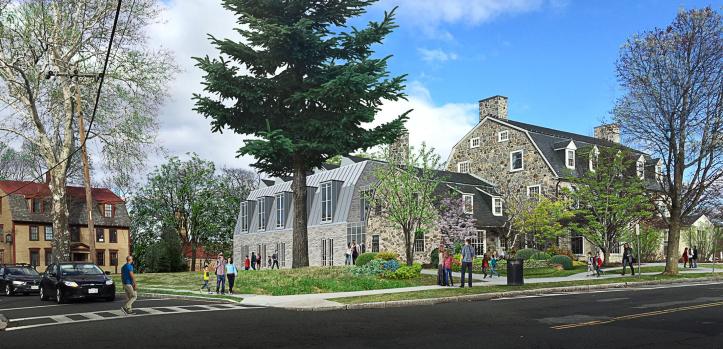
A group of people is circulating a petition that requests the Town Council and Town Manager to halt the plan to re-bid the Jones project and instead pursue building repairs only, saying the revised plans and projected costs are significantly different than what voters supported in a 2021 referendum. In public comment, online articles, and opinion columns, people who advocate to stop the project have suggested that elected officials and leaders of the project have misled the public about project details.
So, what really is going on? Following every twist and turn of this years-long project is difficult. Here’s a description of the facts about the project.
Background
The building project dates back over 12 years, and began with the recognition that the building required significant repair and upgrading to meet contemporary usage and needs. With four other key town buildings with similarly critical needs (Wildwood and Fort River elementary schools, the central fire station, the headquarters building for the DPW), the town developed a financial plan that leverages State funding opportunities for school and library buildings.
In 2017, the Jones Library project was accepted into the Massachusetts Board of Library Commissioners (MBLC) grant funding program and in April 2021 the Town Council approved the debt. While the debt approved for the project is for the total cost (the original budget of $36.3MM), the Council committed to no more than $15.8MM in capital funds toward the project. The remainder of the budget was to be funded through the $13.9MM MBLC grant, and the rest through other funding opportunities and fundraising by the Trustees.
The approved budget was increased to $46.1MM in December, 2023 after cost estimates based on more detailed designs came in higher than originally anticipated.
A single bid for the project was received in April 2024 and was $6.5 MM, or 18%, over the “hard costs” portion of the updated budget ($36.3MM). The bid was rejected and the MBLC extended the deadline for the Town to accept and sign a new bid to the end of the year.
The Trustees’ work in response is two-pronged:
- identify cost-saving options in the renovation and expansion project (“value engineering”) and re-bid in the fall to try to get back within the approved project budget; and
- develop a plan for completing necessary repairs should the renovation and expansion project not move forward.
What cost-saving changes are baked into the new project design?
Historic woodwork. While the original design had included preservation of historic woodwork, the current proposal keeps the interior woodwork (including the main entry and stair as well as fireplaces) intact, not disturbing asbestos in the plaster behind the woodwork. This change cuts out the costs of asbestos abatement that would’ve been required in the original design.
Roofing material. The original design that was approved by the Historical Commission included synthetic slate shingles. The revised proposal changes this to asphalt shingles, which are lower cost than synthetic slate. The Planning Board and the Design Review Board recommended against this change, so the bid package will request that both be included as alternate options.
Windows. The original design included replacing the exterior windows. The latest design potentially reduces costs by repairing the 1927 windows rather than replacing them. The Design Review Board recommended against this change as well, so both options will be included in the bid package.
The use of Cross laminate timber (CLT) in the new addition was included in the original plan but has been removed from the revised plans. This change is expected to create significant savings and potentially help attract more bidders since there are fewer contractors with experience working with CLT, a newer material.
The roof monitor, commonly known as a skylight, over the central stairwell in the new addition has been removed in the revised plans. Natural light will be provided through vertical windows at the roofline as well as windows throughout the entire new addition.
Metal roofing and brick exterior. Plans to substitute these materials have been dropped from the original design, and the revised plans keep these affordable options for insulation value.
Landscaping plans have been scaled back significantly. The children’s outdoor space will still be defined by a hedge, but whimsical patio designs have been removed, as have benches, tables and chairs from patio areas. All shade trees remain as planned and the rear rain garden will use no mow grasses rather than multiple types of shrubbery.
The changes require approval by various Town boards and committees before going to re-bid. The Planning Board approved the plans on July 31 with one qualification regarding the roofing materials, preferring synthetic slate to architectural asphalt shingles. The Design Review Board similarly approved the plan on July 22 with the qualifications regarding roofing material and windows replacement. The Historical Commission will review the revised plans on August 22 (tonight at 6:30pm).
What repairs are needed?
The renovation and expansion project addresses the repairs needed. The Trustees are developing a plan to complete the most critical repairs needed in the event that the renovation and expansion project doesn’t move forward. These critical repairs are:
- HVAC system
- Skylight in the atrium
- Fire suppression system
- Asbestos abatement in the children’s area
- South elevator, to meet accessibility requirements

According to Trustee Farah Ameen, the Trustees’ Building & Facilities Committee is anticipating that the repair plan would be spread over 10 years, requiring potentially two moves to an interim location. While the cost of repairs will not be known until a feasibility study is completed, previous estimates (from more than four years ago) pegged the cost between $14.4MM and $16.9MM. The Trustees have pledged $1.8MM to fund the cost of repairs should the current building project not move forward.
Will the value engineering affect the benefits related to library services that were part of the original plans?
No. According to the Capital Campaign website, the project features and benefits related to library services are not changed with the revised building plans.
Will rebidding the project cost even more to taxpayers?
No. The Trustees are covering the costs to rebid the project, and the Town’s share of the total project budget remains unchanged, at $15.8MM. Fundraising for the project has raised over $39.3MM to date, or approximately 85% of the $46.1MM anticipated project cost. (See current funding sources chart here)
Much attention has been paid to the recent denial of historic tax credits (HTCs) for the project, suggesting that fundraising is falling short as a result. According to the Capital Campaign, HTCs were one potential source of revenue for the project and had not been counted as part of funds secured to date. The Capital Campaign Committee is pursuing other grants and donations to raise the remaining funds necessary to complete the project.
What are the next steps?
The Historical Commission will review the proposed revisions to the plans at its meeting on August 22 (tonight). A historic review process is getting underway to meet preservation requirements for federal grant funding. And, the Trustees are aiming to put the project out to re-bid in September to receive bids later this fall.
Note: this post was edited to cite the source of the information regarding the repair plan.
Allison McDonald served on the Amherst and Regional School Committees 2018-2023 and was Chair of the Amherst SC 2020-2023 and Chair of the Regional SC 2020-2022. She’s lived in Amherst since 2002 and volunteers as the Managing Editor for The Amherst Current.
Discover more from THE AMHERST CURRENT
Subscribe to get the latest posts sent to your email.
 THE AMHERST CURRENT
Nice summary Allison, except for your description of a repair only plan as taking 10 years when all the elements you list are part of the expansion plan, except for the repair of the atrium roof–and the large plan is only supposed to take 2 years, even with demolition of the ADA compliant 1993 addition.
Also, the petition circulating offers three options for signing: 1. save the sustainability and historic features of the original plan, 2. don’t allocate more funds to the project, and 3. stop the project and pivot to a repair project.
LikeLike
I am grateful for the facts that we do know at this point. I am grateful that we have many expert eyes on this project in a town where people with many different perspectives all care about the Jones.
But I am worried that the proverbial center will not hold. I am worried that we have a project that has been going on so long as an active entity that it is hard to keep track of all the elements (financial, legal/compliance-related, sustainability/”green” building attributes, historic preservation, programmatic, etc) and that we now have gone past a bid phase to learn that there was only one bid, and that it was way over budget.
Now the engagement is with VE (stands for Value Enginering that is supposed to save money from the next round of bidding) and things are changing again. Nothing this ambitious has been built in Amherst since the new Police Station and I am grateful, once again, that no-one has the authority yet to demolish the 1993 addition. Watch this space.
LikeLike