
By Stephen Schreiber
The Town of Amherst purchased property at 457 Main Street – the site of the former VFW hall–in January 2023 for $775,000 with the intention to repurpose the site for housing. Now that plan is beginning to take shape as the Town of Amherst is partnering with architecture firm The Narrow Gate to redevelop the site into housing for individuals experiencing homelessness. Community input was gathered in June 2024 to transform the former VFW into a shelter and supportive housing.
UMass architecture student Isabella (Bella) Donovan focused her honors thesis on this project, collaborating with Craig’s Doors and the Town of Amherst. Bella emphasized that while Amherst is seen as a college town, many residents face significant economic challenges and housing crises, with about 2,800 unhoused individuals in Western Massachusetts.
The site spans 39,188 square feet, allowing for a building footprint of 9,797 square feet under zoning regulations, which limit the building to three levels. Bella’s design incorporates trauma-informed principles, using natural light and comforting spaces to create an environment that feels like home rather than an institution.

The first floor features a staff area with direct access to a communal corridor and individual meeting rooms, addressing the need for confidential spaces. It includes eight desks, a conference table, storage for supplies, and an ADA-compliant restroom. Two individual meeting rooms facilitate case management, while a laundry room allows guests to drop off and pick up their items.
The second floor is designated for administrative staff, featuring a conference room, individual offices, cubicle desks, a kitchenette, and another ADA-compliant restroom.
A key aspect of the design is the living/activity space, which provides an alternative community area for guests to interact. Located near the entrance, this space is accessible to the dorm areas and outdoor space. It features flexible furnishings to encourage social interaction or individual reflection. Sliding doors connect the living space to the dining area, which also accommodates varied seating arrangements to foster communal meals.
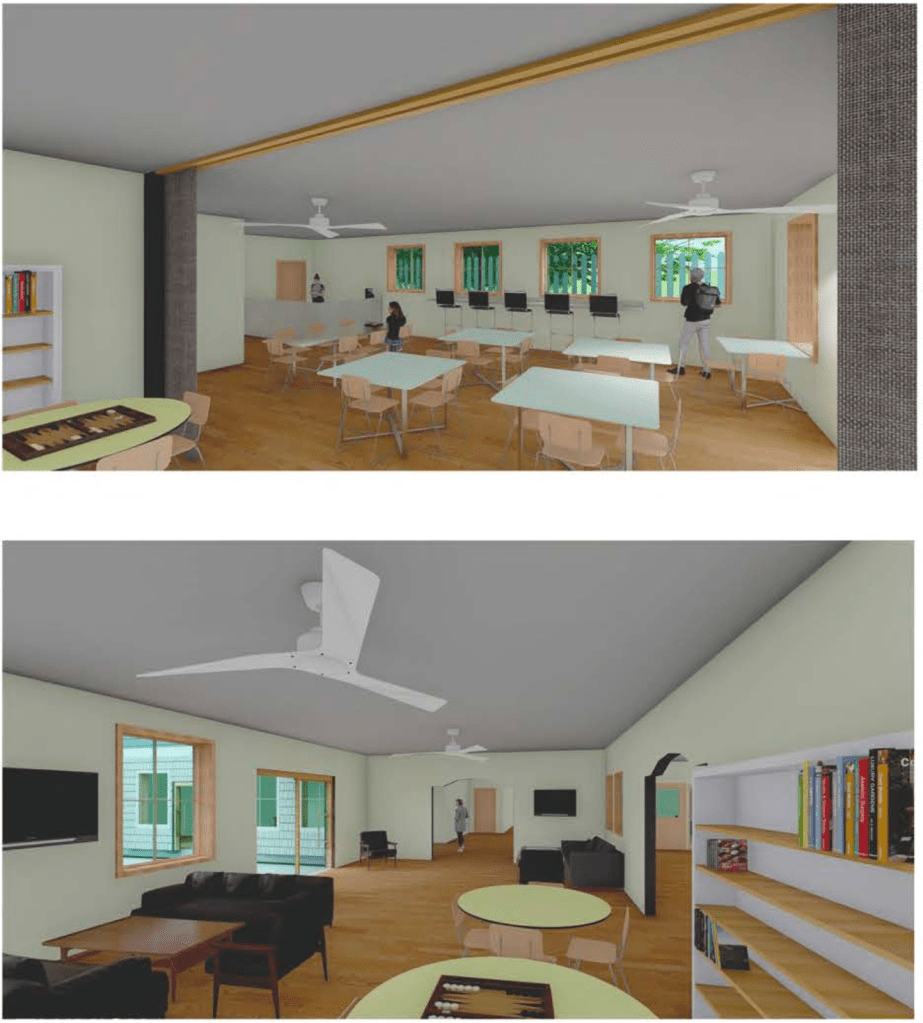
The commercial kitchen, located next to the dining room, supports meal preparation and storage. Double doors allow for easy delivery of food. Outdoor areas include a patio with picnic tables and a community garden, promoting socialization and connection with nature.
Sleeping accommodations are divided into men’s and women’s dorms, with 35 emergency beds. The design includes flexible arrangements to accommodate individuals who do not identify strictly as male or female, with options for overflow sleeping. Each dorm features privacy partitions, personal hooks, and natural light from windows, along with easy access to restrooms.
Restrooms are designed for safety and accessibility, featuring “locker room” styles that allow staff visibility while maintaining guest privacy. Gender-neutral single-user restrooms are also available, ensuring inclusivity for all guests. Showers are equipped with grab bars and wheelchair access.
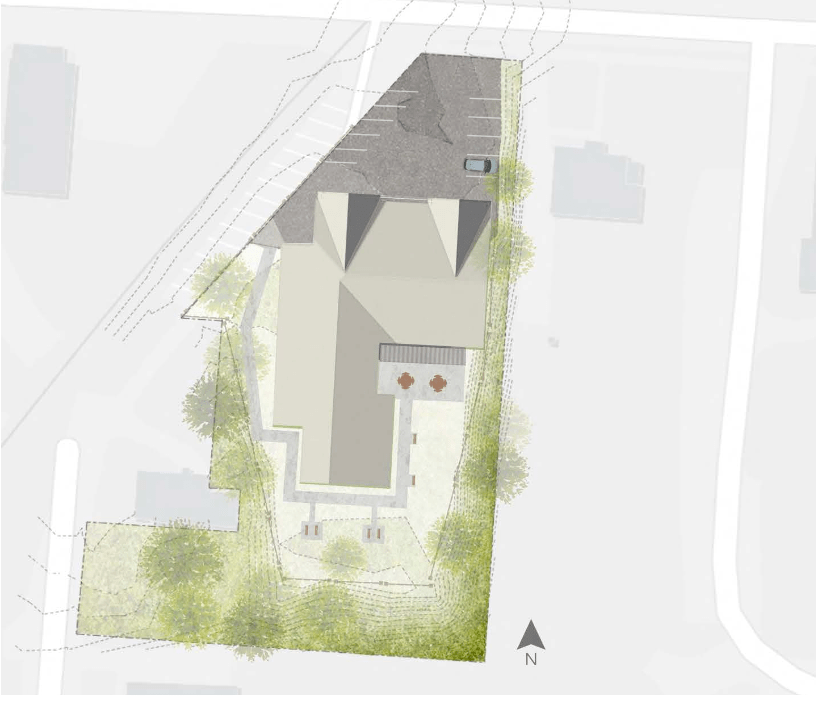
Permanent supportive housing units occupy the second and third floors, facilitating a smooth transition from emergency shelter to stable housing. The building will host a total of 27 supportive housing units, including ten studio and two one-bedroom units on the second floor, and eleven studio and four one-bedroom units on the third floor. Each unit includes essential amenities such as an ADA-compliant restroom, kitchenette, and natural light.
Isabella Donovan’s project aims to provide comprehensive support for individuals experiencing homelessness in Amherst, combining immediate shelter with pathways to permanent housing. Isabella’s advisors were professors Sandy Litchfield and Ray K. Mann.
The Narrow Gate presented conceptual designs inspired by this process on September 25. The firm’s designs will help to inform a more formal process in the future that will result in the construction of a new building serving unhoused and housing-insecure neighbors.
Stephen Schreiber is an architect and chair of the Department of Architecture at UMass Amherst. He was an elected Town Councilor in Amherst from 2018-2022.
Discover more from THE AMHERST CURRENT
Subscribe to get the latest posts sent to your email.
 THE AMHERST CURRENT