
By Jack Jemsek
Have you seen the Disability Awareness signs at one of the Amherst schools? They are beautiful . . . and remind us how important this particular facet of diversity is.

Defined as “something that causes your body or brain to work differently”, disability makes certain things in life much harder for some, but they can still do many things . . . great things.
The Amherst-Pelham Regional Public Schools (ARPS) has a great volunteer organization called the Special Education Parent Advisory Council (SEPAC) that is dedicated to providing representation, information, resources, and support to our community. As required by the state of Massachusetts, the ARPS SEPAC provides input and support to our school districts and school committees in their work on matters pertaining to special education, and we can thank them for the signs. The ARPS SEPAC created a collection of signs for Disability Awareness Month to build awareness and understanding by defining some fundamental terms related to disability and special needs. These include:
- MENTAL HEALTH: learn to take care of our brains like we take care of our bodies;
- INCLUSION: everyone should feel part of the group, with nobody left out, bullied or teased;
- ACCESSIBILITY: make things easy for everyone to use and enjoy; and
- ACCOMMODATIONS: provide changes that help a person learn or do what they need to do.

There are Developmental Disabilities, Physical Disabilities, and Learning Disabilities, some of which are invisible and cannot be readily observed with our eyes.

Then there’s the more scientific conversation of neurodiversity, where we come to understand that everyone’s brain works differently. Neurotypical is the median for how a brain works, while neurodivergent describes individuals who may have ADHD, Autism or a Learning Disability. There’s so much to appreciate in how we are different!
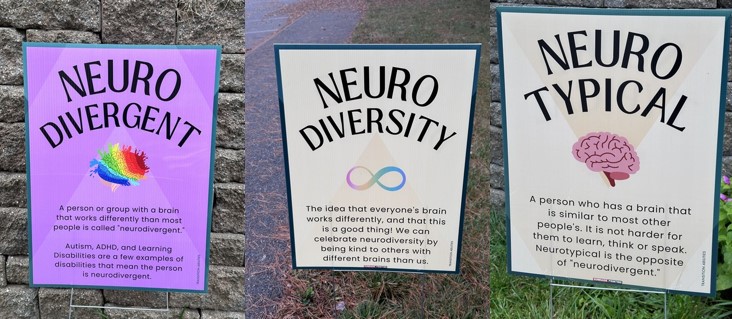
Some folks like Identity-First Language and others may prefer Person-First Language.

Then there are behaviors like Masking and Ableism to be on the lookout for. Masking is when a person with a different brain tries to pretend their brain works the same as others, which can be a coping mechanism but also can lead to some undesirable stress. Ableism is not good; it’s when people think about or treat disabled people like they are not as important.
The take-home lesson here: everyone should be treated with kindness and respect!
During the month of October, these signs will spend a week at each school in the ARPS district, including all four elementary schools, the Middle School, High School and Summit Academy. The photos of the above signs were snapped at Crocker Farm Elementary School last week.
SEPAC’s hope is to use the signs as a way to not only recognize Disability Awareness Month but to educate the school community about disabilities from a very affirming perspective. They hope that the signs generate discussions amongst students and staff that lead to a deeper understanding and acceptance of differences and foster an environment of inclusivity.
If you’d like more information on SEPAC, this LINK provides the schedules for their board meetings and caregiver chats.
In the spirit of diversity, Amherst has historically adopted a mission to steward all kids in the ARPS system regardless of race, gender, sexuality or disability . . . that’s a wonderful thing. Unfortunately, we all know that stigmas can develop at an early age, so appreciating our differences while young and practicing inclusion allows us to both live better while helping others to do the same.
Jack Jemsek is a consulting hydrogeologist and he and his family have been Amherst residents since 1999. He has served on the Water Supply Protection Committee since 2018, the Pioneer Valley Planning Commission Executive Committee since 2020, the Planning Board from 2016 through 2022, and several other local committees.
Discover more from THE AMHERST CURRENT
Subscribe to get the latest posts sent to your email.
 THE AMHERST CURRENT