
By Allison McDonald
When I was in high school, the state of Virginia (where my family lived at the time) required students to pass a “minimum competency” exam in order to earn a diploma. My sister, two years older than me and with intellectual disabilities, passed the English language arts exam on her first try, but did not pass the math exam. She’d attended separate special ed schools throughout elementary school, and now in high school was enrolled in general ed math courses and had earned passing grades. Yet, she could not pass the state’s math competency exam for high school graduation.
You might be thinking that this is where I express my support for eliminating competency tests as a requirement for high school diplomas…but I’m not. My sister’s high school wanted to let her walk at graduation, award her essentially a participation certificate, and not ask her to sit for the math exam again. But my mother, a high school math and science teacher, wanted nothing of the sort for her. She insisted that they follow state guidelines and provide my sister with the educational support to prepare for the test and to administer the test again — and to do so until she achieved a passing score.
Not only did my sister eventually pass the math exam, she did so in time to graduate with her peers and with the same diploma that each of them had earned. This was an incredible source of pride for my sister for the rest of her life. Not just because it opened more doors to her for life after high school — more opportunities for employment and to earn her own wages — but because her credential was no different than any other high school graduate in Virginia.
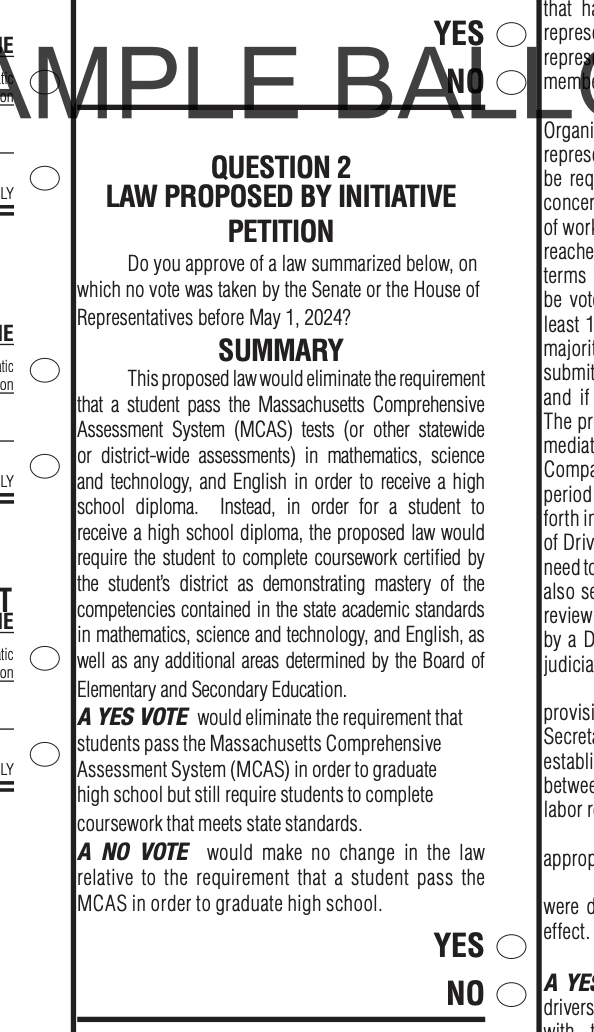
This coming election day, voters in Massachusetts will decide whether to eliminate the state requirement that students pass its competency exams, the MCAS, to earn a high school diploma. For several reasons, I plan to vote “no” and I encourage others to consider the following before deciding how to vote.
Question 2 does not eliminate the MCAS
Many people believe that we should get rid of the MCAS because it is harmful to children and overly constrains teaching. Question 2 does not address this. School districts will continue to be required to administer the MCAS in grades 3-10. The only change would be that students would no longer be required to pass the 10th grade tests in order to earn a diploma.
If Question 2 passes, MA would be one of the few U.S. states with no state-wide standard for high school graduation.
Massachusetts is one of 9 states today (down from a high of 27 states) that has a competency exam requirement for graduation. But, most other states have other mechanisms for ensuring that state-wide standards are met by all public high school graduates in their state. In Massachusetts, the Department of Elementary and Secondary Education (DESE) describes a core curriculum, Mass Core, that is recommended but not required for graduation. According to a recent article in the Boston Globe, half of all public high schools in the state do not require students to complete the Mass Core in order to graduate. Still, even if it were required, the evaluation of an individual student’s learning is left to the individual teacher and school.
That may sound like a fantastic solution, especially if your school has incredible teachers. But not all schools have equally great teachers, and there isn’t any way to know how teaching varies by district or school without a state-wide standard. As my sister experienced, her wonderful and well-meaning teachers wanted to let her graduate simply because she had attended school and worked hard, even though she could not demonstrate the required learning in math.
A high school diploma is not a participation award.
Our schools exist to educate students, to ensure they are equipped with the learning and skills to be able to fulfill their individual potential as thriving members of our community and society. Our schools should not graduate students simply because they’ve attended school and completed work “for years.”

For one, we’d be left with measuring school effectiveness based on the number of graduates, and by that measure Amherst schools are failing, given the steady decline in enrollment and graduation numbers.
But try to apply that logic to any situation where we expect a person to possess knowledge and skills. Physicians and lawyers must complete an accredited education program, but also must demonstrate their knowledge to the state via a standard exam in order to practice here.
Similarly, electricians, barbers and cosmetologists, food servers, and more can’t be licensed in their fields in Massachusetts based solely on putting in the years of training and work, or on the recommendation of their instructor.
Imagine if you had to research the coursework and grading standards for every training program or instructor when hiring an electrician or lawyer. The state sets standards of knowledge and skill that must be demonstrated through a state-wide assessment mechanism so we don’t have to.
Why should a high school diploma be different?
Question 2 will not make our schools better off.
If Question 2 passes, we lose a state-wide standard for understanding how our schools are serving students with no replacement, not even a concept of a plan for one. I would enthusiastically support an effort to improve MCAS, or to devise a new state-wide assessment approach.
But, as imperfect as it may be, today’s MCAS is a measure that ensures that every person who earns a high school diploma in Massachusetts has acquired the same minimum knowledge and skills. And it should not be tossed until a replacement is developed and ready to implement.
For more, this report from the Center for State Policy Analysis at Tufts University provides an explanation of the ballot question and summarizes the arguments both for and against it.
Allison McDonald has lived in Amherst since 2002 and has two sons who attended Amherst public schools. She served on the Amherst School Committee 2018-2023, and as chair 2020-2023. She volunteers as managing editor of The Amherst Current.
Discover more from THE AMHERST CURRENT
Subscribe to get the latest posts sent to your email.


Thank you for your opinion piece. I agree wholeheartedly with you. Pat
LikeLike
When I was a teacher in Springfield, MA. I worked with children who had learning disabilities in addition to being very poor. I had to do MCAS prep. which consisted of teaching the children test taking skills. There was a bit of content, but really the main thrust was test taking skills.
I’m not sure what to think about the graduation requirement. I had the same thought Ms. McDonald pointed out, this question does not get rid of MCAS.
And like it or not, teachers end up teaching to the test. Maybe not all, but many do. And the teaching becomes rote and not that interesting.
I don’t have the answers. I think the issue is more complicated than just the graduation requirement issue. Does standardized testing really test children’s knowledge or just show us who the good and not so good test takers are?
LikeLike
I’m voting Yes. As the students have done the work and been given the grades that show competence, there is no reason to test them again. Just the fact that teachers are having to “teach to the test” rather than following what has been shown to be the required curriculum has been a disaster in the public schools. The teachers will attest to this. The bottom line is Why block graduation for students who have done the work and made the grades? Lacking a high school diploma can negatively impact a person’s entire life. There is no need to launch a young person’s life into a downward spiral because of an additional test that has been shown to have negligible value.
LikeLike
Excellent article on an important issue. Thanks Allison and kudos to your parents for their courage, devotion and support, when an easier but much less fruitful path was available to your sister.
I too support NO on this initiative.
Standards exist for a good reason, and there is no point served by removing the ability to measure results and compare teaching environments by the success of the students they serve.
Doing away with a universal standardized test is destructive of achievement, and the questionable benefits can only be to exempt low-performing districts, schools, teachers or students from confronting and fixing whatever is failing them.
It’s unpopular to point out, but unfortunately the teachers union’s priorities are no longer aligned with their stakeholders’ best interests, and this is why the rift exists on this issue and generally between the union and the community. Massachusetts and Amherst have historically held and tried to maintain the highest standards but that would no longer be the case post-MCAS – or if it is, it will have to be asserted, as it cannot be objectively demonstrated.
LikeLike
Just one small point, this question does not get rid of MCAS. It only says that it would not be used as a graduation requirement.
LikeLike