
By Bryan Harvey
Bryan Harvey, a North Amherst resident who has been instrumental in the formation of the Mill River History Trail, will present “The Mills of Factory Hollow,” exploring the mills and factories that once lined the Mill River and Cushman Brook on Friday, 12:30 pm. Here is a preview.
Driving along Pine Street in North Amherst, you may have noted that the road falls off on one side to a deep ravine. Visiting Puffer’s Pond you may have wondered why there is a pond there at all. Venturing down the Mill River Conservation Trail you may have noticed a few piles of rubble, or paused briefly at some long-crumbled stone foundation. But you may not appreciate that the name “Mill River” is about all that is left of what was once the most heavily industrialized section of Amherst, home to dozens of mills and factories over a period of more than two centuries. The rise — and fall — of that dynamo is one of the most remarkable stories in Amherst’s history, yet it is one we have only dimly understood.
Three years ago, the District One Neighborhood Association (DONA), a community group focused on life in much of North Amherst, took on the task of exploring the Mill River through time. With a small grant from the Town’s Community Preservation Act funds, we commissioned a fascinating historical and archaeological examination of a few known sites — including two early paper mills upstream of Puffer’s Pond. A second CPA grant this year (and two generous early donations) allowed us to engage a historical consultant and begin to rediscover the full extent of activity along the Mill River from where it tumbles down into Amherst from Leverett and Shutesbury in the north to where it meanders into Hadley near the intersection of Meadow Street and the Route 116 bypass.
The extent of activity is certainly full. Beginning in 1727, the Mill River powered a whole series of grist and saw mills to serve the then sparse and agrarian community which began as part of Hadley’s “Third Precinct.” The turn of the nineteenth century saw the beginnings of a shift to manufactured goods for trade. Daniel Rowe built a paper mill in 1798 (remains of which can still be seen), using a laborious hand-production process to make fine rag paper which he shipped to Albany via oxcart. Also in 1798 Ebenezer Ingram built a woolen mill up at “the great falls” (by the current bridge on Bridge Street).
And then in 1809 “modern” industry came to the Mill River: Ebenezer Dickinson (a distant relative of Emily’s) erected the Amherst Cotton Factory, a large and modern-for-its-time textile mill just downstream of the Factory Hollow Pond (now Puffer’s), on the site of the current Mill Hollow Apartments.
The race was on. In just the brief period 1830-38, the Cushman family built its first modern paper mill up on East Leverett Road; the Ingram family built a second woolen mill downstream of the first; Alvin Barnard constructed a forge (later reputed to manufacture equipment for the new railroad); and the Dickinsons built a grist mill on Montague Road that stands to this day (acquired by the Puffer family in 1844, who operated it continuously for the next ninety years).
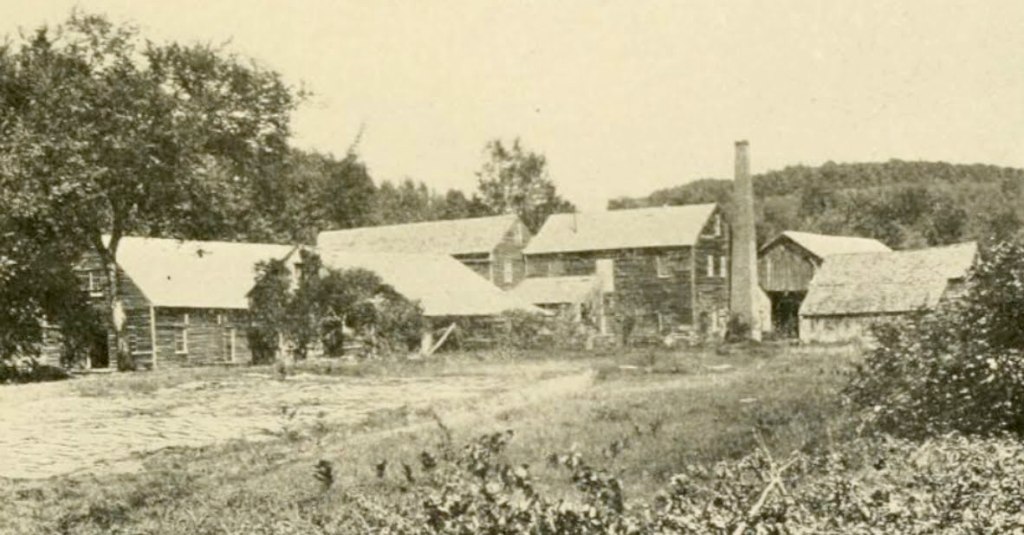
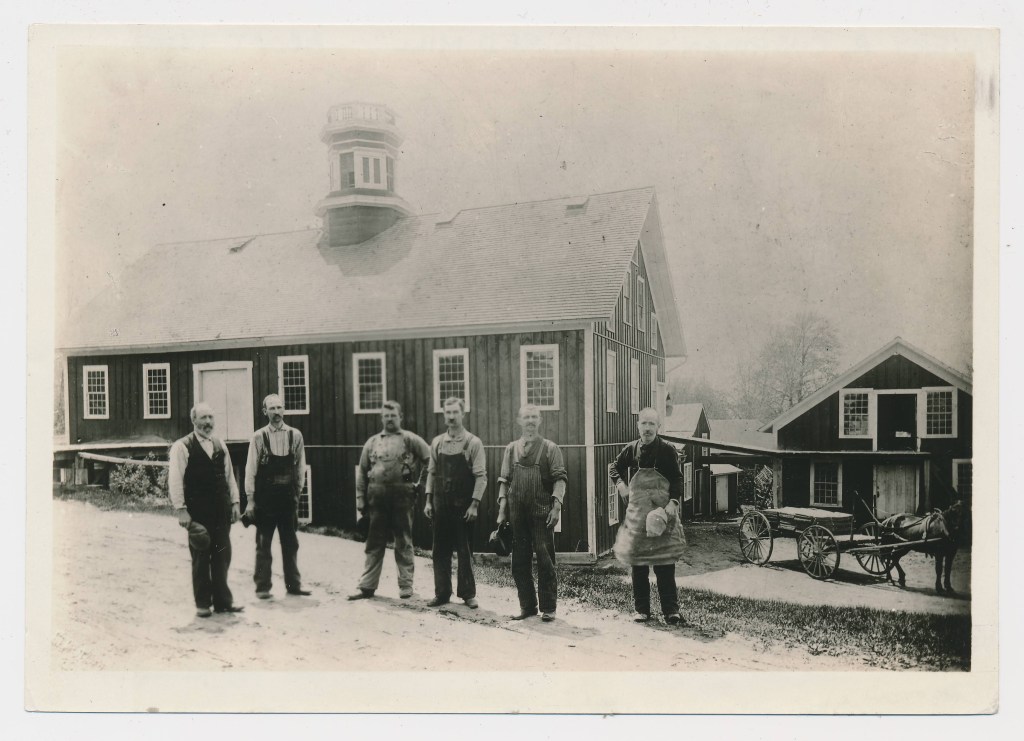
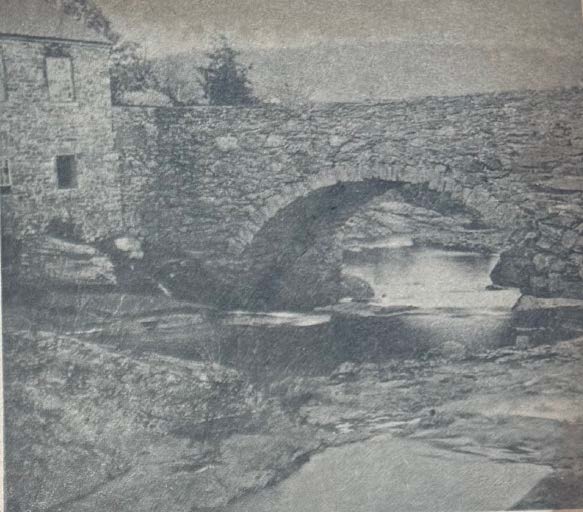
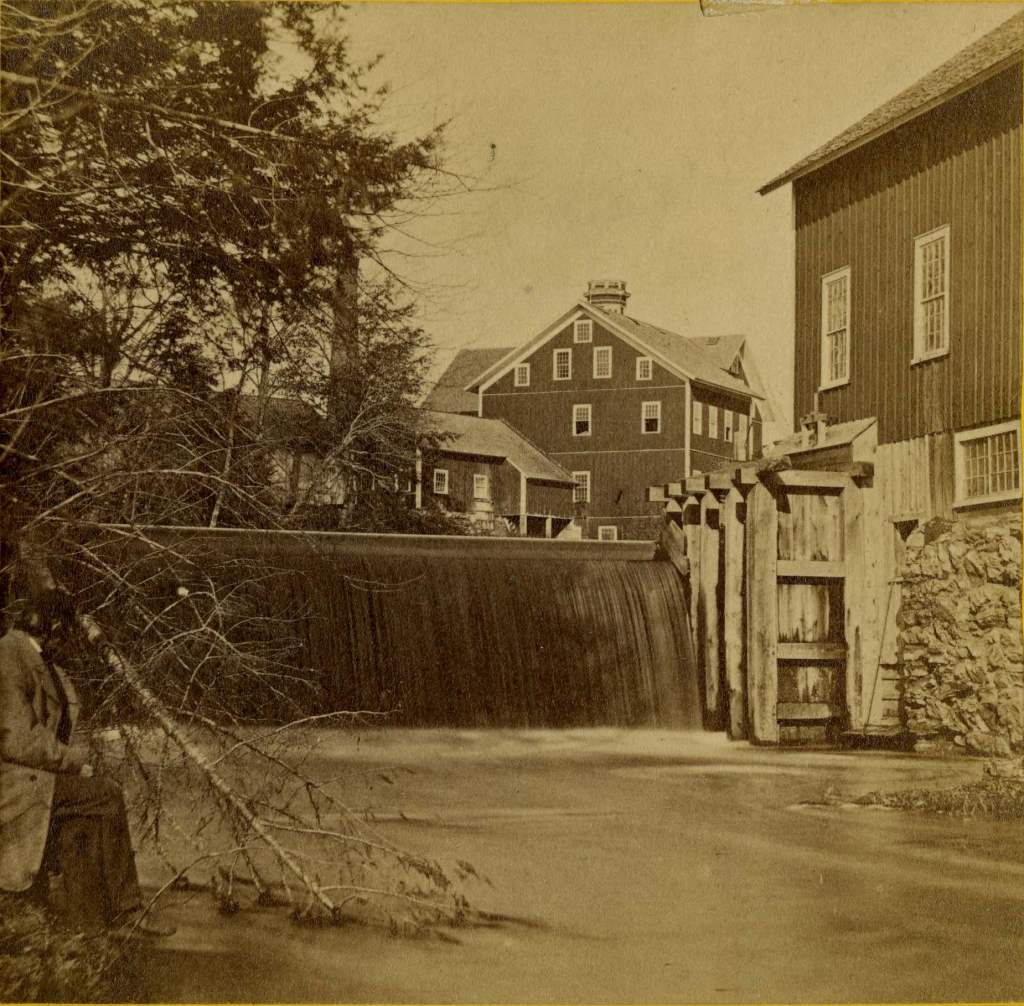
An industrial frenzy followed. By the onset of the Civil War the river had added another three paper mills and six textile mills. The Hills Palm Hat Company, a well-known industry in downtown Amherst, opened a plant on the Mill River in 1856.
The post-War decade was quiet, as the national economy shifted, water power started to give way to steam (and eventually electricity), and the relatively modestly-sized Amherst mills struggled to compete with large-scale operations in Holyoke, Chicopee, and other sites on the Connecticut River. By this time, many of the Amherst factories had burned or been washed away.

A final industrial chapter in the Mill River’s story spanned the turn of the twentieth century. The textile mills were either gone or going, but paper still used the river for the manufacturing process if not for power. The Cushman paper mills off Bridge Street were replaced with large factories producing leatherboard, paper towels, carbon paper, and other specialty products. Substantial planing mills were erected downstream, producing sashes, doors, and other wood products. And in 1910, the Puffer family built its ice house on the current beach at Puffer’s Pond and harvested and distributed ice from the Pond until well into the 1930s.
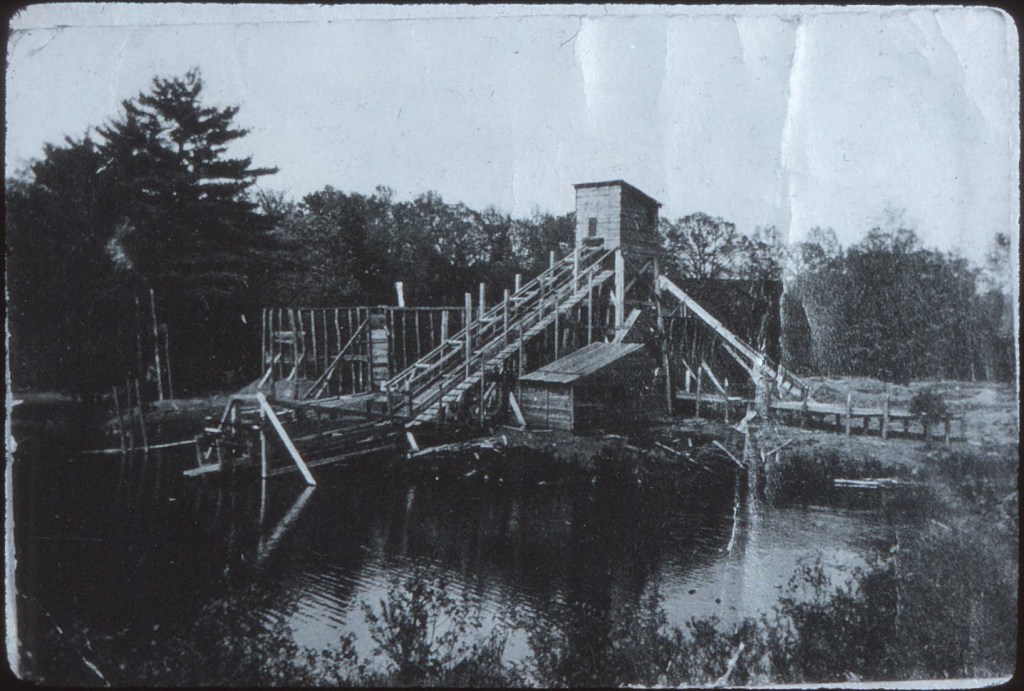
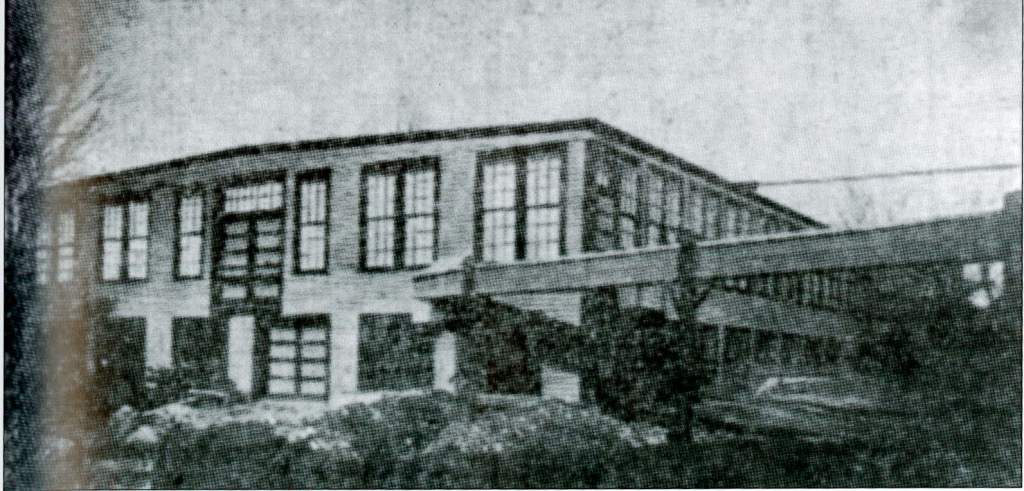
By 1940, nearly all the traces were gone. The large mill pond above the bridge at Bridge Street was drained; the mostly wood structures of the mills had disappeared; and the Mill River’s course was mostly deserted. In the 1960s, the Town began to acquire much of “Factory Hollow” for conservation purposes.
While the factories are gone, the North Amherst and Cushman communities that grew up around them remain, and the stories of the lives of those who lived and worked there still echo down the years. Those of us working on the project have found it endlessly fascinating.
We are still midway through our work, but if you want to learn more about what we’ve unearthed I will be offering a progress report as part of the Amherst Historical Society’s “History Bites” program on Friday, March 14, at 12:30 p.m. in the Bangs Center. All are welcome. (MORE)
Bryan Harvey is a Trustee of the Amherst Historical Society. He also served as chair of the 2001-03 Amherst Charter Commission, served on the Amherst Finance Committee from 1981 to 1991 and on the Amherst Selectboard from 1991-2001.
Discover more from THE AMHERST CURRENT
Subscribe to get the latest posts sent to your email.


Thanks for this article and for the work being done to shine a light on this important and fascinating part of our community’s history.
LikeLike
This is fascinating local history, thanks for the work! I wonder, have you uncovered much about the history of housing segregation by race/class in Amherst, legally enshrined or de facto? I’ve heard rumors, stories, anecdotes over the years about this in town, especially realting to the North Amherst/South Amherst divide…
LikeLike
Hi Jonathan, I’ve also been working on this, indeed, fascinating project – Bryan’s talk today at the Bang Center was excellent (it may have been taped). We haven’t compared North to South Amherst at all so far. We’ve only identified a few Black N. Amherst residents, as much of the work to date has been about the rise of industry – not so much about individuals as yet. There is a story about the prohibition Oliver Dickinson, who donated the land and paid for the N. Congregational Church to be built, made against “negroes or mulattos” sitting in pews on the main floor of the sanctuary. The church was built in 1826 and the provision was repealed in 1830 (I believe when the church installed its first of a number of abolitionist ministers). There’s a wonderful historian (Margaret Orelup) who’s been doing the research for the project and everyone is hoping to interface with Anika Lopes’ Ancestral Bridges.
LikeLike
Reply from Bryan Harvey
Hi, Jonathan. There was certainly class segregation at work in North Amherst housing. As in so many places, “factory housing” was associated with some of the mills. You can still see row houses built for the paper mills on the River side of State Street near the corner with Bridge Street, and a large boarding house once stood across the street in the area between State Street and Pulpit Hill Road. Factory houses also lined Summer Street where it comes toward the Puffers Pond dam, and another boarding house served the factories in “Westville” (where the River used to come down to Meadow Street just before the current intersection with the Route 116 bypass).
I’m aware of racial housing segregation in the downtown area. The Blue Hills Road area had widespread racially restrictive deed covenants. You might want to check in with very helpful folks at the Jones Library Special Collections.
LikeLike