
By Nick Grabbe

I have been observing Amherst’s politics, schools, and culture for 45 years, and I appreciate many aspects of our town. I love the access to nature and activities, the emphasis on ideas and education, and the fact that less than 10 percent of us voted for Trump.
But I’m also aware of some longstanding patterns that have held Amherst back. I started thinking about these problems when I heard about the latest attempt to damage the Jones Library project (see “Minority rule” below).
Although I don’t want to live anywhere else, these problems are a source of wonderment and irritation. They have been around a long time and sometimes seem embedded in our town’s collective psyche.
I call them Amherst’s original sins. Here they are, in no particular order, with links to previous posts that provide more details. Feel free to add your own pet peeves in the comments.
Unaffordable Housing
The median price of a single-family home in Amherst has more than doubled in the last 12 years, and rent levels have also ballooned. There are many reasons, including decades of failure to build enough housing to meet the demand, neighborhood opposition to development, UMass expansion, and Amherst becoming a refuge for city people fleeing the pandemic.
There are societal costs to these high housing costs: homeowners getting wealthier while renters get poorer, young families getting shut out, and public-employee salary demands contributing to budget pressure.
Like many towns in Massachusetts, we have failed to provide enough housing for the “missing middle,” people who are neither wealthy nor poor. Two years ago, Town Councilors Mandi Jo Hanneke and Pat De Angelis proposed zoning changes aimed at increasing housing supply, but withdrew them in the face of concerns that they would benefit students and investors.
Cambridge, the only place in the state with a smaller percentage of Trump voters than Amherst, has taken steps to reduce housing scarcity. It has abolished single-family zoning and allows up to six stories if 20 percent of the housing is affordable on lots over 5,000 square feet.
Minority Rule
We have too often been diverted from our goals by a small number of people who have raised objections to projects that have been approved by democratically elected officials and voters. We sometimes act not in the interest of the town as a whole and wind up with projects that are more expensive than they need to be.
Take the 1990s battle over the Boltwood Walk parking “garage.” In the face of intense opposition from people who live nearby and those who didn’t want to support car culture, we compromised and wound up with only a small increase in the number of parking spaces over what was there before, and a very high cost per space added.
After many years of planning, it appeared in 2016 that we were finally going to build a new elementary school at the Wildwood site. But these plans were derailed when just over a third of Town Meeting members, who objected to the site and/or a grade reconfiguration, killed the project by voting against authorizing the borrowing (contributing, ironically, to the end of Town Meeting). We are now, nine years later, building the school at the Fort River site at a cost that’s an estimated $28.4 million higher than the original plan. The tax surcharge to pay for the new school has started appearing on our quarterly bills.
In 2019, officials turned down a donation by Amherst College of 27 acres for a new public works headquarters because of objections from neighbors. We are still looking for a site for the building.

And now, despite multiple Town Council votes and a referendum showing that almost two-thirds of voters approved of the Jones Library renovation and expansion project, a small but dedicated group of opponents has delayed it, while its costs have skyrocketed. It is now about $10 million more expensive, and there are two new challenges since last week, when the Council voted again, 9-3, to continue supporting the project. Here’s a link to a summary of basic facts about the project.
Abuse/Turnover of School Leaders
In 1993, the high school principal had a heart attack while dealing with an angry parent and died at age 56. I know of three school administrators who have taken leaves of absence because of mental health challenges. In 2023, three School Committee members and the superintendent resigned after enduring harassment from parents.
We’ve had a revolving door of school administrators. In 2010, we had had five superintendents in the previous three and a half years, and four middle school principals in the previous four and a half years. The new superintendent, who was chosen after an exhaustive search, was let go after just eight months. In 2014, two principals resigned on the same day. Our new superintendent has faced intense criticism from other administrators.
This instability has made planning for educational improvement more challenging. Meanwhile, school enrollment has declined by 40 percent since 2000.
We value debate and love to question authority in Amherst. But too often, public criticism has descended into personal attacks, and we have sometimes allowed the loudest voices to prevail, according to former School Committee Chair Rick Hood. In this Amherst Current post, he addressed these issues and outlined how the decision-making process ought to go.
Small Commercial Tax Base
Amherst pays a very high price for its historical reluctance to support business. Residents pay about 90 percent of all property taxes, a much higher level than in Hadley or Northampton. Our average tax bill is almost double Hadley’s, and every time we go there to shop, we provide financial support to their schools and government, not our own.
Plans in the 1980s and ’90s to broaden our tax base by supporting “spinoff” businesses arising from UMass research fizzled out. Tax-paying companies like National Evaluation Systems and HBO/McKesson moved to Hadley. Pharmaceutical and alternative-energy companies made plans to locate in Amherst but found reasons not to.
Town Meeting rejected proposals to loosen development rules in professional/research parks and a plan to allow a hotel and conference center in North Amherst (one opponent called it a “bar mitzvah mill”). A proposal to build a Walgreens on Route 9 was shelved in the face of opposition. Much of the new growth in our tax base over the past 10 years has come from apartment buildings largely occupied by students.
Since 2001, the increase in the assessed value of commercial property has been lower than the increase in residences, adding to the tax burden on homeowners. As Amherst resists business development while maintaining ambitious demands for public services (such as high per-pupil expenditures) and a high percentage of tax-exempt property, the result is high residential taxes, tight budgets and difficulty paying for large projects.
Longmeadow is the only town in Western Mass. with a higher average residential tax bill than Amherst.
Road Disrepair
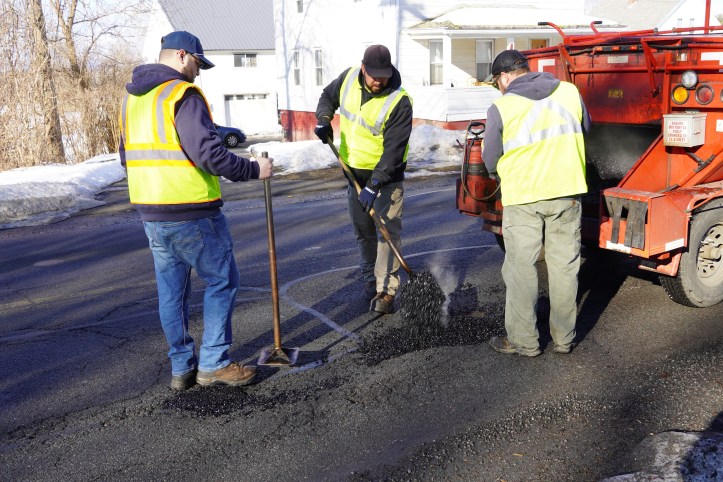
We have failed to keep our roads in good condition over the past few decades. The backlog in road repair has been estimated at more than $40 million.
Part of the problem is the aforementioned limitations of our property tax system; next time you’re driving through low-tax Hadley, check out the better state of the roads. State funding for roads has not increased since 2012, and the town engineer estimates that we’d need to spend $5.7 million to improve all the poorest roads.
We have had different priorities for public funding, and we have the added problem of student vehicles pounding our roads while their excise taxes go to their hometowns.
The impact extends beyond snarky comments about Amherst roads resembling a third-world country’s roads. Potholes aren’t just annoying. Driving over craters in roads can damage tires and suspension systems, and swerving to avoid them can cause accidents.
Roads are supposed to receive priority for repairs based on both condition and usage. But in my neighborhood, little-used upper Cottage Street was resurfaced last year while High Street, which gets heavy usage because it’s near the regional schools, is in terrible shape. Go figure.
Nick Grabbe, the co-founder of The Amherst Current, was a newspaper editor and writer in Amherst for 32 years. He served on the Charter Commission and co-founded a blog about the new form of government called A Better Amherst. He has lived in Amherst for 41 years.
Discover more from THE AMHERST CURRENT
Subscribe to get the latest posts sent to your email.
 THE AMHERST CURRENT
Re: Affordable Housing- For decades, Westchester County has operated one of the best bus transit systems nationally. The success of this has been an annual operating subsidy to a private bus company so the operations remain in the private sector. Creating affordable housing will require a subsidy as well but obviously, no one locally, statewide or nationally wants to be the subsidizer. Just the cost of housing construction alone is so high. Tinkering with density is not going to solve the deficit we see in quantity and price. Locally, the Town should encourage cooperative housing so residents can earn equity in their homes and not pay monthly rents that have no ROI for them. Also, the housing deficits we see should be addressed with regional town alliances because each town has different assets to chip away at the problem. Some have land and others have no land. Some have excess retail space that can be adaptively re-used and others do not.
LikeLike
That’s a good list to begin with!
Elisa Campbell
LikeLike
I think the 8.5% Trump vote in Amherst is an interesting metric . . . suggesting how unified the Town is in a lot of ways, while at the same time suggesting there is unique dysfunction in Town, despite the like-mindedness on national politics. As such, the Town sort of functions as a kind of microcosm for the Democratic Party’s internal tensions . . .
This is a great manifesto . . . but I’m not sure the road repairs deserves to be on this, it’s a regional if not national problem regarding infrastructure. See https://www.mass.gov/info-details/findings-public-infrastructure-in-western-massachusetts
LikeLike
Thank you, Nick. I might quibble with some of your examples (e.g., how much of Amherst’s high housing costs are due to forces within the community’s control), but the pattern you cite is very real. (I am still trying to regrow tail feathers burnt off in several of these episodes.)
In some ways I think it comes down to a perverse notion of “Amherst exceptionalism.” When we view ourselves as the last flickering flame in a world being overtaken by darkness — vs. a real community with real problems and opportunities that demand thoughtfulness and compromise — we fall flat both locally and globally. A community like ours ought to be a shining example of how progressive values can be put to work, not a poster child for the impotence of liberal democracy.
One thing I would add to your list: our propensity to make sure nothing bad can happen by making sure nothing at all can happen. What kind of example is that to the world?
LikeLiked by 1 person
Well said, Nick. Of course, the question is what can we do about these problems. I have suggested bringing back shunning and stoning of the individuals who choose to ignore the will of the voters, and ultimately increase our building costs. But of course, I was just joking, lest anybody think I’m serious and not tolerant of conflicting opinions. Actually, I am intolerant of conflicting opinions when the people do what they can to slow down the process, which costs the town money, when they inevitably lose. You neglected to mention the 25 or so year battle over the parking garage. We eventually got it, at a greater cost, and a parking lot and garage that was like a camel… a horse designed by committee.
LikeLike
Thanks, Nick, for your commentary. It’s well past time that these issues were properly addressed. With the upcoming Town Council elections, it might be useful to ask candidates how they would address them, responses to be disseminated through the Amherst Current.
LikeLike
This Amherst fan from Vermont thanks you for your insightful essay, Nick. If you were to expand Amherst into a state it would be Vermont. In the past 40 years we’ve become very good at blocking or delaying infrastructure and residential construction. Miro Weinberger, the former mayor of Burlington, put it this way in an editorial* in today’s VT Digger:
“But make no mistake, if we are going to end homelessness, be a state where young families can get a start, provide all our kids a good education, enjoy high quality health care throughout the state — if we want a future of abundance, not scarcity — we are going to have to grow.
The alternative is a Vermont that becomes increasingly unaffordable, where only the wealthy or those receiving aid can live, where our schools continue to empty, where our rural communities are hollowed out, where our workforce shortage worsens, and where more Vermonters find themselves without homes. That’s not the Vermont any of us want.”
*https://vtdigger.org/2025/04/24/miro-weinberger-if-vermont-wants-a-future-of-abundance-we-must-choose-to-build/
LikeLike
Comment from Paul Basken:
Nick Grabbe in “Amherst’s Original Sins” recites some of the well-known problems with housing affordability in Amherst and beyond. But he then repeats the same old deadly misunderstanding about what to do about it.
In Massachusetts, every family is forced to spend about $14,000 every single year subsidizing the most costly and destructive and socially divisive mode of transportation — private cars — regardless of whether and how much they actually use one ( https://www.hks.harvard.edu/publications/64-billion-massachusetts-vehicle-economy ).
At the end of an article decrying housing affordability, he then suggests spending even more taxpayer money forcing upon us — whether we want it or not, whether we can afford it or not — this extremely ruinous method of transportation.
We will not solve the problems that Nick Grabbe points out if we do not reconsider his tragically mistaken belief that we will heal ourselves by forcing upon ourselves even more of the death and ugliness and alienation and unaffordability that comes with our car-only compulsion.
Paul Basken / UMass alum
LikeLike
Perhaps our State Reps. should confer with others from cities and towns with large tax exempt institutions about revisiting the State controlled formula for Payments In Lieu Of Taxes paid to them. The assessed value of the real estate, if taxed, would result in far greater revenue.
It’s not just student vehicles beating up main roads. Faculty and staff owned ones do as well. Contractors for maintenance, landscaping, repairs, new construction, as well as deliveries of food and merchandise do as well. There must be hundreds of Amazon, FedEx, UPS, Postal, etc. truck visits each day.
UMASS is getting a very cheap ride on the backs of resident taxpayers.
LikeLike
I re-read that post of mine you referred to from February 2022.
It’s too long and I wanted to pull out what I think is the important (and obvious) part so that is below, with additional comments about it.
“When a decision needs to be made, or an issue resolved, it should go like this:
1. All voices should be heard and listened to with as much empathy as possible.
2. Those voices need to be reasonably stated. That does not mean they can’t be angry or even a bit loud. Anger is often understandable and warranted. But they cannot under any circumstances include personal attacks. And no one person should be allowed to dominate a discussion.
3. Then the decision makers need to deliberate carefully, putting aside as much as possible any bias that exists in their minds.
4. Finally, a decision is reached.
5. At that point, input and deliberation is over on that topic.
Not everyone may like the decision, but they need to respect the fact that the process is over.
Too often in Amherst, Step 5 does not work that way, and the process is never over for some people.
It is, of course, appropriate and expected for those who don’t agree with a decision to keep working on changing minds for the next time a similar decision needs to be made. But it’s not OK to continue to challenge a decision that was made, after this process is done.”
—-
Do we do Step #1 well enough? I think so, however…. I do think that sometimes those in charge make decisions, which they become attached to, before hearing all the voices.
Part of the reason is that sometimes work needs to be done in advance in order to present something to the public. During that work, one can become attached to an idea and it can be hard to let that idea go.
On the 2016 school plan, I became attached to the idea of replacing FR and WW at the same time — unusual, and wonderful, for the State to have approved — with a new 2-6 school, and with CF becoming a PreK-1 early education school. To me it seemed like a fantastic solution for many reasons.
Was I open to changing my mind when presented with pushback but the “Save Amherst Small Schools” group? Did I do step #3 well? I honesty think I did. I did lots of my own comparisons on spreadsheets and documents. I met with the leaders of that group, with another SC member. I told them I really heard them, and I did, but I simply disagreed.
Then votes occurred. On the SC it was 5-4 in favor. On the FC the vote was yes (I forget the tally) and the town-wide vote (override) was yes.
But then #5 in the process did not happen. Some would not accept the votes. And as you know, the 2/3 voted needed for bond authorization at town meeting did not pass. Whatever else you think, that was insanity. A bond authorization vote is about whether or not the town can afford the plan, not a vote on the plan itself. That was the only vote in the process that required 2/3. If plan approval needed 2/3 vote then the SC vote would have needed that.
One could say that those in favor of the plan did not respect the vote of TM as we tried to get it overturned in a town-wide vote. In my view, the insanity of that TM vote — not what we were supposed to be voting on — warranted that.
At any rate, now we have a school building plan that is around $28 million more expensive than the 2016 plan.
Perhaps sometimes we can do #1 better, and we should think hard about that. But we certainly have a problem with #5 — people simply do not accept the vote. It’s not entirely unlike January 6, but without the violence.
LikeLike
Comment from Tom McBride:
Mr. Grabbe,
Reacting to your piece, Original Sins, and now trying to go through my memory, yes, we have a way too small commercial tax base.
Yes, there has been continual talk about the high cost of housing in Massachusetts, and that includes the high prices in Amherst, or perhaps I should say, especially Amherst. I am talking about single family homes owned by year round residents. And if you look at statistics concerning the combined income required to support a home like this, it is very high.
Three, I am not speaking for or against subsidized housing, but let’s say that it has a place. The “catch”, is that you have to qualify for it.
Four, combining some of the information I just mentioned, it culminates with your perfect phrase, the “missing middle”.
I don’t know the numbers, but I would be willing to guess that many people that work for the town as clerks, police officers, those that work for the department of public works, for the fire department, and other departments, do not live in town.
Tom McBride
LikeLike