
By Jack Jemsek
The Town of Amherst’s investment in a greener future achieved yet another milestone this month when the State accepted Amherst, along with 18 other municipalities, into the inaugural group of Climate Leader Communities. Town Manager Paul Bockelman stated that the designation “reaffirms the Town’s standing as one of the top communities in Massachusetts addressing climate change.” The Climate Leader designation will help move Amherst toward reducing the Town’s carbon footprint 25% by FY 2025, and 50% by FY 2030, ultimately achieving Town-wide carbon neutrality by 2050.
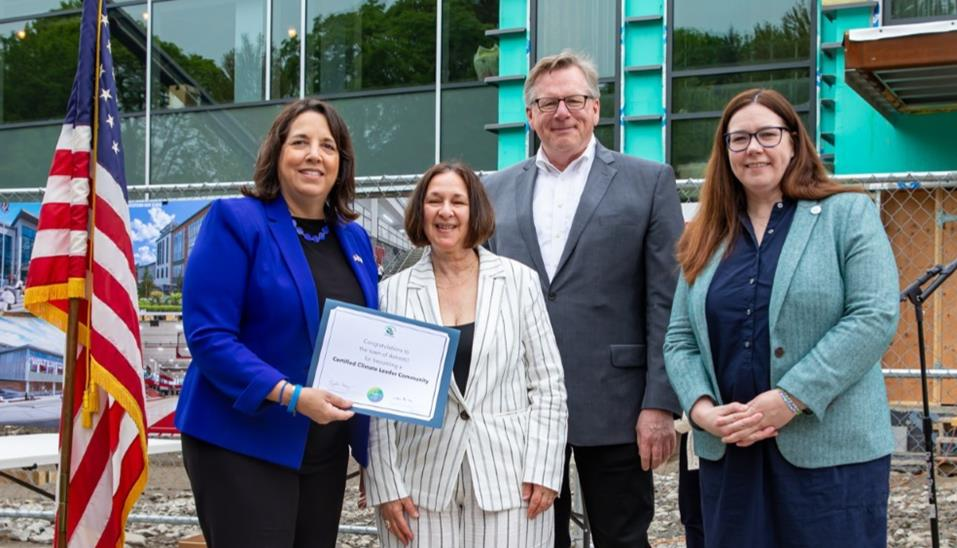
One of the upsides of being a Climate Leader Community is that the Town will be eligible for the Decarbonization Technical Support Grant, which can total up to $150,000 for design studies supporting municipal clean energy projects. Additionally, the Town will be eligible for Decarbonization Accelerator Grants, which may total up to $1 million to support projects that reduce municipal operations’ greenhouse gas or carbon dioxide (CO2) emissions. This first round of funding will be good through 2026, but additional funding rounds from the MA Department of Energy Resources (DOER) have not been ruled out.
To learn more about the Town’s climate actions, the Amherst Current sat down with Stephanie Ciccarello, the Town’s Director of Sustainability. Ciccarello has worked for climate action at the Town level since the early 2000s, when she helped the Town establish the Energy Conservation Task Force. At that time, Ciccarello helped the Town participate in the Cities For Climate Protection campaign to reduce CO2 emissions, and later develop the Town’s October 2005 Climate Action Plan (2005 Plan). The 2005 Plan came about from the Town’s early involvement with ICLEI-Local Governments for Sustainability program, which encouraged sustainable development on the local level. The 2005 Plan provided the groundwork for CO2 emission inventories and reduction goals, as well as the implementation and monitoring of the plan’s progress.
The Town was named one of the original 102 Green Communities by DOER in July 2012, which was the next significant green milestone achieved by Amherst. Ciccarello stated that the Town’s efforts to implement the 2005 Plan assisted the Town in reducing CO2 emissions and improving energy efficiency. To facilitate the Town’s selection as a Green Community, the Town adopted the state’s Building Energy Stretch Code. The Stretch Code, administered by the Town’s Inspection Services Department, requires that new construction in Town have improved energy efficiency compared to the previous code.
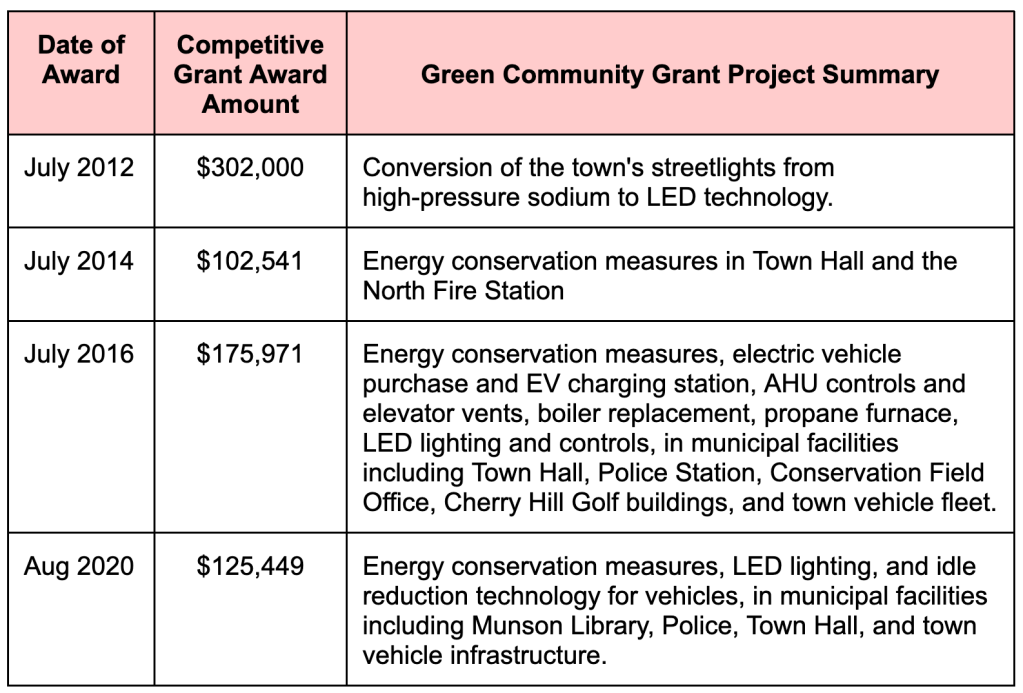
Amherst has been awarded approximately $700k in competitive grant funding through the DOER Green Community program, with each of the following projects completed:
Another green milestone was achieved in 2016 when the Town conducted a CO2 Emissions Inventory to provide a baseline for reduction goals. The inventory found that energy use in buildings accounted for most of the Town’s CO2 emissions (76%). A second CO2 Emissions Inventory conducted in 2022 to measure progress toward the carbon neutrality goal found a 12% reduction from 2016.
In 2017, Amherst passed one of the first Zero Energy Town Buildings Bylaws in the nation. This was due to the efforts of the Zero Energy Amherst and Town working groups, whose members recognized the importance of building construction and maintenance in achieving carbon neutrality for the Town. The Town Council revised the bylaw in 2021.
The Town’s participation in the State’s Municipal Vulnerability Preparedness (MVP) Program began in earnest in 2018 when a $29K MVP Planning Grant was received to assess and develop ways to build community resiliency. The Town later won a $100K MVP Action Grant from the State to prepare the Town’s Climate Action, Adaptation, and Resilience Plan (CAARP).
At the behest of the Town Manager and the new Town Council, the Town’s Energy & Climate Action Committee (ECAC) first convened in May 2019. Despite the challenge of the pandemic, the ECAC oversaw the community review process that led to the adoption of the CAARP in June 2021. The CAARP has served as the backbone for setting the Town’s climate action goals, and provided a means to oversee the implementation of the plan to achieve 100% renewable energy/electricity by 2050, reduce CO2 emissions, and build climate resiliency for the Town in ways that support equity, climate justice, and economic prosperity.
Regarding the extent to which the Town’s climate initiatives extend beyond the municipal buildings and services, the Amherst Current asked Ciccarello how climate goals could be incorporated into the private sector. She stated, “Ultimately, the goal is to reduce carbon, become carbon neutral, and eliminate fossil fuels. Decarbonizing the Town’s vehicle fleet and building stock is the focus of the Climate Leader program. It is hoped that the Town will ‘lead by example’ for the private sector.”
Ciccarello reminded us that the town has promoted several community-wide climate initiatives, such as the Solarize Amherst campaign, which has helped approximately 200 homes install rooftop solar panels. Currently, the Town is promoting the Heat Pump Incentive Program, a two-year program that makes it more feasible for homeowners to convert to energy-efficient heat pump systems. She also encourages people to visit the Amherst Sustainability Dashboard to get ideas on how to get more involved with the effort to achieve our climate goals.

Unfortunately, the global initiative to reduce CO2 emissions being embraced by Massachusetts is not currently shared on the Federal level. Access to financial incentives to improve energy efficiency has been largely suspended, with once helpful online links now broken and yielding “Page Not Found.”
Still, climate action on the city and state level, even in the face of federal inaction, can significantly reduce greenhouse gas emissions, as discussed in the University of Maryland’s 2024 report U.S. Climate Pathways for 2035 with Strong Non-Federal Leadership. We asked Ciccarello her thoughts on the current federal administration seemingly abandoning climate action, and she emphasized, “That is why local communities need to stay the course and keep doing what they are doing. We need to work together collectively until, hopefully, circumstances for broader support change again.”
Jack Jemsek is a consulting hydrogeologist and he and his family have been Amherst residents since 1999. He has served on the Water Supply Protection Committee since 2018, the Pioneer Valley Planning Commission Executive Committee since 2020, the Board of Health since 2024, the Planning Board from 2016 through 2022, and several other local committees.
Discover more from THE AMHERST CURRENT
Subscribe to get the latest posts sent to your email.
 THE AMHERST CURRENT
Here’s a horrible possibility, that we probably have to brace ourselves for: that the terrible folks working in this current federal executive branch figure out a way to penalize the Town of Amherst financially for its diligence in addressing and combating climate change. There…..I’ve said it, I’m sure that it has occurred to others….maybe now it won’t happen. Thank you to Jack Jemsek, and to the Amherst Current, for reporting on this essential issue.
LikeLike