
By Stephen Schreiber
The back buildings of Amherst’s central business district are in a period of layered transformation—new residential density, institutional growth, mixed-use infill—all being built behind facades that are familiar. These back-building projects test whether the town’s downtown can evolve without losing its human scale, historic rhythm, and community feel.
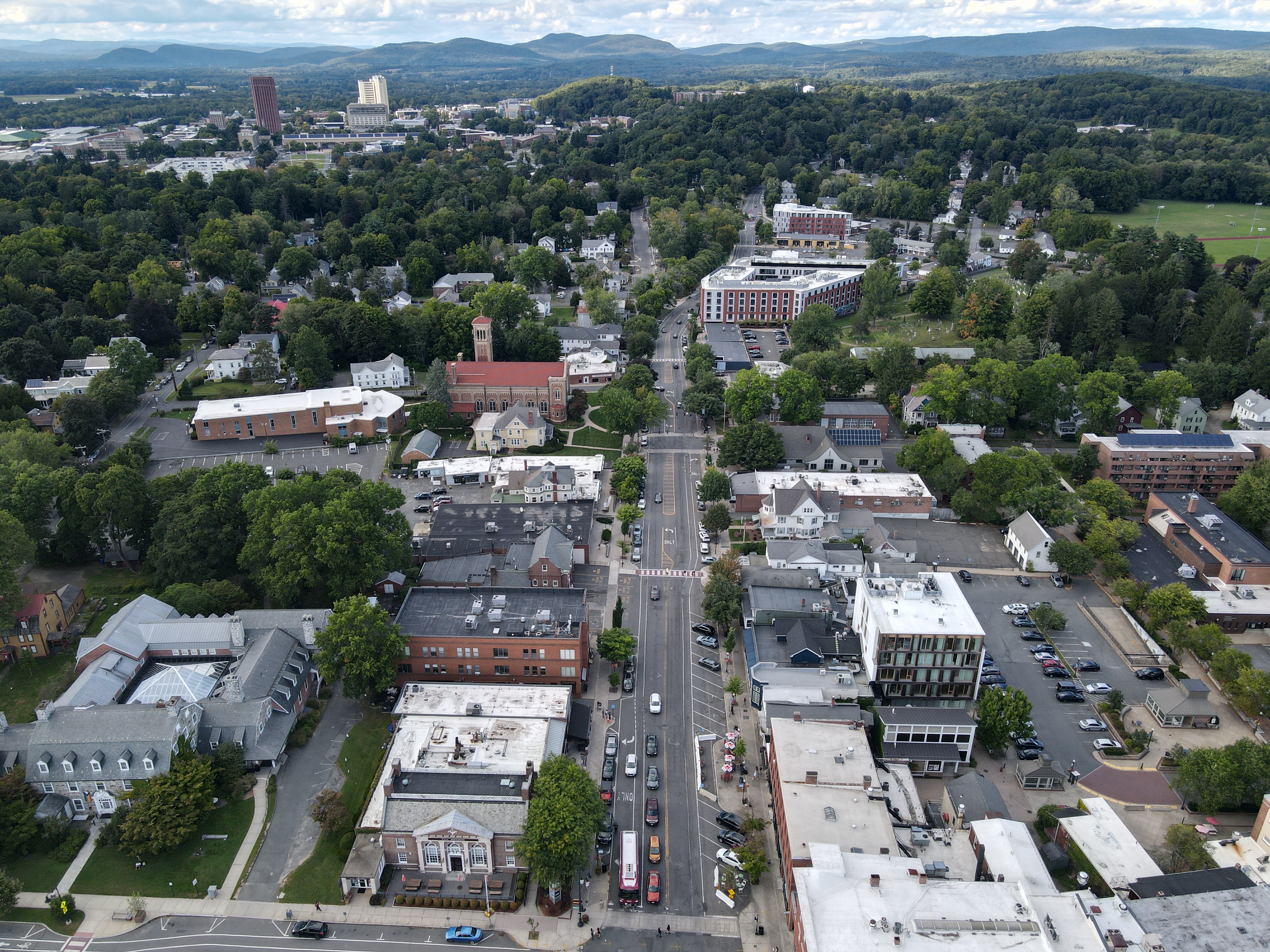
The transformation is happening largely out of sight—behind historic facades, in alleys, service yards, and secondary structures that for decades were invisible parts of the central business district. These “back buildings” once stored deliveries, housed printing presses, or sat as empty barns. Today, they are being reimagined as some of the most important sites of Amherst’s growth.
Amherst’s back buildings have always been pragmatic. In the 19th and early 20th centuries, they housed cold storage for grocers, carriage houses for merchants, and mechanical rooms for shops.
As the retail economy and transportation means shifted in the late 20th century, many of these spaces fell into underuse. Some became parking lots; others, storage zones. Yet in recent decades, as housing demand has soared and the town has sought to concentrate development downtown, these forgotten parcels have become prime territory.
Back-lot development offers possibilities of building up behind the preserved streetscape, adding housing and mixed-use space without altering the familiar faces of Main, Amity, and the Pleasant Streets.

The first clear example of this strategy came with Boltwood Place, completed in the early 2010s. Located just off Boltwood Walk in a former service yard, Boltwood Place transformed a rear lot once used for parking and service functions into a five-story, mixed-use building. Apartments occupy the upper levels, while ground-floor commercial space is intended to activate the pedestrian alley. The project has compact, energy efficient design, demonstrating that Amherst could add residents to its downtown core without overwhelming scale or historic character. It also signaled a new willingness by developers and planners to see “the back” of Amherst not as dead space, but as fertile ground for infill.
A far larger project is taking shape behind the historic A.J. Hastings building at 45–55 South Pleasant Street. Hastings closed in 2021 after nearly 100 years of operation. The new project, approved in 2024, preserves the brick storefront and renovates the Hastings building. An aging wooden structure at 55 South Pleasant, once home to the Jeffrey Amherst Bookshop and later offices and salons, was demolished, as was the Hastings rear ell. Amherst College’s campus store occupies the ground floor, keeping retail alive on Pleasant Street. Rising five stories and 55 feet tall, a new structure is being completed at the rear, attached by a stair and elevator tower.
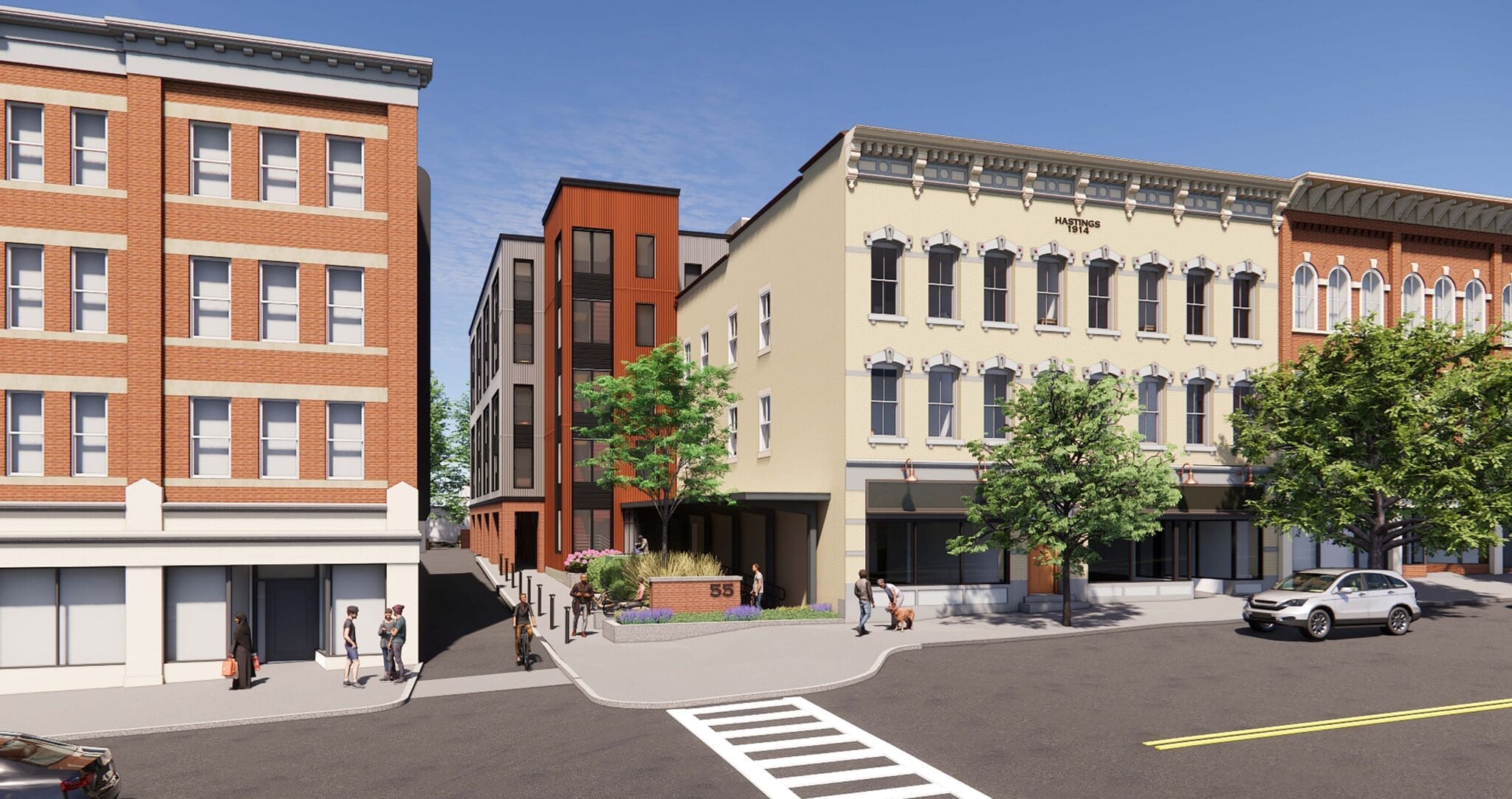
The upper floors of both the historic Hastings building and the new rear addition will hold dozens of market-rate apartments, most of them leased to Amherst College. A covered arcade and plaza will carve a new walkway into the block, improving downtown walkability and replacing what was once a service alley and cold storage area.
For Amherst, this project represents a new scale of back-building infill. Where Boltwood Place was compact and modest, the Hastings redevelopment pushes upward, testing how far Amherst’s downtown can grow while preserving its historic streetscape.
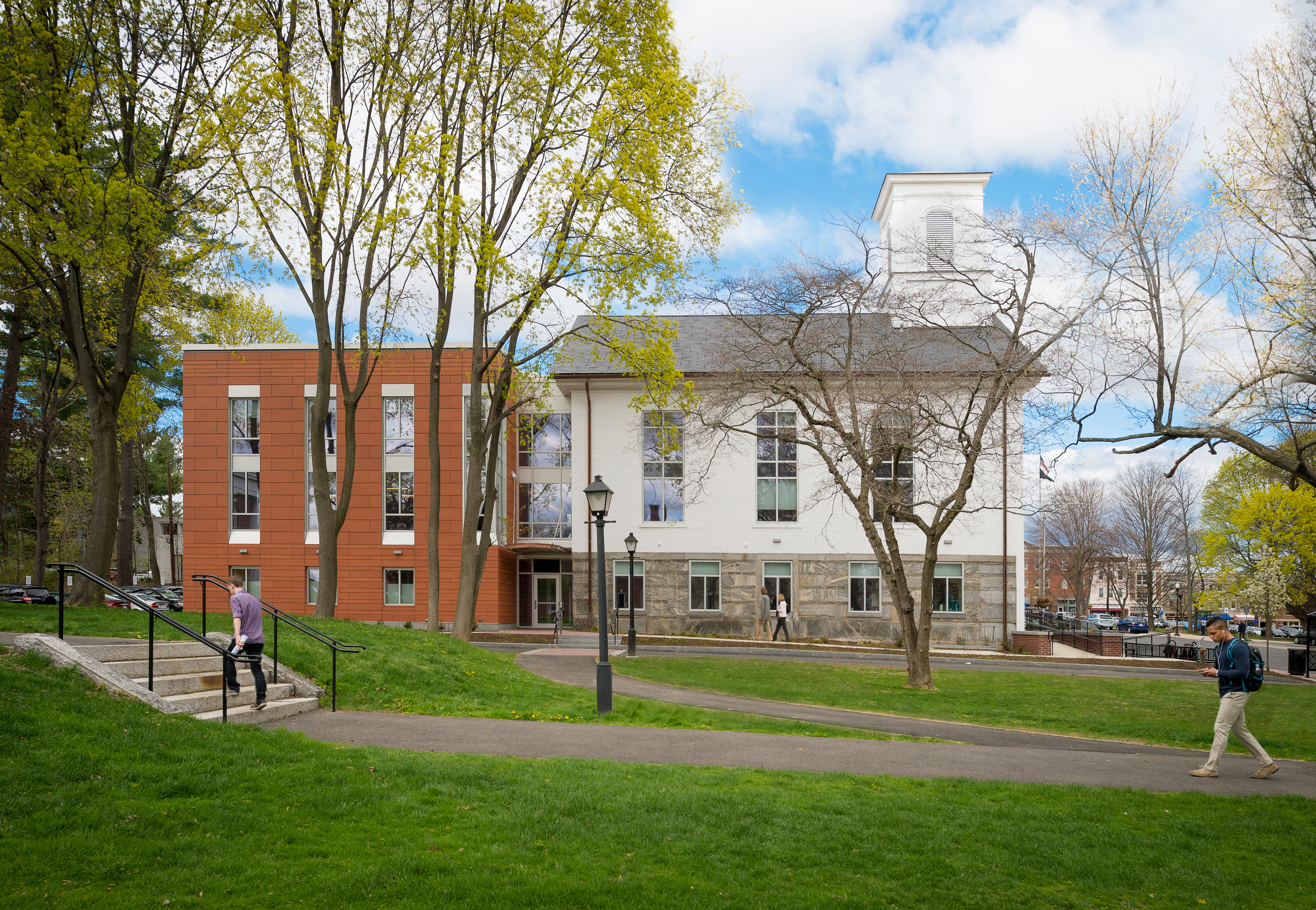
Another key example (albeit institutional rather than residential) lies at 79 South Pleasant Street—the former First Baptist Church, built in 1834, located on the Town Common. Repurposed around 2013, this building now houses the Five College Center for the Study of World Languages, along with several administrative units for Amherst College. It stands as an example of how non-commercial back-lot or rear acreage—here, a prominent civic/social edifice—can be adapted without eroding downtown’s identity.
These hidden spaces deliver more housing, more walkable connectivity, and more vibrancy while keeping the qualities that drew people here in the first place. Boltwood Place, the Five College Center, and Hastings offer evolving models for new development.
Stephen Schreiber is an architect and chair of the Department of Architecture at UMass Amherst. He was an elected Town Councilor in Amherst from 2018-2022.
Discover more from THE AMHERST CURRENT
Subscribe to get the latest posts sent to your email.
 THE AMHERST CURRENT
This is an outstanding highlight of the fresh energy coming into our downtown. These buildings (1) contribute mightily to the tax base ($75k+ for Boltwood alone!); (2) are the ideal height environmentally; and (3) are significantly more beautiful than many of the existing buildings downtown (CVS, BoA, the petrol station, etc.).
Another point of evidence that thoughtful construction in Amherst is a win-win.
LikeLike