
By Nick Grabbe
Mandi Jo Hanneke said that Amherst should lower the barrier to the creation of two- and three-family housing.
Vince O’Connor advocated for rent control and school spending that is determined solely by the School Committee.
Andrew Churchill said that the greatest barrier to addressing Amherst’s problems is that “we get too divided as a community.”
Ellisha Walker said that as a younger person and a renter, she represents people who often don’t feel represented in government.
Allegra Clark said CRESS should be fully funded and integrated into the public safety dispatch system.
Freke Ette, who referred to himself as a baker, said that “we can’t increase our appetite and expect that the pie will increase.”
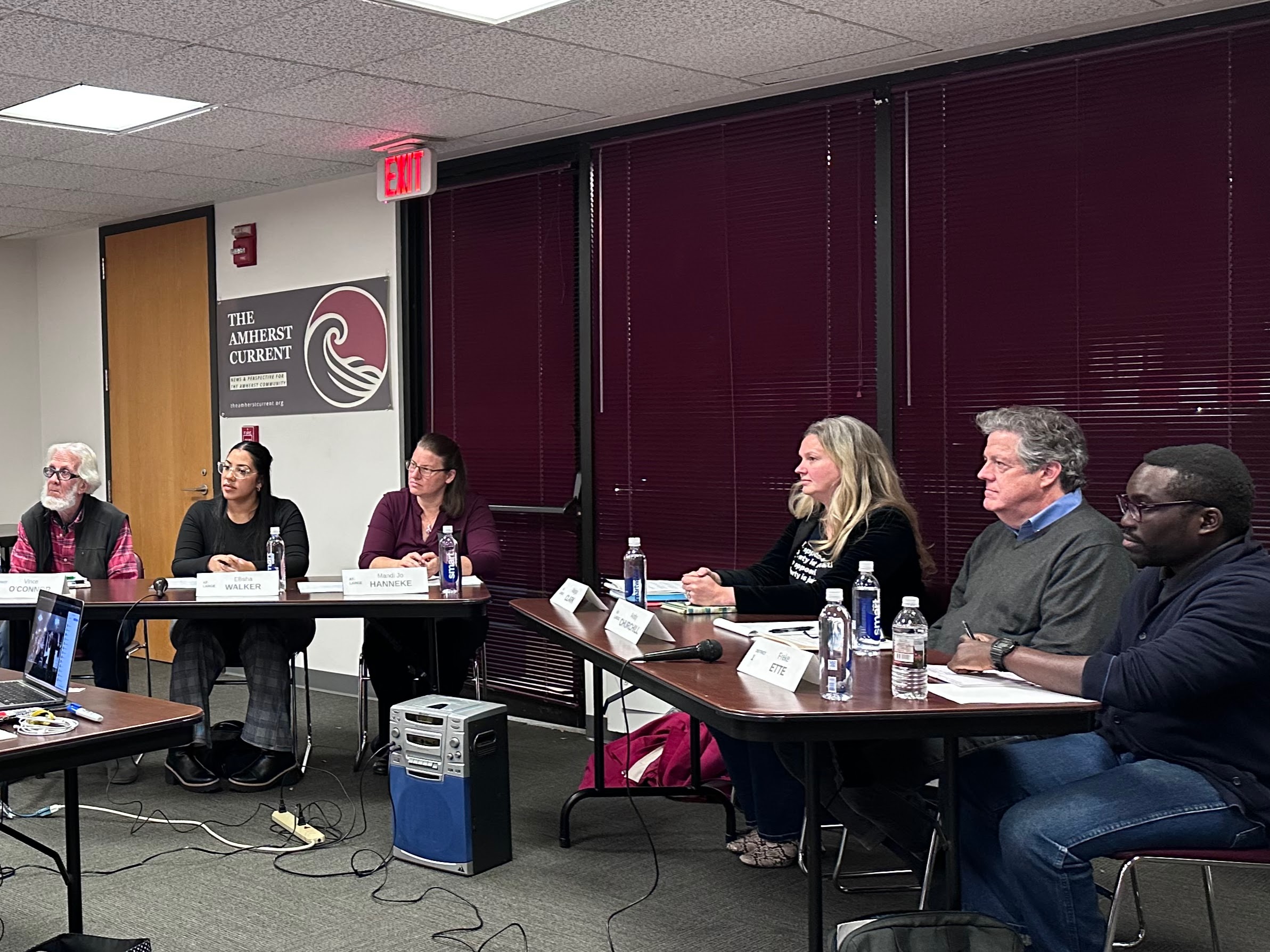
These six candidates for Town Council engaged in a debate Friday night sponsored by The Amherst Current. There will be a second debate Monday at 7:30 p.m. in the Bangs Center and livestreamed, featuring Town Council candidates from Districts 2, 3, 4, and 5. The debates are moderated by Stan Rosenberg and co-sponsored by the Graduate Student Council of the UMass School of Public Policy.
Voters will choose members of the Town Council and School Committee November 4. For information about the election and Monday’s event, go to our 2025 Election Central.
The candidates addressed a range of issues, including budgeting, housing, economic development, infrastructure, and the potential for an override of the state law limiting property tax increases. Read on to learn more, or watch the recording below.
Budget Priorities
Many cited school spending as a top priority. Walker said that our spending should be aligned with our values. “I think that we have a lot more alignment than we think in terms of values in this community, and how do we make sure that our budget is actually reflecting those values that we hold?” she said. “What ways can we as a council strategically engage in two-way dialogue with residents in a way that will help us to establish priorities?”
Churchill said that Amherst has both a housing crisis and a revenue crisis.“ If we’re going to fund the things that comport with our values and our quality of life that we expect in Amherst, we’re going to need more money,” he said. “Expenses are rising faster than revenues and at the same time, it’s very hard for low- and middle-income folks to find housing that they can afford in town. We need to have a focus on housing as a revenue generator and as a way of expanding supply so that costs don’t rise so quickly.”
Housing Affordability
The candidates agreed that housing affordability is a problem.
Clark supported strategies outlined in the new Housing Production Plan. “One thing that I think I’d like to look into more would be town-gown relationships, strategic agreements, and.. a way to negotiate for some housing for municipal employees, because there are so many employees that work for the town that can’t afford to live here,” she said.
Hanneke proposed reducing housing regulations, even though that is “scary” to some people. “If we are serious about addressing a housing affordability crisis, we really have to look at zoning reforms for the missing middle. Some of that I’ve already tried to propose, and it has not gone anywhere. I may bring it back,” she said.
Economic Development
On economic development, the candidates spoke about the connection between the town and UMass.
O’Connor said the University should provide more housing for students on campus, and the town center and village centers should not be dedicated to housing.
“I’m not a fan of ‘build your way out of it’,” he said. “We’ve been doing that for a decade. We’ve displaced a number of small businesses downtown and basically created another UMass dormitory area.”
Ette said it’s possible to leverage UMass and the colleges to promote business development to broaden the tax base. “Let us think of the educational institutions as equal partners in the town and create an environment where we could work with them,” he said.
Infrastructure
The discussion of infrastructure focused on roads and public buildings.
Churchill said there’s a $42 million backlog in road repair, and although arterial roads are in good shape, neighborhood roads are “falling apart” and we need a “concrete plan.”
“I have a friend who bicycles around the region, and he has confirmed for me that the worst roads in the region are in Amherst,” he said. “That’s fairly anecdotal, but it’s how it feels. I think we can’t afford to just keep saying, ‘Well, we’re going to do a million here, a million there,’ and let things continue.”
O’Connor said he was opposed to prioritizing the Jones Library renovation/expansion project over building a new fire station and public works facility. “We need to demand of our legislators …an Impact Fund for state facilities like the university, that are creating infrastructure problems for the communities in which they’re located, and allocating state money to compensate towns like Amherst for that impact,” he said.
Property Taxes
While some candidates said that with municipal and school expenses rising, an override should be considered, others said that it doesn’t make sense to do that when the government is running a surplus.
Hanneke said that we’re getting closer to needing to ask taxpayers if they are willing to raise taxes to bridge the budget gap. “It’s logical to ask them and not to tell them whether to do it or not, to present the facts,” she said. “Only our residents, who are having to pay that bill, can decide whether, what that increase would cost, and what it would cover, is it worth it for them. It’s not something I can decide for them.”
Walker cited the surplus and said she would not support putting an override on the ballot, but if there is such a vote, the ballot language should be easily understandable. “The number one thing that I have heard from my constituents at this time is that they cannot afford another increase in their taxes or their housing prices,” she said.
Public Engagement
The candidates also spoke about ways to improve transparency and public engagement in town government.
Clark suggested requiring at-large councilors to attend at least one meeting in each district per year.
Hanneke said that perhaps the early-morning “Cuppa Joe” series featuring Town Manager Paul Bockelman could take place after school or during athletic contests to reach more parents.
Closing Statements
Each candidate made a closing statement.
Walker, an Amherst native and graduate student in public policy, is an incumbent at-large councilor. She said, “I think our council should reflect the true diversity of our community, and that means in terms of race, age, income and family. And as a single parent, I understand the challenges that many families face here. I’ve shown up in communities across Amherst, listening, learning and amplifying the voices of my constituents, and I am committed to serving with honesty and integrity and authenticity, keeping residents at the center of everything we do.”
Hanneke, an attorney who was vice chair of the Charter Commission, has served for seven years as an at-large councilor. She said, “I’ve proven that I can forge collaborative relationships in working with others that don’t always agree with me and that I don’t always agree with to find common ground and then make proposals that will help make Amherst a vibrant, healthy town that respects all of our voices.”
Churchill, an at-large candidate, has chaired the School Committee and Charter Commission. He said, “Amherst conflicts reflect our broader society’s culture, but they’re also difficult because the issues are complex. There’s multiple sides, holding different perspectives and feeling threatened for different reasons. Maybe if we realize we’re all in this together and assume we can learn additional nuances of each situation from others.”
O’Connor, a longtime Town Meeting member who has lived in Amherst for 50 years, is a candidate in District 1. He said, “I’m running to give the council a chance to be successful and to support good school budgets and accurate managerial budgeting.”
Ette, who said he will appear on the ballot as Ndifreke Ette, is an incumbent councilor from District 1. He said, “I’m a quiet person, and I count my words, and over the past two years, I think I have learned enough to be able to speak more, and I intend to do that with this coming term.”
Clark, an at-large candidate, went to high school in Amherst, is a social worker, and is on the Affordable Housing Trust. She noted that she will appear on the ballot as Charlotte Allegra Rice Clark. She said, “I’ve engaged in numerous grassroots community organizing groups, specifically around schools, around racial equity and around the police department. So I love being in community with people. I feel like I thrive when I’m talking to others.”
Join us for our next event, with Town Council candidates from Districts 2, 3, 4, and 5. Monday, 7:30-9:30 PM at the Bangs Community Center in the Large Activity Room and online. Get the livestream link and more info on our 2025 Election Central.
Discover more from THE AMHERST CURRENT
Subscribe to get the latest posts sent to your email.
 THE AMHERST CURRENT