
By David Porter
How to adequately fund Amherst’s schools and fix its roads and other aging infrastructure were the two budget concerns most cited by candidates at the outset of Monday night’s Town Council debate hosted by The Amherst Current and the Graduate Student Council of the UMass School of Public Policy.
But it was the town’s housing challenges that seemed to loom over the rest of the evening – and they elicited the biggest reaction from the crowd at the Bangs Community Center, many of whom were students, a group often at the center of discussions of the town’s housing conundrum.
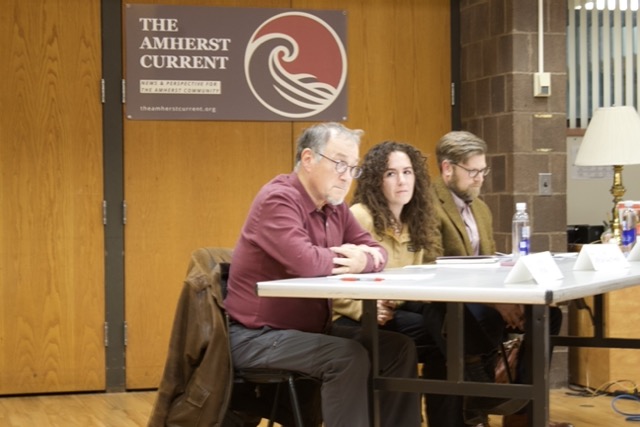
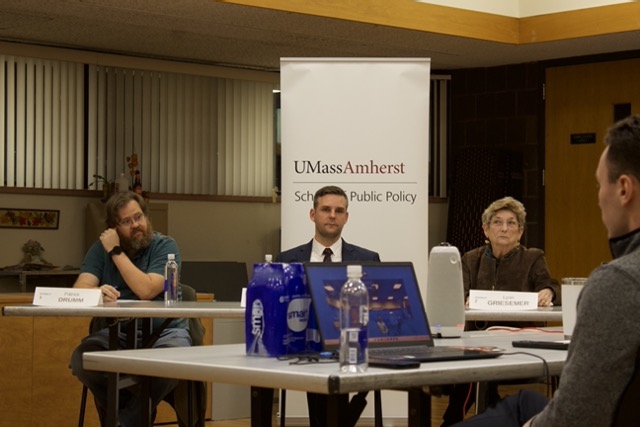
The debate was the second of two presented by the Current and the School of Public Policy, and featured candidates from Districts 2, 3, 4, and 5. A debate held on October 24 included at-large candidates and candidates in District 1. Both debates were moderated by former Massachusetts Senate President Stan Rosenberg. Voters will choose members of the Town Council and School Committee on November 4. Voters can select two Council candidates for their district and three at-large candidates.
For information about the election, go to our 2025 Election Central. Read about the first debate, among At-Large and District 1 candidates for Town Council.
The following candidates participated in Monday night’s debate:
- District 2: Jason Dorney and incumbent Lynn Griesemer
- District 3: Patrick Drumm and incumbent George Ryan
- District 4: Dillon Maxfield
- District 5: incumbent Ana Devlin Gauthier
Read on to learn more, or watch the recording below. (The debate begins at around 5:00 in the video recording.)
Griesemer and Ryan, the longest-tenured councilors at the debate, with seven and five years, respectively, touted their accomplishments–including shepherding the Jones Library expansion and elementary school construction projects and amassing cash reserves for a new DPW building–but noted the town’s ongoing challenges. Ryan suggested taking a “big picture” approach with schools and creating a five-year plan “that lets parents and teachers know that they have some kind of security.” Griesemer cautioned that the next year or two will be challenging with federal dollars eroding and the state unable to make up the shortfall–and no new construction projects on the horizon to bring in new tax revenue.
Dorney was the only candidate to bring up Amherst’s reparations efforts, stating that Amherst College, “as a direct beneficiary of enslavement,” should fully fund the reparations fund. He also advocated for imposing term limits for councilors at six years. Drumm pushed for more transparency and engagement from the Council, noting that in his neighborhood “very few people know who’s representing them” and that some still think Amherst is using the Town Meeting format.
In her opening statement, Devlin Gauthier focused on process as a means to make town government more efficient and responsive, saying, “We need to leave behind the mindset of, ‘This is how we have always done it’ in favor of, ‘What do we need now and in the future?’”
Maxfield drew applause from the gallery by advocating for more student housing in downtown Amherst and decrying the current situation where students, in his words, pay high rents only to end up “living in a living room cordoned off with a shower curtain.”
The candidates agreed that housing is a significant problem in Amherst, from a lack of accommodations for students to inflated home prices that squeeze out those with moderate or low incomes – “the missing middle,” as Ryan called it. Drumm, Maxfield, and Dorney suggested easing zoning restrictions; Devlin Gauthier recommended owner occupancy requirements and deed restrictions for those selling starter homes. Ryan suggested deed restrictions as well as interest-free loans to help those aging in place maintain their homes, and working with the Amherst Community Land Trust to preserve smaller homes and keep them more affordable. Griesemer pointed to a planned, mixed-use building on University Drive at Amity Street as one solution, as long as it can be affordable for students.
All the candidates acknowledged the dire situation of the crumbling, century-old DPW building. Griesemer recalled the project being put aside in 2008 and cautioned against making the same mistake again. “Everybody keeps looking at Amherst’s wonderful reserves. Guess what? That’s why we’ve been building them up, so we can build those buildings … We can not afford to back off it,” she said.
Dorney struck a different chord from the others when he questioned the squirreling away of cash reserves for a new DPW building while positions and programs are being cut in the schools. “It’s like we’re saving money to renovate our kitchen while our basement is flooding, and we’re not addressing the problem,” he said.
Devlin Gauthier countered that “Every room in the house is flooding,” suggesting the schools are not the only department facing budget challenges. Referring to the delays to beginning the new elementary school and DPW building projects, Devlin Gauthier characterized them as examples of how the town often lets “perfect be the enemy of the good.”
In his closing statement, Drumm described attending UMass and remaining in Amherst, then returning to town after a stint in eastern Massachusetts. He said he wants to focus on school funding and infrastructure issues.
Maxfield accused his District 4 opponents, incumbents Jennifer Taub and Pamela Rooney, who were not present, of siding with homeowners who don’t want to solve the housing crisis because they “already have theirs, and they’re fine shutting the door behind them because it doesn’t impact them.”
Griesemer listed the Council’s accomplishments during her tenure, including enhanced recreation spaces and providing seed funding for affordable housing, as well as the aforementioned capital projects, and said future priorities would include establishing a resident advisory board and providing proper funding for the CRESS community responders unit.
Dorney returned to the housing theme, stressing the need for more and diverse housing types to serve all residents. “We can’t be a town that is just for really wealthy people and college students who are getting squeezed for their last dollar by predatory landlords,” he said.
Devlin Gauthier directed her statement at voters, urging them to “look for individuals who will show up prepared, who will do the work, even when that work isn’t political, or their project of choice. Look for plans, not political platitudes.”
Ryan closed by saying he would focus on school funding and infrastructure challenges, but would also address issues affecting Amherst’s burgeoning senior community. “We need to better attend to their needs and concerns,” he said.
Discover more from THE AMHERST CURRENT
Subscribe to get the latest posts sent to your email.


For more than a decade, renters in Amherst have watched hundreds of new housing units—mostly student apartments—rise across town, adding thousands of beds to the off-campus market. Yet those projects haven’t made it easier for local renters to buy a home.
Theoretical “filtering down” of housing costs never materialized. Prices for starter homes remain out of reach, even for renters who have been here for years. Councilors Jennifer Taub and Pam Rooney aren’t protecting some imagined homeowner elite; they are pressing for an Amherst that sustains real neighborhood life—a balanced community of students, faculty, workers, families, and retirees. (And note that Jennifer and Pam enthusiastically supported the overlay district on University Drive.) They are resisting a future where the number of full-time residents keeps falling and Amherst loses its center of civic gravity.
LikeLike
Amherst has indeed seen a wave of new housing over the past decade, much of it geared toward students — but that doesn’t mean we should stop building. To the contrary, there has not been enough housing built to meet demand across all income levels.
Amherst’s rental market is driven primarily by UMass demand, and the only way to stabilize prices is to expand supply — not freeze it.
The “filtering down” process that Ira Bryck mentioned doesn’t happen overnight, but research across the country shows that when new housing—of any type—is added, it relieves pressure on the existing stock. It follows that Amherst should encourage a variety of housing options throughout the Town to meet the rigorous demands of the housing crisis.
Conventional wisdom suggests that new housing helps ease the conversion of older, more affordable homes to rental properties or from being bid up to higher purchase prices. When we impose moratoriums on new housing, we exacerbate the squeeze on long-term residents, faculty, and workers competing for the same limited number of units.
And there’s a bonus to building housing . . . Andy Churchill and Bryan Harvey have stated the increased revenue advantage of the wave of multi-housing that has been built over the last decade. This has lead to an additional $2.5M annually being poured into the Town budget, essentially bypassing the need for a Prop 2-1/2 override during the last decade. That’s the bonus of what building multi-family housing and apartments can do for Amherst!
I think we all can commend TC’s 11-1 vote to allow the overlay district on University Drive. Still, it doesn’t change the fact that restricting multi-family development elsewhere in Town hinders Amherst’s effort to achieve its affordable housing goals.
If we want Amherst to remain a diverse, sustainable community — not an enclave for those who bought decades ago — we need policies that expand housing opportunities throughout the Town, not retrench them.
LikeLike
Ira,
Filtering down only occurs at a rate of 0.5% annually for owner-occupied and 2.5% for renter-occupied, so it takes time. Source: https://www.aeaweb.org/articles?id=10.1257%2Faer.104.2.687&
Perhaps more importantly, filtering down is severely restricted in an airtight market like Amherst’s. There are virtually no opportunities to “trade up,” since so few properties are on the market, relative to the population. Empirical research shows that markets with dramatically insufficient housing stock, like Amherst, can even experience a “filtering up” in which rich families buy middle-class houses. Source: https://www.aeaweb.org/conference/2021/preliminary/paper/GebsZrYS?
Researchers find that filtering (and affordability, generally) increases when zoning restrictions are relaxed and development is encouraged. Source: https://www.nmhc.org/globalassets/research–insight/research-reports/filtering-data/nmhc-research-foundation-filtering-2020-final.pdf
To use an analogy, we’re in a housing famine, and the only sensible solution is to plant more veggies and breed more chickens. We haven’t yet satisfied Amherst’s appetite, but that doesn’t mean we should stop doing what every researcher (and liberal pols like AOC, Obama, and Ezra Klein) tells us to do. We’re in a housing crisis; let’s act like it.
LikeLike
Amherst’s housing debate has gotten tangled in well-meaning visions that don’t always fit our distinctive reality. For such a small town to host a major flagship university is both our gift and our challenge. When we talk about “building more housing,” we should pause to ask: more of what, for whom, and at what cost to the character and completeness that once made Amherst so livable?
We’ve prided ourselves on being a complete town—strong schools, steady finances, functioning infrastructure, real neighborhoods, and a civic mix that included families, older residents, professionals, and students. That balance is slipping. Our schools face enrollment and funding strains. Our roads and budgets are stretched. Our civic center tilts ever more toward transience, and political divisions—often amplified by organized blocs—make long-range thinking harder.
It’s easy to invoke the national housing shortage as a reason to build here, but Amherst’s situation is not generic. We are already 69 percent non–year-round residents. Adding more density without restoring the town’s year-round fabric risks deepening, not solving, our problems.
What’s needed now is less reflex and more reflection. Housing for young families, working people, and retirees—all essential to the town’s health—deserves creative support, but not by granting every zoning exemption or squeezing more apartments onto unsuitable parcels. A small town with a great university should model balance, not imbalance. Amherst’s strength will come from rebuilding its completeness, not abandoning it.
LikeLike
Ira,
UMass students don’t want to live in sleepy residential areas. If we permit the development of off-campus (taxable!) student housing, they will move out of our neighborhoods, freeing up housing stock for non-students.
The development of student housing yields property tax dollars, affordable housing “set-asides” and permitting fees, which we can then invest in the non-student population. Proper student housing brings in more families (teachers and other staff) to our community, filling out our school vacancies.
In the past, Amherst thrived because housing supply and demand were in equilibrium. Let’s not overcomplicate this: we are in a declared housing crisis. We need an “all of the above” development strategy:
– More affordable housing
– More market rate housing
– More senior housing
This new non-student housing should be subsidized by revenues derived from student housing. Our only alternative is letting Sunderland (116 North Flats, $600k/annually in property taxes) and UMass (Fieldstone, $3,590,000 annually in property tax exemptions) eat our lunch.
LikeLike
Consider these:
1. What ratio of full-time residents to student renters do you think makes for a balanced, thriving community—and where are we today compared to ten years ago?
2. What gives UMass Amherst the right to expand undergraduate enrollment year after year without producing a concrete, enforceable plan for housing those new students within the campus or town boundaries?
3. How have thousands of new private student beds built in the last decade measurably improved our “town-gown” relations, housing affordability, or neighborhood stability—can you cite local examples?
4. Why would a young family in search of a home town choose Amherst (facing declining K–12 enrollment, visible infrastructure decay and a town government digging the hole deeper) and outbid a well-financed student landlord for a house in Amherst?
5. What do you believe is enabling surrounding towns to build high-quality libraries and other public buildings for a fraction of what we are paying?
6. What local evidence exists—rather than economic theory alone—that market-rate student-housing projects lower rents or create “trickle-down affordability” for non-students in Amherst?
7. Given that infrastructure repairs (such as roads, water, and sewer) have lagged behind population pressures, what is your realistic assessment of the “growth pays for itself” argument?
LikeLike
Ira,
Here’s what I envision:
– Greenlight student housing to relieve pressure on family neighborhoods.
– Welcome market-rate construction that funds public services.
– Use new revenue to increase subsidies for seniors and low-income households.
Regarding your questions:
1) We cannot control UMass’s enrollment numbers; if we want to equalize the ratio, we would need to build a lot more non-student housing. If Amherst uses taxable student housing as a revenue stream, non-student residents would actually benefit from having a high student-to-non-student ratio.
2) Mass. Gen. Laws c. 59, § 5(b) outlines the idea that UMass property is exempt from local property taxes, and has no obligation to house anyone. And we shouldn’t be encouraging more Fieldstone-like tax-exempt on-campus development, we should site it just off-campus and use the revenues to increase funding for schools, etc.
3) If you think building student housing is expensive, you should see how expensive it is NOT to build housing. Do your own research. What do housing economists say about supply and demand? What do the top ten most affordable college towns have in common? Just look it up, you’ll find the answer. The properties built in the last decade by Amherst Innovative Living alone pump millions of dollars in property tax revenue into our local fisc. Does anyone actually think prices would go down if we had fewer housing units?
4) I agree that Amherst is becoming less attractive for families. That’s why we need to (1) build more just-off-campus (taxable!) student housing to draw the students out of residential neighborhoods (they don’t want to live there either!); and (2) build more affordable and market-rate housing for families. Moratoria and zoning restrictions will only make these problems worse, as corroborated by any empirical research on the topic.
5) lol you got me on that one, but I doubt it’s housing-related. That said, Sunderland increased its town budget by 6% permanently just by greenlighting 116 North Flats. Generally, the surrounding towns have fewer zoning (and other “red tape”) laws, which generally decreases the price of their construction. There’s tons of data on this effect, too.
6) Unfortunately, nobody has done a scientifically rigorous study on housing in Amherst. I wish they would, though. We can imagine, though a counterfactual. What if–poof!– 1,000 housing units in Amherst just disappeared. How could prices possibly DECREASE in that scenario?
7) Growth doesn’t always pay for itself. A family like mine (two children in Amherst’s schools) costs the town about $40,000 annually in services beyond what we pay in taxes. Conversely, each Minuteman housed in a tax-paying apartment earns the town about $1,000 annually.
So the town SPENDS money on me (non-student) but EARNS money from students (provided they reside in Amherst, off-campus).
LikeLike
I also want to add: sometimes theory is stronger than one-off results. Imagine that a mini-hurricane hits Hadley, wiping out the entire asparagus crop. According to theory, local asparagus prices should go up.
But what if Burlington, VT has a massive asparagus bumper crop? Or perhaps, the demand for asparagus suddenly plummets? In this case, asparagus prices may drop, despite the hurricane.
The supply skeptics (see: the Indy) in our community never cite to any empirical research to support their position, because there isn’t any. They don’t even try to detail a mechanism for how our community is exempt from traditional housing pressures: Are we experiencing gentrification? Is there some housing cartel behind the scenes?
The “build all of the above” is a win-win solution for everyone. Who loses?
LikeLike
Evan :
Your comments of the benefits of more student housing is a house of cards.
Years ago, the argument was made,that by increasing student housing in downtown, it would contribute to a robust downtown . That hasn’t worked .
Present empirical evidence .. OK.
Hadley’s asparagus crop couldn’t
get wiped out by a hurricane . The season for asparagus doesn’t coincide with hurricane season, plus the asparagus can’t get wiped out . It is under the ground and grows daily , and is then picked daily at 5am in the spring .
Your examples illustrate a tendency to over exaggerate the facts.
LikeLike
David,
Also, downtown housing contributes tens of millions of dollars in local spending. Amherst Innovative Living employs dozens of local residents, people who attend church, coach baseball teams, and volunteer locally. That one company pays more than $1 million in local taxes annually. The construction workers who made it are real Massachusetts humans, too, equally deserving of our dollars.
Use your eyeballs downtown: nearly half of the seats in any given restaurant are occupied by students. Literally walk downtown and mentally subtract the students. Without them, it’d be a ghost town. Please go take a look at Greenfield, which looked very similar to Amherst before our student boom.
LikeLike
I would never try to get in an asparagus argument with a Hadley native, I’d lose my lunch money every time! Regarding Dave’s comment: “Years ago, the argument was made that by increasing student housing downtown, it would contribute to a robust downtown. That hasn’t worked.”
Let’s rewind about ten years and imagine Amherst without the very developments you feel “haven’t worked.” Would the town truly be in a better place?
1) First—but not foremost—our property taxes would certainly be higher. Without these projects, Amherst would be facing a Prop 2½ override, since the new downtown developments now contribute roughly $2.5 million annually in tax revenue . . . and we don’t need to belabor the importance of increasing tax revenue in this Town!
2) Kendrick Place (2015) replaced an uninviting, weed-filled vacant lot that sat for decades at the northern gateway to downtown. Today it’s a vibrant, attractive building that enhances the streetscape while providing much needed housing.
Verdict: Amherst is better.
3) One East Pleasant (2018) replaced the aging Carriage Shops, which, though beloved by many (I still miss the Loose Goose), had become financially unsustainable and structurally deteriorated. The new mixed-use building fulfills the Master Plan’s call for high-density downtown housing. In addition to the 134 new units, it adds two great restaurants—Protocol and IYA. The only real flaw is a narrow sidewalk, which can be addressed later.
Verdict: Amherst is better.
4) Center East Commons (462 Main St., 2023) is an excellent infill project that brings new housing to a walkable location near downtown.
Verdict: Amherst is better.
5) 26 Spring Street (2023) redeveloped the former Masonic Lodge site with a modern multi-story apartment that complements the nearby existing structures (Grace Episcopal and the Lord Jeff).
Verdict: Amherst is better.
6) 11 East Pleasant (2023) replaced several long-standing businesses, including The Pub, Cousins Market, and The Mercantile. While their absence is felt, the addition of 90 new, modern housing units in the heart of town supports Amherst’s long-term goals for a vibrant, lived-in downtown.
Verdict: overall, Amherst is better.
7) Hastings Apartments (45–55 South Pleasant St., 2025) adds a 5-story mixed-use rear addition behind the historic Hastings building, where the new Amherst College Store is located. It’s a thoughtful example of infill development that blends new housing with historic character in downtown.
Verdict: Amherst is better.
In short:
These developments have not hollowed out Amherst—they’ve helped sustain it. They’ve replaced decaying or vacant properties, generated millions in tax revenue, supported local restaurants, and created hundreds of new housing units within walking distance of campus and downtown. Far from “not working,” they fulfill the mission of Amherst’s Master Plan.
As Jonathan Tucker wrote about Amherst, “the perfect remains the enemy of the good. No development, however thoughtfully and carefully planned, responsibly permitted, and competently executed, will perfectly meet the expectations of all of those who believe their interests are involved.”
LikeLike
David,
Once again, I–the one with whom all the economists agree–am asked to present empirical evidence, as though I haven’t already (in previous posts on this issue, and in the Indy comments section). I’ve cited like 20 peer-reviewed studies, as well as local data to corroborate the theory.
My opponents on this issue NEVER present any data to prove their point. Go click on a random Indy article on housing. See how they exclusively cite to each other’s articles, and never to any real economics? The other day, they accidentally posted an article from StrongTowns, thinking it supported their us-or-them theory. Once I pointed out that StrongTowns clearly favors market-based solutions, they deleted my comment and took down the article.
They have no supporting economics. They don’t dig into Amherst’s history. They don’t examine the tax revenues, or talk to local scholars.
Instead they start with a populist idea (developers + neolib town council conspire to replace non-students with students) and just repeat it ad nauseum. Anyone who questions their conclusion is subject to personal attacks:
How many students live in your neighborhood?
How are you affiliated with the developers?
Are you a Republican?
Look, I don’t know much about the biology of asparagus, but I think most people understand the analogy. When you’re in a food shortage, you grow food. When you’re in a housing shortage, you build housing. What facts have I exaggerated?
LikeLike
On this Election Day, my hope is that Amherst chooses town councilors who still believe in the usefulness of dialogue—where people actually listen before answering, and where disagreement is not seen as treason. I hope for candidates who see a level playing field as essential, not as a quaint notion; who are curious enough to ask what the unintended and long-term consequences of every “bright idea” might be.
We call ourselves a college town, but the word “balance” too often gets lost. Amherst needs leaders who can hold the scales steady—between town and gown, homeowners and renters, faculty and staff, families and students, long-timers and newcomers, the idealistic and the skeptical. It should be possible to honor progress while keeping our footing.
We also need a planning board and department that live by the bylaws we already have, instead of bending them to fit the next development proposal. We should fill boards and committees with a real range of views—people capable of collaboration rather than confirmation. And please, let’s not keep spending money we don’t have or promised not to spend. Trust in government begins with keeping your own word.
Amherst has wasted too much community talent by circling the wagons around one political action committee, convinced it alone holds the moral high ground. Meanwhile, its bias toward monetizing the endless demand for student housing grows ever clearer. We are told this is “helping the housing crisis,” when what it’s really doing is expanding student capacity while crowding out everyone else. Amherst is now roughly 69 percent students.
I wish for new blood on our Town Council—people with progressive values and a deep respect for common ground and fair process. That, more than anything, would be a sign of real progress.
LikeLike