
By Allison McDonald
The region’s four towns got a detailed look at the financial future of their schools at the Four Towns meeting on Saturday, March 14, where district leaders walked through a draft budget that tries to balance rising student needs, higher costs, and the fiscal limits of Amherst, Pelham, Leverett, and Shutesbury.
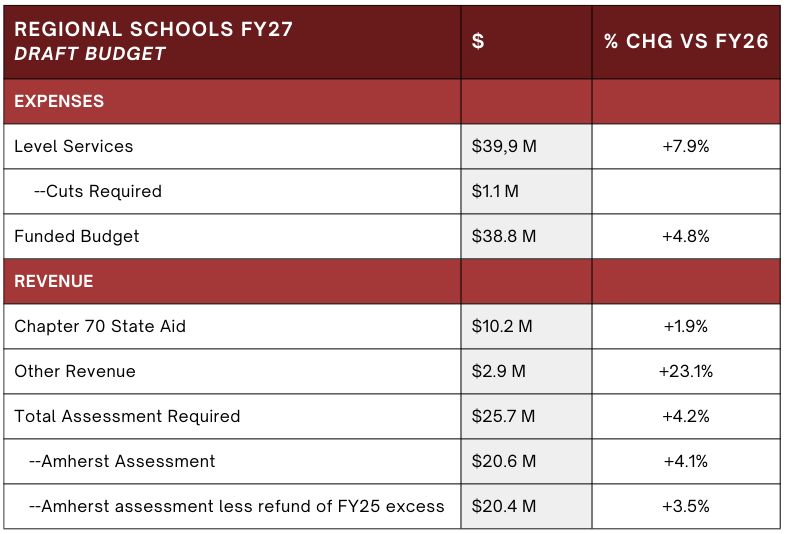
Over roughly an hour and a half, administrators framed the FY27 regional school budget presentation by first showing a “level services” plan—one that would preserve current programs and supports—and warning that they must trim about $1.1 million to make the bottom line workable for the towns. At the same time, they flagged millions of dollars in upcoming building repairs needed at the middle and high schools.
Overview of School Priorities
The budget presentation began by describing the district’s students and the services provided for them.
Tonya McIntyre, Executive Director of Student Academic Success, walked the audience through who is in the schools today and why that matters for the budget.
The regional district serves about 1,183 students across the middle and high schools. One quarter (25%) of them are special education students who require individualized programs, therapies, or specialized classroom support.
The district is also linguistically and culturally diverse. Students speak 44 different languages, and the number of multilingual learners has grown in recent years. Additionally, about 12% of students are low-income, and roughly 3% are both English learners and special education students, requiring intensive support.
At the same time, overall enrollment has declined by around 13% over the last decade. McIntyre emphasized that the problem isn’t fewer students—it’s that the students who remain often have more complex needs, academically and emotionally, than in the past.
She pointed to standardized test data (MCAS) showing persistent achievement gaps between higher-needs students and their peers. Targeted programs, such as Summit Academy, which provides alternative pathways and credit recovery for students who might not thrive in a traditional high school setting, support the differing needs of students to help address the gap.
That picture of a smaller but higher-need student body set the context for the financial discussion that followed.
FY27 Budget Presentation
The main budget presentation came from Shannon Bernacchia, the district’s finance official, who joined the meeting remotely.
Bernacchia began by showing a “level services” budget of nearly $40.0 million, which shows the cost to maintain current programs in the next year.
Operating Expenses
Several major budget lines are growing quickly:
- Salaries and Payroll: Staff costs are up due to contractual step increases and cost-of-living raises (COLAs). Within that, payroll for school administration is projected to rise by about 16.8%. Town officials asked what’s driving the significant increase in administration payroll (for principals, assistant principals, and deans), but no explanation was provided.
- Substitutes: Spending on substitutes is slated to increase by about 30%, which Bernacchia linked to higher staff absenteeism. When questioned by town officials about this, she explained that the actual spending on substitutes in recent years has been higher than what had been budgeted and that the FY27 budget reflects a three-year average of the actual spending for substitutes.
- Special Education: Costs for out-of-district tuition and special education transportation continue to climb, driven by the number of students with significant needs and the high price of specialized programs and transportation. The increases also include rising legal and compliance costs related to federal and state compliance.
- Health Insurance: Like many public employers, the district is facing large increases in health insurance premiums, though the projected 8.5% increase is substantially lower than initial estimates.
Other non-payroll costs—such as utilities, transportation contracts, and services—are also part of the upward trend, but were not discussed in great detail.
Revenue
On the revenue side, Bernacchia outlined a mix of state aid, local assessments, and reimbursements:
- Chapter 70 state education aid is expected to increase slightly for the region (+2%).
- Regional transportation reimbursement from the state is also projected to go up (+6%).
- Medicaid reimbursements are expected to remain steady.
- Revenue from interest on funds is anticipated to increase substantially (+280%).
- Increased use of Excess & Deficiency funds for budget support (+33%).
Even with those projected revenue increases, however, the district estimates it needs to cut about $1.1 million from the level services budget to reach assessment levels the four towns can support.
More Than $1M in Cuts Needed to Balance the Budget
To close the gap, district leaders described a mix of staffing shifts, moves in grant-funded positions, and targeted new positions to be able to continue providing needed support for students. Changes include:
- Shifting one teacher position at Summit Academy from the general fund budget to the Summit revolving fund, a separate account supported by program revenues.
- Sharing certain staff at the middle school between the regional district and the Amherst elementary district, spreading their costs.
- Shifting some current roles, such as counseling positions, onto grant funding, including Title I federal grants, reducing their impact on the general fund budget.
- Consolidating low‑enrollment course sections, which will effectively increase some class sizes, but within the district’s acceptable limits.
At the same time, the proposal adds a few positions, including a psychologist, a Board Certified Behavior Analyst (BCBA), and some paraeducators, in order to strengthen support for students with special needs.
Both McIntyre and Bernacchia emphasized that the district is trying to preserve classroom and direct student services first, making reductions instead in areas that will be less visible to students—though they acknowledged that no cuts are painless in a tight budget.
Big Capital Needs on the Horizon
On top of the annual operating budget, the meeting also touched on major capital projects for the regional schools. These include:
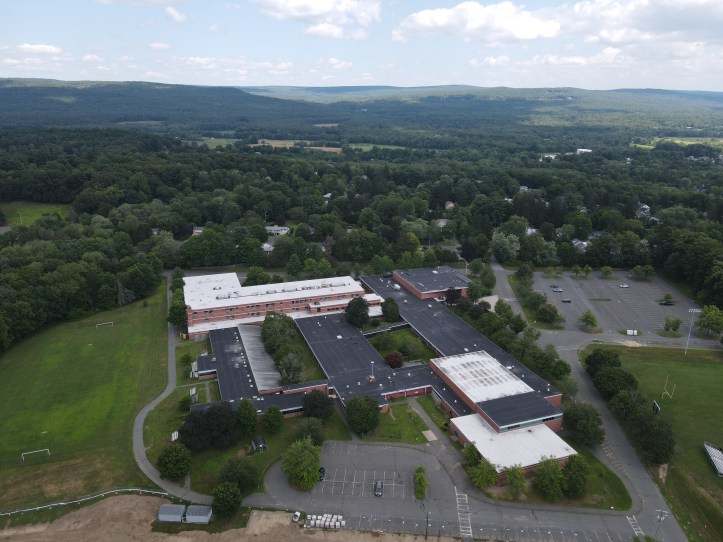
- Roughly $8 million for a new roof for the high school.
- Roughly $10 million to replace windows and doors at the high school.
- Additional maintenance and modernization work at the middle school.
The district hopes to tap the Massachusetts School Building Authority (MSBA) and other outside funding sources to cover part of these costs. Even with grants, however, the projects represent significant obligations for the member towns and will likely be the subject of many future meetings.
Next Steps
The Regional school committee is expected to vote on a final FY27 budget at its next meeting, on Tuesday, March 24. Once adopted by the Regional SC, the budget and assessments must be approved by three of the four member towns.
An artificial-intelligence tool assisted in the making of this article by summarizing a recording of the meeting which was reviewed and adapted by the writer.
Discover more from THE AMHERST CURRENT
Subscribe to get the latest posts sent to your email.
 THE AMHERST CURRENT