
Valley Chronicles By Freke Ette
Amherst Cinema’s film series, Best Picture ‘76, has completed its run. It exceeded my expectations. Every Sunday and Tuesday in March, five bona fide American classic films, all different in scope and ambition, screened to fans and the merely curious alike. Audiences of all ages turned up, filled the seats and stayed around for conversations afterwards.
Far more than required viewing for aspiring cinephiles, the films felt fresh and redolent, losing little of their charms. And while some concerns were passe and other themes seemed prescient, they all gave me much to reflect on.
Jaws
When a mangled corpse, the probable victim of a shark attack, washes ashore Amity’s coast, local officials must decide whether to close the beach or keep it open, in hope the dismembered cadaver is a one-off, unfortunate accident.
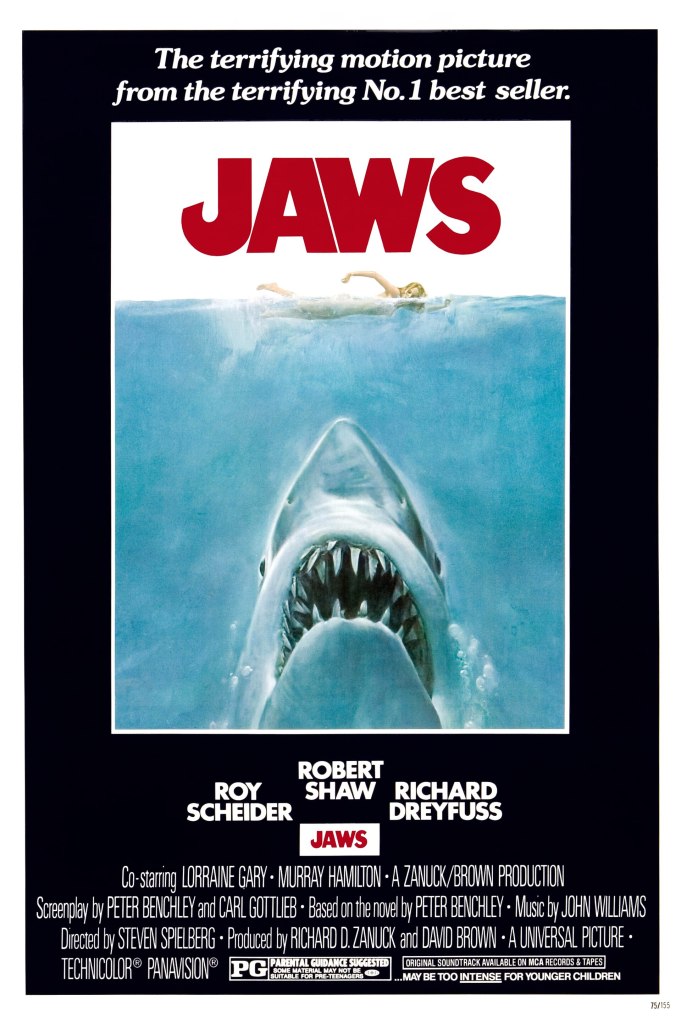
Because Amity is a tiny New England beach town that depends on the summer swim season for a significant portion of its annual revenue, the choice isn’t an easy one.
Apologies to my neighbor on the left, who I kicked a couple of times. The scares were still effective, especially in the first half. Verna Field’s expert editing evoked dread, amplified by John Williams’ famous throbbing score.
Jaws raised political questions that defied simple answers and offered villains too subtle to hate.
Police Chief Martin Brody (Roy Scheider) unilaterally closed off the beach before being overturned by Amity’s mayor. At first glance the mayor appears to be the bad guy. Flanked by business leaders, spineless and two-faced, he willingly puts swimmers in danger. For what exactly?
Yet when one considers that the chief doesn’t like open waters and is a recent transplant from New York, our initial moral certitude gets muddied. Perhaps, both men could have arrived at a workable solution that balanced the town’s interests, if only they communicated better.
The second half bears the real weight of the film. As leaders drag their feet, shark hunter Quint (Robert Shaw), Chief Brody and marine biologist Matt Hooper (Richard Dreyfuss) team up to hunt the creature and end its reign of terror.
When the renegade team packs their equipment and heads out to sea, they must overcome their insecurities, mutual suspicion and competing egos.
The three men represent three types of authority, and corresponding responsibilities. Chief Brody’s public authority relies on speech, leading by command. Hooper, as an oceanographer, exhibits scientific expertise honed from years of research. Meanwhile, Quint represents the working class, the community who relies on their hands to survive.
And that’s how the film introduces Quint. His hands, screeching fingernails on a blackboard during a press conference, interrupted the gathering (and crept me out.)
As their boat floated aimlessly in the Atlantic, their confrontations centered on whether the masses are ignorant or salt-of-the-earth, whether scientists are prospective tyrants thumbing their noses at the less schooled or unrelenting, unbiased defenders searching for truth, and whether public officials have any useful skills.
The filmmakers placed a finger on the scale. Quint screams as he gets chomped down by the shark, while the audience quivered with guilty pleasure. Obviously, hands aren’t enough to protect Amity.
Chief Brody blows up the shark, though he requires Quint’s gun and Hooper’s pressurized gas tank. I see it as a tacit approval of politics—the art of getting things done for the community. The shark may not listen to reason, but a head and hands stirred by public responsibility and love of family surely will finish the job.
Nashville
I consider it an understatement to describe Nashville as a great film. I encountered the world in a new way once the lights came on.
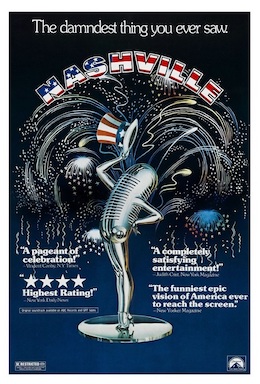
The film depicts encounters with several characters—locals and vagabonds, artists and boors, phantoms and mimes—over the course of a week in Nashville.
For a film with a running time over two hours, the plot was malnourished. Session musicians repeating takes in the recording studio, performers drowned out by roaring engines at the Nashville Fairgrounds Speedway, congregations gathered for Sunday morning service, then hitting the club at night. Its scenes were reaction sites, relying on confrontations engineered to reveal the essence of superfluous characters.
Moreover, individuals displayed no psychological depth, thrown together by the screenwriter’s whim. And yet I sensed a realistic portrayal of how little we dwell on our daily lives. Just like us, the characters acted without thinking.
In an early scene, a car wreck leads to a standstill on the highway. People curse; others brawl; some choose to drive toward incoming traffic. The sequence on its own would be impressive as a brilliant comedic set piece. Yet it takes a step further by highlighting how civility melts under the unanticipated heat of inconvenience.
Consider how you feel when running late for an appointment? Is your anxiety proportional to your endeavor? Or do you find, after the fact, that you momentarily lost your reason.
Director Robert Altman gestures at realism, not by employing documentary techniques, but through dexterous sound mixing and editing. Certain scenes had so many people speaking simultaneously, it sounded like the Babel Tower lobby.
In the hands of a lesser craftsman, the auditory overload would have resulted in a crash, like unbalanced Jenga bricks unable to support the polyphonic oversaturation.
Instead, I experienced a masterpiece of sensory manipulation, a fugue with a Mid-southern twang.
Like the characters, if we paid any attention to the world, we’d notice that even our quietest moments only feel that way because we’ve chosen to live without awareness.
Nashville reaches its climax when a beloved stage performer is shot on stage by a gunman. Mayhem ensues. A runaway housewife (Barbara Harris) gets thrust into the spotlight, where she rises to the occasion with an energetic rendition of, “It Don’t Worry Me.”
I caught some audience members quietly singing along with the backup gospel choir. It sent shivers down my spine.
Altman cares more about people than stories. Despite the infinite characters and absurd scenarios, Nashville is a deeply human film, pulsating with life and even a pinch of cynicism—a politician who rants on all that’s wrong about American politics, then fails to even make an appearance.
When the film ends with the gentle camera upward tilt from the pandemonium on stage, settling on the blue sky overhead, I was reassured that regardless of what we face, every day is a beautiful day.
One Flew Over the Cuckoo’s Nest
Randle McMurphy (Jack Nicholson) is committed to a hospital for psychiatric tests. He might be faking insanity to escape the draft or even more onerous punishment. Will his tests determine his fitness to return to “normal” society, or will his presence turn the hospital upside down?
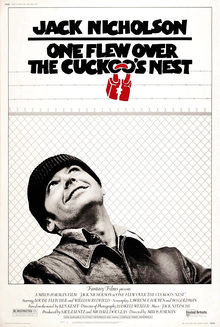
The bulk of the film is a battle of wills between McMurphy and Nurse Ratched (Louise Fletcher in a deliciously sinister performance.) Nurse Ratched considers the patients under her care too weak to make their own decisions.
As sheep need a shepherd, inmates need an overlord to instruct, and even manipulate, their desires. In other words, the psych ward becomes the state and Nurse Ratched, its benevolent dictator.
Consequently, McMurphy’s introduction upsets her meticulously curated universe. Here comes an agent of chaos threatening the stability of the polity.
No tyrant wants that.
McMurphy’s resistance, his willingness to question the rules and undermine her authority, triggers a backlash. Not before, a patient dies, however.
Revolutionary fires must be quenched through a final solution, so McMurphy is turned into a vegetable by lobotomy. Nevertheless, his sacrifice isn’t in vain. In the closing scene, stoic Native American inmate Chief (Will Sampson) escapes confinement and runs into the fields and possible freedom in Canada.
The audience erupted in applause. I couldn’t figure out if it was because they thought the film was so good or because, like the patients, we had finally regained our freedom.
Director Milos Forman chose restraint in his editing and sound mixing. I was surprised at how quiet the film was, as one would have expected bedlam in a psych ward.
But, no. Forman deliberately showed the stillness was artificially created by the authorities: through prescription medications, enforced curfews and classical music maliciously piped through the record player.
The film succeeds on the strength of the ensemble cast, who navigate a full range of emotions and facial expressions.
And Jack Nicholson. What a face! Creepy, stern, kooky, conspiratory, features contorted as if made from clay dough. Not to be outdone, Nurse Ratched’s was a great foil, her steel visage, stern, impassive, sometimes disappointed, though never annoyed.
Nevertheless, despite the compelling drama, the riveting acting and the exquisitely composed atmosphere, I was unmoved.
The fault lies with me. I have never understood resistance for its own sake.
America loves its outlaws and renegades, but deconstructing authority isn’t liberation. In truth, McMurphy hated authority more than he loved freedom—his gestures didn’t lead to a new world, the status quo was reestablished with vengeful violence and outside of the film’s fantasy ending, Chief would have been recaptured and tried for murder.
Counterculture’s progeny is yet another culture. If McMurphy had lived long enough, he would have traded his A2 jacket and faded Levi’s pants for a Brioni suit, becoming a master of the universe on Wall Street.
These films are no longer playing at Amherst Cinema, but they are available on DVD in the Amherst libraries. Or, visit JustWatch.com to find out where to stream them.
Discover more from THE AMHERST CURRENT
Subscribe to get the latest posts sent to your email.
 THE AMHERST CURRENT