
How the Closing of Hampshire College Could be the First Move in a Transformational Cascade of Regional Improvement.
Opinion By Dominic Endicott
The sad closing of Hampshire College is symptomatic of massive change in higher education, and more broadly across American society. Rather than following the fate of other closed campuses into either oblivion or overly commercial development, I would like to make the case that there is a path to reconceive of the Hampshire legacy as one of transformation, for the college and campus, for Amherst, for the Pioneer Valley, and perhaps resulting in impact far beyond this region. My thesis is laid out below.
America is rushing into an uncertain future. Anthropic is the fastest growing company in the history of capitalism. Our economy is rapidly reorganizing around data centers, artificial intelligence, and energy. The nature of work is changing faster than during the Industrial Revolution, with 50% or more jobs likely to be fundamentally redefined. The stresses and divides that have characterized the past several decades will only accelerate. The old economy of 2020 is rapidly evolving into the network economy of the 2030s, operating in increasingly unfamiliar ways. We cannot stop this change. We need to adapt to it.
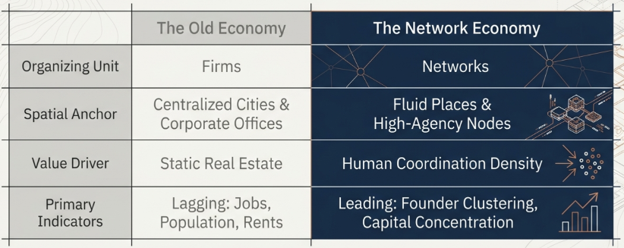
Higher education has anticipated prior societal waves, from the founding of Harvard College in 1636, to the land-grant universities in the late 19th century, to the Endless Frontier of Vannevar Bush after 1945.
Hampshire College, founded in 1958 as an ambitious attempt to reinvent the liberal arts from first principles, was prescient. Hampshire’s leadership in areas such as self-directed education, interdisciplinary learning, faculty mentorship, experiential and lifelong learning, all anticipated key educational trends.
The Agentic Era, in which humans will be co-existing with AI, AI-agents, robots and new intelligences, will require a fundamental reinvention of the American university, a task for which few institutions are well positioned. The pressures that have resulted in the closure of Hampshire College will affect every other institution, with many likely to fail or retrench.
Paradoxically, then, Hampshire College’s legacy could be to again blaze a trail for others to follow. The new role of the American university will be to become the cognitive infrastructure for transformation. That is, the vehicle to support the region’s economy to adapt to the emerging new reality. The Pioneer Valley, the state of Massachusetts, New England and the United States will need to adapt. Could Hampshire be the place where this adaptation is pioneered?
At least four new tasks or constructs are thus emerging for higher ed institutions:
- Applied Studios
- Frontier Regional Institutes
- Commercialization Accelerators
- Knowledge Towns.
Hampshire College’s legacy could be to innovate across all four, with initial focus on the Amherst and Pioneer Valley region.
Applied Studios are 6–8-week sprints to support rapid adaptation of companies and workers to high growth markets in fields such as biomanufacturing, energy, advanced manufacturing, services, and financial engineering.
Frontier Regional Institutes are purpose-based entities designed to rapidly scale the region’s capacity in high-potential markets and missions, for example in regenerative agriculture, advanced and automated manufacturing, grid resilience, cognitive systems, longevity and placemaking.
Commercialization Accelerators are platforms to position the Pioneer Valley to compete at a global level.
Knowledge Towns become the place-based foundations to support talent attraction and a critical mass of epistemic density to drive innovation and commercialization.
This all sounds highly visionary, and it is. It runs against pragmatic challenges such as: how can we respond to the $20 million debt of Hampshire College (and more broadly the operating costs of maintaining and running the infrastructure of what has been a loss-making institution)? Capital could probably be raised to help cover the debt and operating expense, but only with a viable business plan.
The cost of running Hampshire College was around $35m-$40m a year, while net revenue was around $20m. With enrollment of 750 students, the annual cost per student per year was around $45K, and the revenue around $27K, implying a loss of $18K/year/student. This kind of loss is typical of the economics of many small New England colleges.
An obvious, even though difficult, solution to this loss-making reality is to run the college very differently, closer to an executive MBA. Assuming Hampshire can currently serve about 1,000 students on any given day, and we try to fill it every day of the year, entails a cost of $110/day including room & board, less than the price of a hotel night. How can we deliver a compelling and even transformational experience for 1,000 clients each day, for 365 days a year? Could this approach maintain the ethos of Hampshire College?
The truly experiential in-person component of a college education is about 800-1000 hours per person in a regular academic year. Excluding 8 hours of sleep, there are 5,840 hours a year available. This means that the truly transformative hours represent less than 25% of the available capacity. When students are on-line (on smartphone, laptop, watching TV) or on long vacation or on weekends when students are away, the campus generates very little value for that student, and continues to cost $110/day per student.
By focusing the time on campus on activities that can be done in-person, we could run 4 times more students per year (4,000 vs. current capacity of 1,000), at a cost per student of around $10K. This means that our break-even price could also be around $10K, which is much more affordable than today’s net price of $26K.
The Applied Studio becomes a testbed of this model, as a means of rapidly leveraging the existing capacity of the school, while pointing the way towards the other programs. A studio, a term inherited from the discipline of architecture, is a means of personal transformation, in pursuit of a key societal objective, as illustrated below.
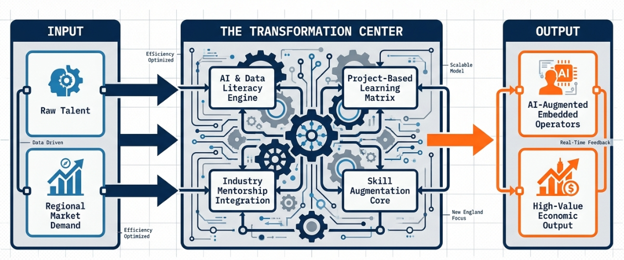
Clients of studios could be current students in the 5-College system, local workers, company executives, remote workers and students, and many others. Some of the Hampshire staff could be retained, but it is likely the delivery would come from people with strong transformational skills, AI proficiency, and deep vertical expertise. The Pioneer Valley is certain to be brimming with such talent, if we know where to look.
This paper does not propose a specific and bankable solution. But it does point to a path to begin a conversation. The current crisis in Hampshire College is an opportunity to explore a new role for what was a highly visionary and collaborative endeavor.
Dominic Endicott is a venture capitalist, management consultant, civic capitalist, and advisor to Higher ed. He is the co-author, with Professor David Staley, of Knowledge Towns: Colleges and Universities at Talent Magnets (published by Johns Hopkins University Press in Hardback in 2023)
Discover more from THE AMHERST CURRENT
Subscribe to get the latest posts sent to your email.


Hampshire was founded in 1965 not 1958!
https://www.hampshire.edu/hampshire-experience/mission-and-vision/history
LikeLike
This piece is embarrassing. The very premise of it, that we can’t stop AI, is false. If it comes to pass that AI couldn’t be stopped, it’s because tech CEOs, their minions, and others brainwashed by technology had too much influence. AI will ruin everything we cherish and what makes us human and make most people dumber. It should be stopped.
LikeLike