
Opinion By Evan Naismith

A few weeks ago, UMass Amherst quietly announced its plan to revitalize its on-campus dormitories. It won’t be building them itself. Instead, UMass contracted with American Campus Communities (ACC), a wholly-owned subsidiary of Blackstone, a private equity firm with $1.2 trillion under advisement. Some of Blackstone’s other investments include shale oil fields, casinos, and data centers.
UMass’s announcement received no local attention whatsoever, but the Boston Globe recognized its importance. The Globe noted that these public-private partnerships (“P3s”) are becoming increasingly common, largely because many state universities are too cash-strapped to finance their own dormitory construction. It also reported that UMass is promising not to lose any beds on campus, but they are not promising new ones. ACC declined to comment.
Details about the new dorms are still sparse. In fact, there’s an outside chance the ACC partnership will affect only campuses east of Amherst. But it’s almost certain they’re setting up shop locally. Here’s what’s for certain, though: because ACC’s development is on campus, they’re exempt from municipal bylaws. They don’t have to heed our design or environmental standards. We get no say in siting, and we will foot the bill for any traffic improvements. Off-campus developers must pay Amherst an up-front exaction fee equal to 10-12% of a building’s value. ACC won’t pay this. Worst of all, these for-profit dorms won’t contribute a dime to our property tax roll.
I don’t want to bury the lede: ACC chose Amherst as its next host because our town refuses to permit off-campus student housing at scale. Because of the scarcity, ACC can charge exorbitant rents, and they admit this. When an interviewer asked ACC’s chief marketing officer what the firm looks for in a host community, he replied, “markets with barriers to entry.” Did you hear that? They prefer “tough on developer” municipalities because burdensome regulations block competition, making it easy for ACC to price-gouge students. Boy, are they going to love Amherst.
Fieldstone: We Should Have Learned Our Lesson
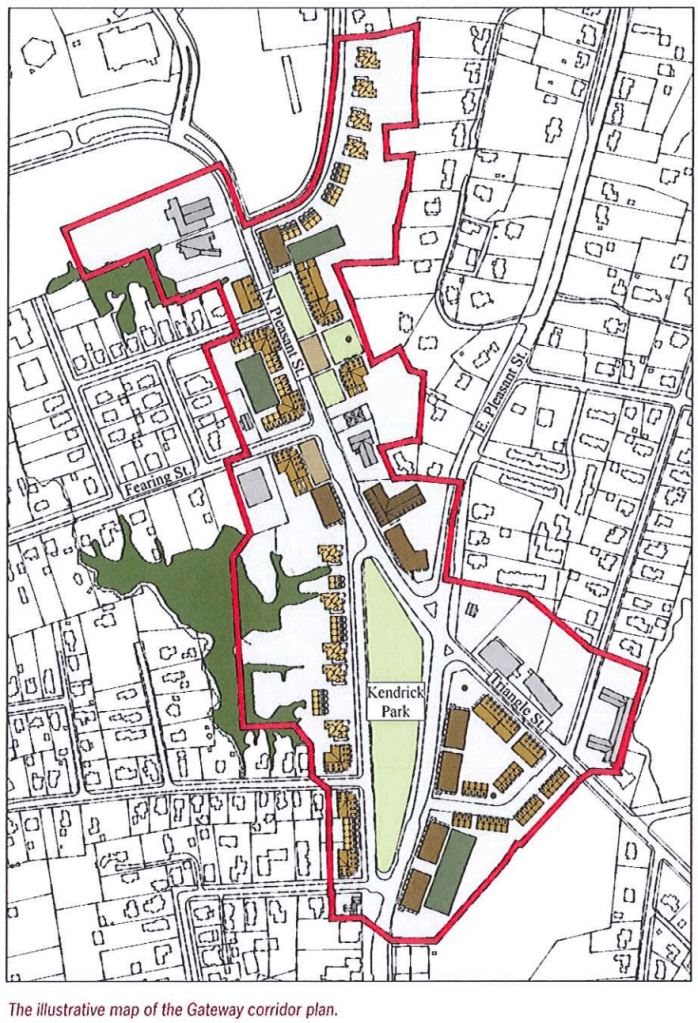
It’s tempting to say “we can’t help what UMass does on campus,” but that’s simply not true. The Town Council should seek authentic cooperation and dialogue with UMass, like we used to do. Take a few minutes to look at the 2011 pamphlet detailing the Gateway Corridor Project, a comprehensive “town-gown” project intended to redevelop the Kendrick Park area. Honestly, it’s worth your time. Then-Town Manager John Musante worked shoulder to shoulder with UMass officials to find win-win solutions. The whole community got involved.
As part of the project, the town paid for a group of Amherst residents to travel to UConn and UNH and talk with planning directors about community-oriented student housing solutions. When the residents returned, they pitched a plan: replace some of the dilapidated student rentals around Kendrick Park with larger mixed-use student apartments. They concluded the apartments would improve the tax base, minimize noise complaints, and aid code compliance—a true win-win.
As a sign of good faith, UMass offered Amherst a multi-acre plot of land near Fearing Street on one condition: it had to be used for taxable student housing. The asking price? One dollar. When Amherst countered, “How about we use it for a park instead?” UMass rescinded the offer.
Some residents then began layering on new demands to the project: no mixed use, no undergrads, and so on. One resident pushed back: “I am a bit confused, wouldn’t it be sensible for the students to live here as opposed to breaking into new neighborhoods?” A prescient thought, but it was too late. UMass concluded that collaboration with the town was impossible, and shortly thereafter announced the $200 million Fieldstone project. It was located just a few blocks from that $1 plot.
Had Fieldstone been built off campus, its developers would have paid Amherst $20 million in upfront exaction fees and $3.9 million in annual property taxes. Sadly, ACC’s Amherst debut is merely history repeating itself.
The Negative Effect on Amherst
While I admit that ACC uses surprisingly green construction, its legal track record is spotty. ACC has been repeatedly sued for deceptive practices, forcing a Missouri judge to mandate new language in its advertisements. ACC paid a $5 million settlement for allegedly negligent balcony maintenance that led to an undergraduate’s death. Students have cited unsafe living conditions and black mold issues in ACC’s dorms.
Students will probably pay more for housing, too. Current dorm pricing at UMass starts at $9,000 per person per academic year for a shared standard room. For comparison, ACC’s newest on-campus property, at Purdue, charges from $10,500 to $17,368 per person per academic year.
Those expensive on-campus apartments will push more LLCs to convert family homes into student rentals. Thousands of students currently live in the inexpensive Southwest dorms. Once UMass decommissions those cheap dorms to make way for ACC’s market-rate apartments, the lower-income students will be pushed off campus. And what is their only feasible off-campus option? Renting a house in a residential neighborhood with a bunch of friends. Not good for Amherst.
What Can We Do?
The prospect of a private equity firm becoming the town’s largest landlord is reprehensible. Amherst should fight ACC and its ilk with an all-of-the-above strategy. Ira Bryck has argued that the town should challenge Fieldstone’s “educational” tax-exempt status. It’s a long shot, but I agree, if only to send a message. One municipality recently did just that to ACC, and a judge forced it to pay $6 million in back taxes and tens of millions in prospective taxes.
More importantly, the Town Council needs to proactively pursue an evidence-based housing policy, the way our peers have. Newark, Delaware, home to the University of Delaware, is slightly smaller than Amherst. Despite its diminutive size, it has permitted thousands of bedrooms of off-campus market-rate student housing over the last decade. The result: millions of dollars in property tax revenue, which Newark spends on senior services, infrastructure, and public schools. Additionally, Newark has far fewer LLC conversions of family homes, and no push for rent stabilization because nobody needs it. Monthly rents there run $350 to $600 cheaper than Amherst’s. ACC has not developed student housing in Newark, because Newark’s housing market is healthy. Ours isn’t.
We built this crisis ourselves, one rejected zoning change and one citizen lawsuit at a time. Every off-campus bedroom we refuse to permit lands eventually on a UMass balance sheet, and now on Blackstone’s. Giving tax breaks to private equity firms is clearly destructive to Amherst’s future. We need to learn from our mistakes and fix the broken housing policies handed down to us from previous generations.
Evan Naismith is a five-year resident of Amherst and a graduate from the Commonwealth Honors College at UMass Amherst. He is the VP of the American Constitution Society at UConn Law School, where he specializes in public interest law.
Discover more from THE AMHERST CURRENT
Subscribe to get the latest posts sent to your email.


Thank you for this well-reasoned argument. I’m a downtown homeowner and would love to see more off campus housing built to provide more tax revenue for our public services. Is anyone on Town Council paying attention?
LikeLike
I think there’s reason for hope.
During the recent Zoom session discussing the future of the Hampshire College property, the Town Council expressed unanimous support for rezoning to allow a diverse mix of housing types, possibly including purpose-built student housing. By the end of the presentation, only 6% of citizen-attendees indicated skepticism about such a rezoning, down from the pre-meeting poll of 8%. This interaction tells me three things: (1) the TC increasingly understands the magnitude of our housing crisis; (2) TC members are finding their voices and are capable of changing the minds of constituents; and (3) the anti-development sentiment in our town is held by a small number of residents who do not speak for the rest of us.
I think most folks who run for TC don’t realize that a big part of the job is raising money, and that there are very few methods of raising revenue. Student housing is–by far–the easiest way of creating new dollars for teachers, infrastructure, and fire stations. The Town Council knows that are only two reliable ways to create revenue: build off-campus student housing or pass Prop 2 1/2 overrides. The first option is economically progressive because it lowers rents for all residents. The second option is regressive because it increases rents (via pass-through) for all residents. For any responsible legislator, the choice is crystal clear.
Finally, we’re seeing the NIMBY voices in town temper their rhetoric. Check out this quote from the comments discussing a housing proposal from 2024: “Students are not a ‘suspect classification’ under the Equal Protection Clause. If there’s a rational basis for the discrimination, it can stand.” (source #1). This is a former town councilor openly advocating for using Amherst’s bylaws to discriminate (her words, not mine!) against students.
Here in 2026, this crowd is much more cautious with their language because people are finally assigning such statements the moral approbation they deserve. Continue to speak out, Amherst. Call the TC and tell them that students are entitled to the same dignity and rights as year-round residents. Indeed, students are counted as full-blown Amherst citizens by the US Census, state CBDG/roads formulae, and our own municipal districting maps. It’s time we treated them like equals.
Source #1: https://www.amherstindy.org/2024/12/06/what-is-a-student-home-planning-board-adds-definition-to-adu-bylaw/
LikeLiked by 1 person