
Developing a budget for the Amherst-Pelham Regional school district is a complicated process that requires consideration of the financial input from the four member towns in addition to the fiscal needs of the schools. Below, we break down some of the core elements of regional school budgets.
For a more comprehensive overview, the school district has a basic school budgeting FAQ that describes the overall budget process and highlights some specifics related to regional school districts in Massachusetts.
What’s an assessment method?
The assessment method is the approach that’s used to define how much money each of the four towns in the region contribute to the annual operating budget.
The annual budget defines a total dollar amount — the total assessment — that then is allocated to each town using a formula, or assessment method.
There are 2 types of assessment methods.
- Statutory method – the default assessment method defined by the state. Requires annual approval by 3 of the 4 towns (via Town Meeting or Town Council vote).
- Alternate method – the assessment method defined in the regional district agreement. Sometimes called the “regional agreement method.” Requires annual approval by all 4 towns.
How does the statutory method work?
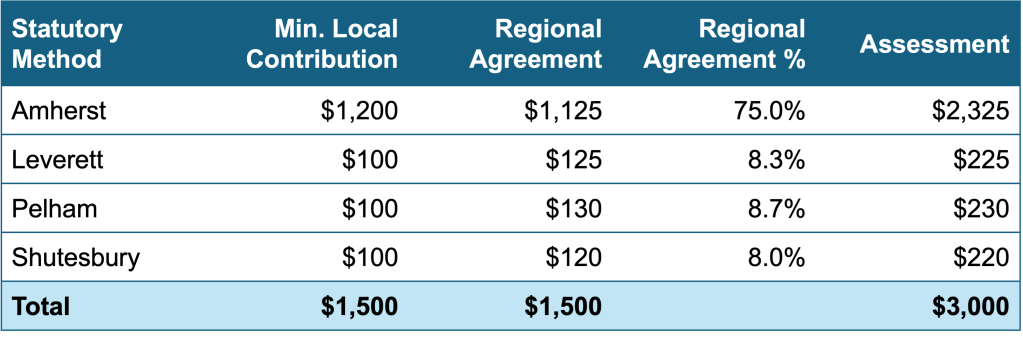
- Starts with the “minimum local contribution:” the amount of money that the state requires each town to contribute to the regional school district.
- The minimum local contribution is based on the town’s income, property values, district enrollment, and other variables related to the town’s wealth.
- The difference between the total assessment and the sum of the four towns’ minimum contributions is allocated to each town using the formula defined in the regional agreement.
Let’s say the total assessment is $3,000 and the minimum contribution for the four towns totals $1,500. The remaining $1,500 of the total assessment is then allocated to each member town according to the regional agreement.
How does the alternate method work?
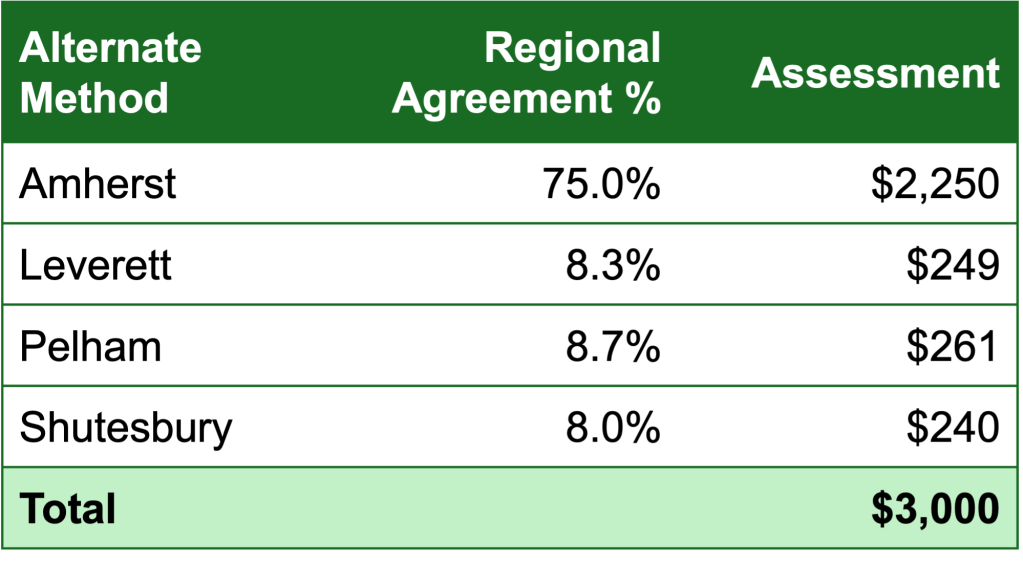
- 100% of the total assessment is allocated using the formula defined in the regional agreement.
- The ARPS regional agreement allocates costs to each town based on a five-year rolling average of enrollment.
So, using the same $3,000 total assessment in the example above, here’s what each town would be assessed using this method.
What method has ARPS used?
- ARPS has used some form of the alternate method since 2004
- In FY19, the 4 towns agreed to phase back to the statutory method over the next 5 years
- In FY23, the district amended the regional agreement method to restrict the year-over-year increases in each town’s assessment to between -4% and +4%.
For the FY26 budget, the Regional school committee approved an alternate method and voted to amend the regional agreement so that the increase vs. FY25 for each town is equal to 6.5%. This assessment method was rejected by the Amherst Town Council on March 24, 2025 and the school committee will need to determine a new budget and assessment method.
Even More About Assessment Methods
State Guidance for Regional Districts
Presentation by MA Association of School Business Officers
 THE AMHERST CURRENT