
By Evan Naismith
This week, Amherst’s Town Council referred zoning Articles 18 and 19 to the Planning Board. If passed, these articles would cause immense damage to both housing affordability and the town’s property tax base.
What the Articles Propose
Article 18 would impose a one-year moratorium (with a possible 90-day extension) on the construction of any residential building with four or more units in the Business General (BG) and Business Limited (BL) zoning districts, or until the Council adopts new downtown design standards. It also urges that UMass build 5,000 new on-campus housing units.
Article 19 defines “student home” and mandates:
- 700 to 2,000 ft minimum distance between student houses;
- Consideration of rent stabilization; and
- Limiting student rentals in 1- and 2-family homes to arterial streets (with existing rentals grandfathered for 10 years).
While they might seem wise at first blush, both articles are legally unsound, economically harmful, and morally suspect.
Moratoria Drive Up Housing Prices

Moratoria on building are legally dubious and almost always regressive. By creating artificial scarcity, they disproportionately harm the BIPOC communities, who are twice as likely to be renters. Restrictions on new construction benefit existing landlords, who can increase prices due to artificially low competition.
Ezra Klein’s and Derek Thompson’s new book Abundance addressed the issue of restrictive housing policies head-on:
“The foundational premise of Abundance is the assertion that there is a widespread ideology of scarcity … liberals have focused too much on subsidizing demand … without ensuring that the supply of these essential goods grows to meet the rising need.”
Liberal academia is in consensus that restrictions on housing construction drive prices to unaffordable levels. This academic paper shows that private for-profit development of student housing in college towns eases pressure on the existing housing stock, enabling year-round locals to afford to live in peace.
This study shows that the construction of “expensive” and market-rate housing reduces the cost of nearby working-class and low-income housing units. So does this one.
This one shows that new market-rate housing tends to increase the probability that low-income renters will move into neighborhoods (i.e., more options) and lowers the probability they’ll move out in certain weaker housing markets.
This study from Massachusetts shows that zoning throughout the last century was often explicitly or implicitly used to hinder housing growth and to prevent lower-income residents and people of color from moving into many towns. Note that all of these studies were done by liberal academics (including the National Low Income Housing Association).
Our own town council and planning board agree with these studies. The language of Article 18 is copy-and-pasted from a proposed 180-day moratorium from 2021. Thankfully, that one was voted down. The Amherst town council concluded that “a moratorium, no matter how well intentioned, would do more harm than good.”
This Specific Moratorium is Likely Illegal
To comply with state and federal law, any moratorium must be rationally and substantially related to public health, safety, or welfare. In other words, the town would have to present studies (or similar evidence) demonstrating that the sidewalks were too narrow to accommodate the increased foot traffic.
Yet, the author of the articles went on record stating that the purpose of Article 18 is to “favor maintenance of family neighborhoods and disincentivize LLC real estate investor ownership of houses intended for student rental.” Shifting ownership to one preferred group (families) is not a legally cognizable reason for zoning restrictions, it’s economic favoritism. As such, this article is likely illegal. The town would be liable for any financial damages to downtown property owners.
Let’s put a pin in the UMass component of Article 18 for now, I want to save the most important for last.
Article 19 is Almost Certainly Illegal
As a reminder, Article 19 seeks to:
- Establish a minimum distance between student houses;
- Give consideration of rent stabilization; and
- Limit student rentals to arterial (main) streets in all zoning districts.
Consideration #2 is patently illegal in Massachusetts, so every tax dollar spent considering it is wasted.
How would we possibly administer consideration #1? Imagine that two Amherst families were renting homes to students within 1000 feet of each other. How do we decide which family has to cease their rental? Flip a coin?
Even if we found a sensible way of implementing #1 and #3, it is still illegal “ultra vires” zoning. While it is legal for municipalities to regulate how a property is used (residential, etc.), it is illegal to regulate who uses a property. The City of Worcester thought it could subvert this principle by classifying student housing as “boarding houses,” but was struck down by the Supreme Judicial Court (College Hill Properties v. Worcester (2019)). Article 19 is morally dubious, as well, as it relegates students to a lower caste of property ownership. Thankfully, “Our Constitution…neither knows nor tolerates classes among citizens” (Justice Harlan, dissenting in Plessy).
Encouraging On-Campus Housing is Financial Suicide for Amherst
Article 18 urges UMass to construct 5,000 more units on campus. This is by far the most irresponsible component of either article. If UMass complied, our property tax base would be crippled for generations.
To illustrate this point, let’s examine two recently built student apartment buildings. This is Fieldstone and this is Olympia Place. They were both built by large, for-profit developers. They both have the same environmental and traffic impacts on the Amherst community. They’re alike in almost every way, except that Fieldstone is built about 300 feet inside the UMass perimeter, and Olympia Drive is built about 500 feet outside the UMass perimeter.
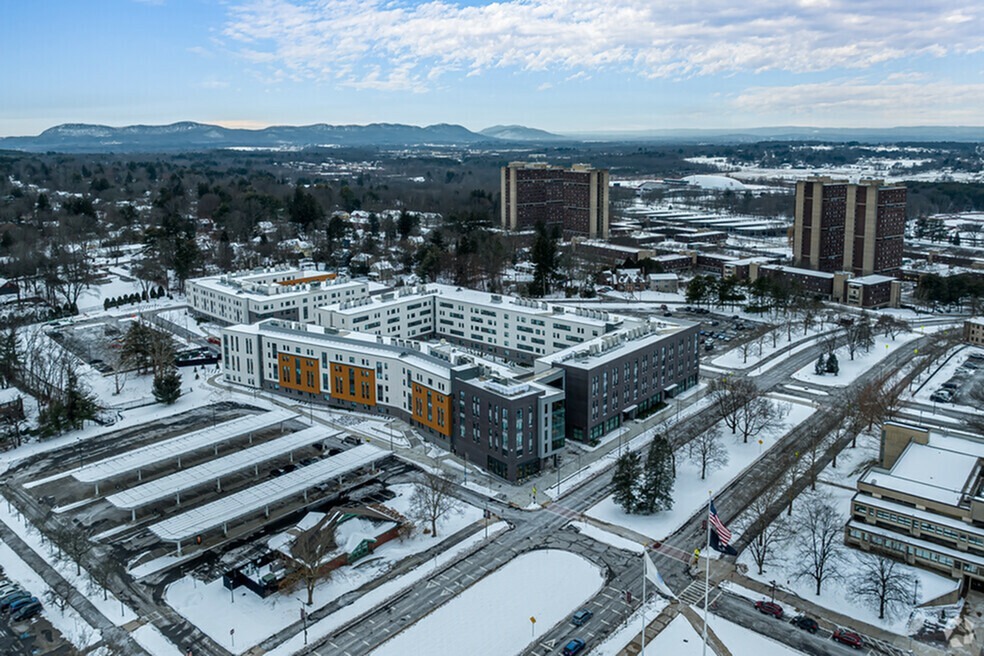
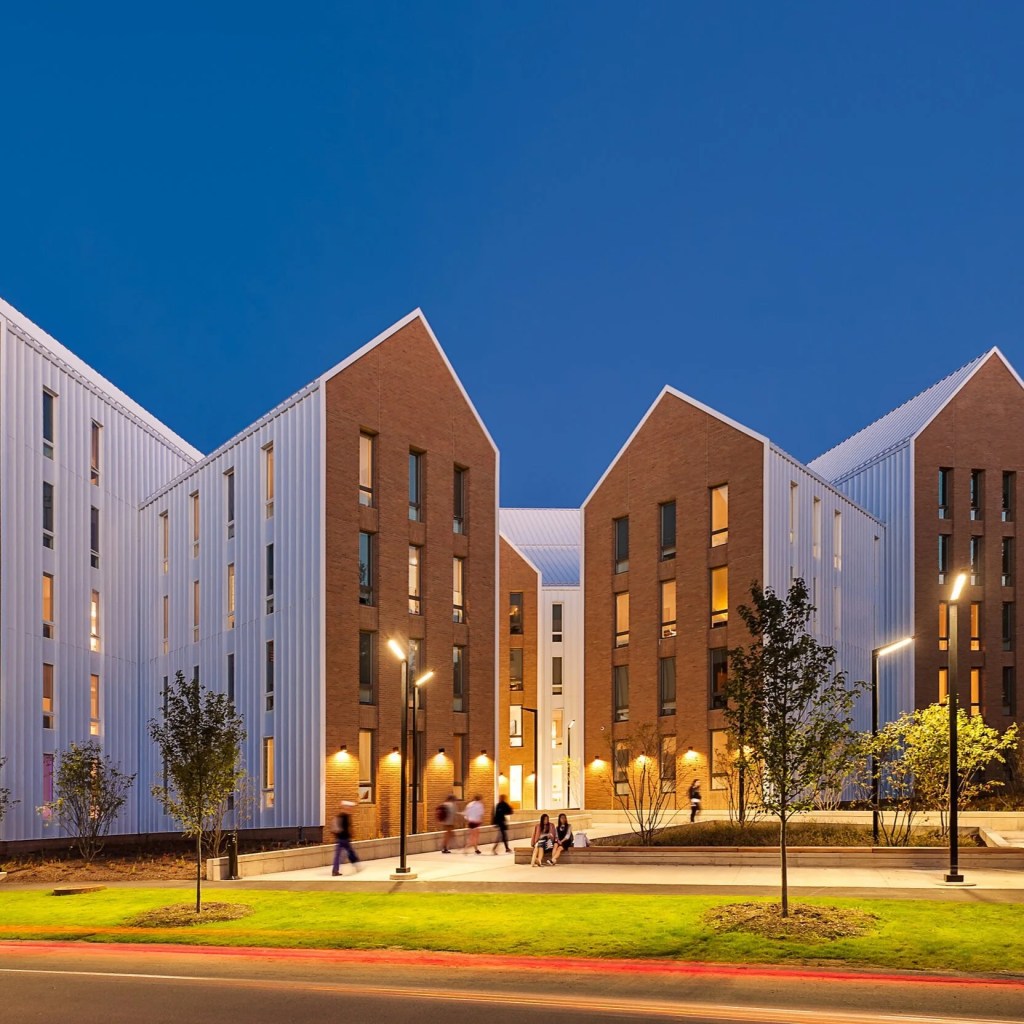
Over their service lives (~70 years), Fieldstone will contribute $0 to Amherst, but Olympia Place will contribute $22 million in property taxes. That’s more than Amherst’s outlay for the Jones Library. In other words, the developers of Olympia will eventually pay Amherst more in property taxes than the property actually costs to construct.
The financial future of the Amherst town government is contingent on revenues from student housing. Consider this: if Fieldstone were situated just outside the campus walls, it would have permanently increased the town budget by more than 3% (comparing Fieldstone’s annual local property tax exemption of $3.59 million against Amherst’s FY26 proposed budget). Amherst foregoes $10,000 in daily revenue because Fieldstone is located just inside the campus walls.
Note also that there was nothing nefarious about Fieldstone’s developers’ deal with UMass. They were both rational parties acting in the best interests of their stakeholders. UMass received a $20 million payment and ownership of the building (to preserve its tax-exempt status). Fieldstone’s developers, in turn, received the right to operate the building in perpetuity with a permanent exemption from local property taxes.
During this debacle, the Amherst town council sat on the sidelines–like a .500 baseball team standing pat at the trade deadline–watching its competitors (and yes, UMass is a competitor in this regard) grow richer. Fast forward a few years to this September, several town councilors discovered that the council’s inaction (and actual encouragement of new on-campus development) would cost year-round residents hundreds of millions of dollars in tax revenue. They floated the idea of attempting to retroactively tax the project, only to realize they had forfeited the legal right to do so. Yet, somehow, just one month after mourning the lost revenue, nine of them recommend doubling down on that same policy.
But, wait, there’s more. When larger projects are sited within UMass borders, the town forfeits the right to negotiate concessions from the developers (e.g., requiring 20 units of low-income housing or contributing $200,000 to traffic improvements).
Asking UMass to provide a tax shelter for large developers is political malpractice, and long-term residents should be outraged. We should instead mimic the Olympia Place model, lining the perimeter of UMass with student housing. The Olympia Place model would permit easier management of student-related traffic and noise concerns, and we could negotiate community benefits from the developers. With increased revenue, we could subsidize housing for seniors and enhance our downtown infrastructure, ultimately benefiting year-round residents. The Olympia Place model is the only feasible way to relieve pressure on the existing housing stock while simultaneously fortifying our property tax base.
The Bottom Line

Amherst requires new construction to lower the cost of housing for full-time residents and provide vital property tax dollars. Article 18 provides tax exemptions for large developers and a monopoly for existing landlords. Attempting to replicate the Fieldstone model would deprive year-round Amherst residents of literally hundreds of millions of dollars of future revenue. If we instead replicate the Olympia Place model, we could increase revenues by nearly 20%.
Progressive policies require a robust tax base. If we plan smartly, we can force developers to permanently underwrite services for year-round services. If we instead adopt Articles 18 and 19, we expose ourselves to litigation and atrophy the tax base for generations. Please contact your town council members and urge them to adopt housing policies that benefit Amherst residents, not developers.
Evan Naismith is a five-year resident of Amherst and a graduate from the Commonwealth Honors College. He is the VP of the American Constitution Society at UConn Law School, where he specializes in public interest law.
 THE AMHERST CURRENT
Simply put – thank you Evan.
LikeLike
Regarding Article 19, lot line to lot line limits have been instituted in other college towns, like State College, PA and Wilmington, DE. Existing rentals were grandfathered in, and those properties were only effected when the ownership changed. Two main results: Housing stock was actually clawed back from student rentals into family housing, and rampant investment that was driving a surge in housing prices was reduced, making the towns more affordable for working class families.
The problem faced here in Amherst is especially acute, as we are in the smallest town in America to host a state flagship campus. Without meaningful regulation, investors will continue to displace families and our already strugling residential population will continue to shrink.
LikeLike
Hey John! Thanks for your comment and your readership of the Current.
I want to add a little context to your statement above.
It is true that other municipalities have instituted lot line limits- however, this doesn’t guarantee applicability in Amherst. Both of the examples you cited are in states with different structures of local government (both DE and PA are less home-rule-oriented than MA, as a general rule) and have different enabling legislation controlling land use decisions. I lack the expertise to make a legal determination on the matter, but it is not a simple matter of borrowing legislation.
Further, it is important to contextualize the extent of investors purchasing single-family homes to use as rentals. If we use LLC ownership of homes as a proxy for investor ownership (which is an imperfect, but usable proxy), then we are discussing a relatively small number of properties. According to data in the draft Housing Production Plan (HPP), roughly 20% of the 680 single-family-home rental in Amherst are owned by private LLCs – the other 80% are rented out by their owners directly. This means that the major beneficiaries of student housing aren’t out-of-state-investors; the people monetizing single-family homes are mostly our neighbors and community members.
The HPP also speaks to the relatively low rate of sales involving LLC “investors”, saying that “this amounts to a rate of nine homes being sold to an LLC each year in the past five years and 5.6 percent of all single-family home sales from 2019 to 2023,” (p.63). Again, not as dire of a situation as public comment often makes it seem. Investor purchases of single-family homes is a national trend (about 1/3 of recent home sales, according to a recent CNBC report, or significantly more than in Amherst). Troubling? Maybe. Unique to Amherst? No.
LikeLiked by 1 person
John,
According to the data linked below from two impartial sources, rental prices in State College, PA have skyrocketed since the enactment of the lot line limits in 2013.
2013: $875
2025: $2,000+
Is that the future you want for Amherst? Your assertion that “rampant investment” in State College increasing housing supply “[drove] a surge in housing costs” is unsupported by the very instance that you cited, and has been repeatedly disproven by peer-reviewed studies. Please show me one peer-reviewed study showing how restricting supply decreases prices.
Furthermore, a zoning practice that is legal in PA might be (and is) illegal here in MA. Nuisance law would be a better bet than zoning regulations, but that also can’t be preemptively imposed on a class of individuals.
The fact is that we the people of Amherst, through NIMBY policies and poor forethought, have forced these college kids into our neighborhoods. UMass has no duty to house them, and the failure to replicate the Olympia model will only exacerbate this problem.
https://www.deptofnumbers.com/rent/pennsylvania/state-college/
https://www.point2homes.com/US/Average-Rent/PA/State-College.html
LikeLiked by 1 person
Rents everywhere have “skyrocketed” since 2013, not just in State College, as the tables show. You may want to reread the tables in the articles cited, and be more forthcoming in your opinion piece.
My source of info was an hours long discussion with the head of zoning in State College. So sorry to hear this guy didn’t support your claims. Your facts are lacking in context, and your numbers are cherry-picked and/or not consistent with the charts you cite. In addition, you fail to explore how the relative size of Amherst’s student population to its resident population impacts our situation, i.e.: we are the smallest town in the country to host a flagship campus, let alone another two additional college campuses.
There is a lot of finger pointing in Amherst, blaming “NIMBYism” for our housing woes. Just curious, but where do you live in Amherst? There are folks from the Amherst Forward crowd, whose views you echo, who do not have to worry about student rentals encroaching on their neighborhoods. Are there students across the street or next door where you live? There are where I live, and some years the students are relatively well behaved, and some years not. But the properties are not well maintained, and this adversely impacts the property values of everyone on the street. If the Amherst Forward clique lived on a street with 22 houses, 3 of which are rented in violation of town regulations around occupancy, health codes and parking they might start exhibiting a little NIMBYism, too. Bottom line, it doesn’t matter if it is an LLC or a private owner owns a problem property. Amherst fails to enforce the regulations already on the books to regulate the behavior of owners and renters, a major source of consternation among property owners and a driver of the push to regulate rentals more stringently. Why not encourage the town to follow its existing codes before relaxing them further?
LikeLike
John, you are correct that rent prices have skyrocketed everywhere since 2013, increasing by about 50% during that time frame (source below). However, they increased by 100% in State College after the enactment of the lot line ordinance, double the national increase.
You claim that I’ve cherry-picked data. So, please, share the data that I left out. Please show us peer-reviewed data showing…
1) Any of the proposed Articles are legal
2) Lot line ordinances decrease prices
3) Rent moratoria decrease prices
4) Siting students in on-campus (property tax-exempt) housing is a better economic solution than the (taxable) Olympia model.
Our uniquely low resident-to-student ratio makes it especially important that we heed the scientific consensus on the economic effects of anti-growth zoning choices. It’s insulting to social science for you to just wave off the clear findings of housing PhDs and organizations like the National Low Income Housing Coalition (cited above).
Your “where do you live” line of attack is ad hominem. Am I allowed to have an opinion on immigration despite the fact that I don’t live on the border?
Let’s pretend I’m a billionaire developer from Boston. Would that make the evidence I cited any less valid? Would that make Articles 18 & 19 legal? Would that make on-campus development a better financial decision for Amherst than the Olympia model?
Notably, I, too, am arguing in favor of a form of NIMBYism. But mine is taxable and legal.
Please replace “housing” with “immigration” and re-read your argument. Not a good look. In the meantime, I’ll let my evidence and arguments speak for themselves.
https://ipropertymanagement.com/research/average-rent-by-year
LikeLike
Hey Evan!
Thanks for your comments on previous Current articles and for this passionate op-ed!
When you reference Article 19 as “almost certainly illegal”, did you consider Village of Belle Terre v. Boraas (416 US 1 (1974)) in your rationale?
LikeLike
Alex,
I like where your head is at, but there’s a major (but subtle) difference between the facts in Belle Terre and the language of Article 19:
The ordinance in Belle Terre “restrict[s] land use to one-family dwellings and prohibit[s] occupancy of a dwelling by more than two unrelated persons.”
Article 19 has very similar language, but then adds that the only type of person the language applies to are those who “are attending undergraduate or graduate programs offered by colleges or universities.” That’s the illegal part.
If Amherst wants to impose restrictions on ALL homes containing unrelated persons, that might be legal. But, come on, are we really going to go door-to-door asking people for their paperwork to prove they’re related? That’s ICE-y and icky.
Further, Belle Terre was simply an affirmation that there is no federal law against that type of legislation. The Constitution is the floor, not the ceiling. As evidenced (admittedly imperfectly) by City of Worcester v. College Hill Props., LLC (2013), the MA Supreme Judicial Court is wary of legislation that imposes housing restrictions on students.
LikeLike
This is super informative and insightful – thank you! As a planning student, I’ve often wrestled with land-use Supreme Court decisions and often struggle to reconcile policies with precedent (here included), so this is a very well-received and much-appreciated clarification!
LikeLike
Reminder: The Amherst Current encourages robust debate on housing policy.
Please keep comments focused on ideas and data rather than questioning fellow commenters’ motivations or personal situations.
Strong disagreement is welcome; personal assumptions about others who disagree less so.
LikeLike
Hi, thanks for this article. I believe you have a minor factual error in the paragraph pasted below – you state that it is regarding article 18, but in fact it regards article 19.
Yet, the author of the articles went on record stating that the purpose of Article 18 is to “favor maintenance of family neighborhoods and disincentivize LLC real estate investor ownership of houses intended for student rental.” Shifting ownership to one preferred group (families) is not a legally cognizable reason for zoning restrictions, it’s economic favoritism. As such, this article is likely illegal. The town would be liable for any financial damages to downtown property owners.
https://www.amherstma.gov/DocumentCenter/View/82097/8b-Zoning-Bylaw-Change-Petition_Article-19_09-24-2025
LikeLike
Good catch. You’re right.
LikeLike
Mr. Cox & Mr. Naismith
You are flying at 30,000 feet on this issue .
Our neighborhood has at least 8 student houses that were once homes to families .
The owners live in California , Boston , Springfield.
2 years ago we busted up a non lettered fraternity operating out of a house nearby . With the help of code enforcement and the police department we’re able to get them out.
They had frequent noise complaints , fights and chanting at a late hour .
Student housing in residential areas is the cheapest way for students . The developments you support are very expensive to all .
LikeLike
David,
You claim that “the developments you support are very expensive to all.” Yet,
– Every unit in Olympia Place is rented out this year, so it’s clearly not too expensive for students, and it’s clearly profitable for the developers.
– The 200 students residing in Olympia Place would otherwise almost certainly occupy Amherst residential homes. Their residence in Olympia, therefore, leaves ~30 Amherst homes vacant for families.
– Olympia Place is assessed at $17m, so it contributes $310k every year in property taxes to services for year-round residents.
David, if you could press a button to make Olympia Place disappear, would you do so? Of course not. Because well-planned off-campus development is Amherst’s best way of getting un-lettered frats out of neighborhoods.
Bottom line: Olympia Place gets the riff-raff out of your neighborhood and lowers your personal tax burden by about $30/year.
LikeLike
I did read this, and for the most part it made sense to me.
The point about developing 5,000 additional units on campus is something I have been very sympathetic to. I agree with the point that Amherst will lose tax revenue if this occurs on campus. But I don’t think that there is any way around it. There’s just so much land in Amherst so the mostly likely place to build is on campus. It also may be best for students so they are walking distance from classes and other campus amenities. I don’t think that the Town tax revenue interest should determine where to build. I’m in favor of building on campus and off campus. I just want to see it happen.
Meeting the demand for student housing will only affect the value of off campus property held by student landlords. They have been gouging students for years so I am not sympathetic. I doubt that the property values of your home or mine will be affected. Our homes are not now something that a developer of student housing would be interested in because the cost is too high to recoup the investment. So we are effectively in a different market. If there are fewer conversions of “our homes” into student rentals, that should make them more attractive to people who want to move into Amherst.
The University is not going to develop new residences on campus with its own money; they have better things to do with that money, like constructing buildings where they can rent the space to private corporations. Everything is more and more judged by whether it will produce new revenue or not. Residences do not unless they are built and managed by someone else with the University getting its cut.
That’s my story and I’m sticking to it.
John Hornik
LikeLike
Evan :
To your bottom line comment .Riff-raff is not a term that should be used to describe anyone .
I could care less about a $30 dollar tax savings because of Olympia Place or any other development.
A moratorium is in order . Let’s take a breath on development .
LikeLike
David, my riff-raff comment was tongue-in-cheek. Remember, I am the one asserting that students have equal property rights to long-term residents. In fact, I was a UMass student just two years ago. And while you “could care less” (sic) about the tax savings from development, most residents do care that Olympia alone contributes $346,000 annually to our town.
LikeLike
Dave Farnham — great to see you here, and I appreciate you sharing your perspective on this issue. I’m also glad to hear that the non-lettered fraternity situation was finally resolved — what a headache that must have been!
That said, I have to respectfully disagree with your view that Amherst should take a pause on multi-family development. Like Evan, I believe the proposed Articles are legally unsound and economically harmful. When I served on the Planning Board, one of our primary concerns was always to ensure that the Town’s actions were legally defensible. The last thing we wanted was to expose Amherst to litigation because a zoning decision couldn’t hold up under legal scrutiny.
Land use planning, at its core, is about balancing private rights with the public interest — always within the guardrails of established law. Both Article 18 and 19 are problematic for the reasons Evan outlined, but I’d like to expand on the risks of Article 18 specifically — and of building moratoriums more broadly.
The value of additional housing in Amherst is undeniable. As Churchill & Harvey noted in their June 2025 piece, without the recent larger multi-family developments, the Town’s budget would be about $2.5 million smaller — at a time when we’re already struggling to fund essential needs like schools and infrastructure. And as John Hornik mentioned earlier, any new housing — whether on-campus or off — should be welcomed with open arms. I fully support the idea of partnering with UMass to expand housing opportunities, but Article 18 is not the way to achieve that.
In principle, I oppose the proposed moratorium because it would restrict legitimate land-use rights without any compelling justification related to public health, safety, or welfare. In my view, Amherst is nowhere near meeting that threshold.
Beyond that, moratoriums send a deeply negative signal to the development community. Why would a developer invest in multi-family housing here if there’s a looming threat that projects could be frozen midstream? That uncertainty alone drives investment elsewhere — and fewer projects mean higher costs for everyone.
When a town gains a reputation as being development-unfriendly, the costs of new housing inevitably rise. Developers factor that “zoning risk” into their budgets, which acts like an invisible tax that ultimately gets passed along to renters and homebuyers.
As Evan rightly emphasized, if these Articles were to pass, housing costs would rise even further — and the Town could find itself in costly legal battles defending ordinances with no solid legal footing.
More lawsuits, higher housing costs — no thank you.
Reference: Churchill & Harvey (June 2025), Can Housing Help Us Find a Way Out of Our Fiscal Mess?
LikeLike