
Opinion by Evan Naismith
Some Amherst residents claim that the town’s unique demographics make it an economic unicorn: somehow, the law of supply-and-demand doesn’t apply here. But we’re not unique; there are other small towns with big universities, and many of them have more progressive housing policies than us. They keep prices reasonable for everyone by encouraging market-rate development of student and non-student housing.
Let’s see how Amherst stacks up against West Lafayette, Indiana, home of Purdue University, which has a student population even larger than UMass’s.
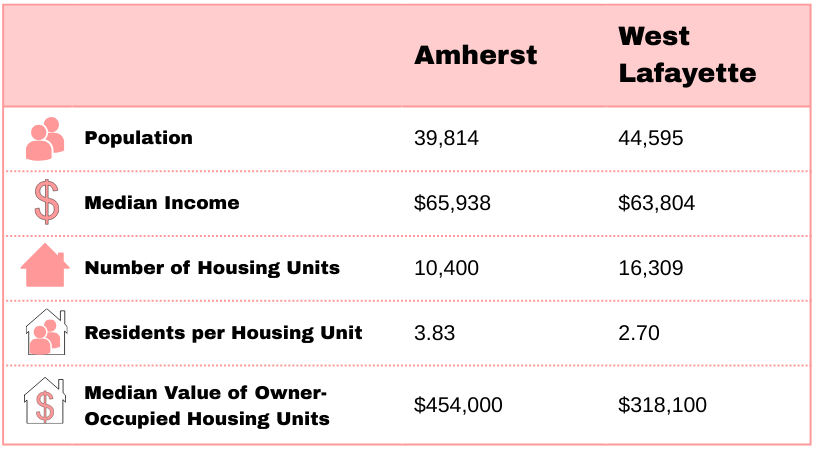
According to the data, West Lafayette has 30% more housing units per resident than in Amherst. So how closely does that ratio affect affordability? It’s literally a one-to-one ratio: homes in West Lafayette are 30% more affordable than those in Amherst. Granted, housing supply isn’t the only factor that determines prices, but it is clearly the main driver.
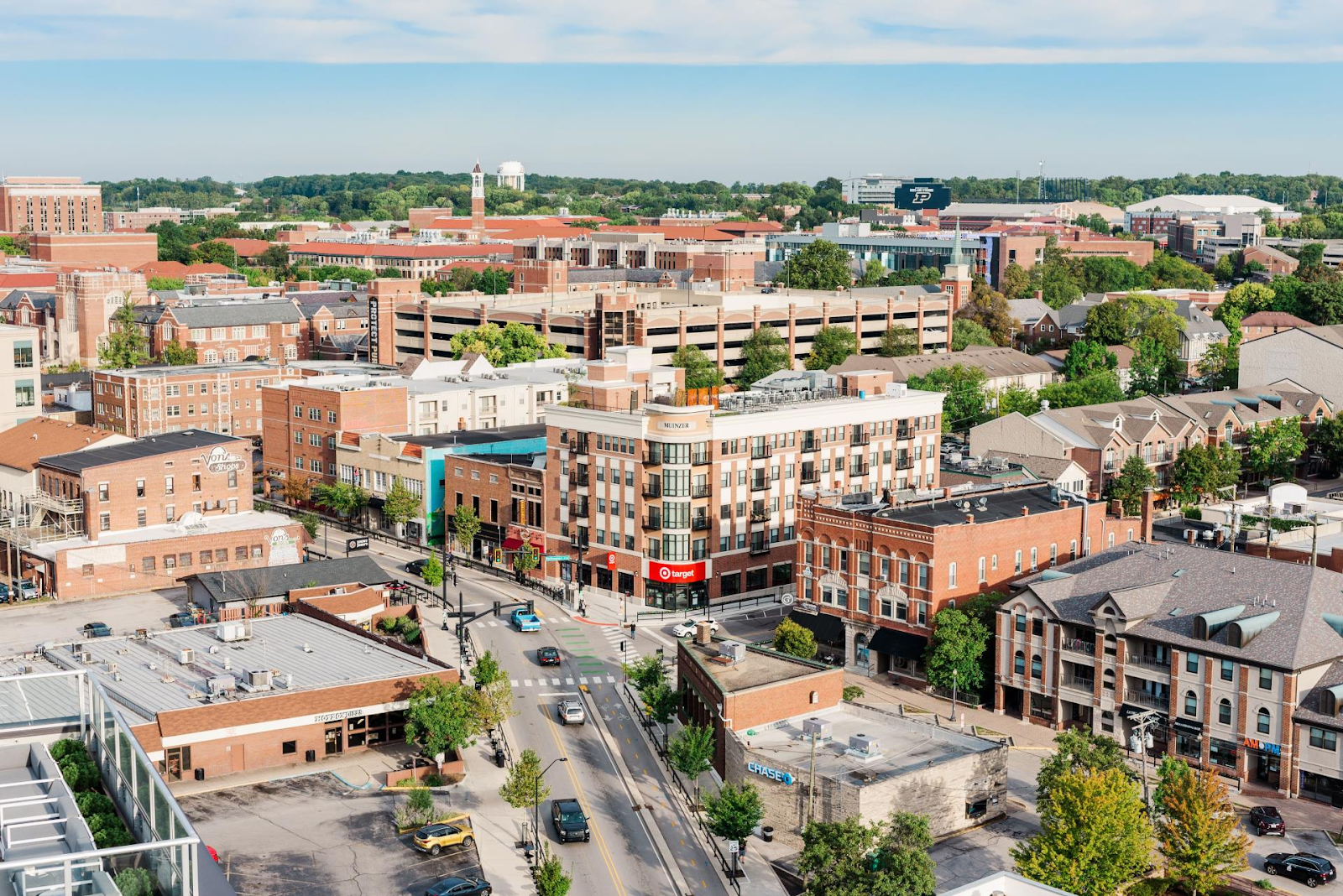
It is simply a fact: West Lafayette has a more progressive housing policy (“build and let build”) than Amherst. Our policy, by contrast, fits the dictionary definition of conservative: “averse to change or innovation and holding traditional values.”
Our policy is also regressive: Amherst housing scarcity gouges full-time residents, with the benefits accruing to banks, realtors, and landlords who can charge whatever they want. Amherst NIMBYs think they’re frustrating LLCs by denying permits, but academics know that capital investors prefer to invest in zoning-restricted markets! They get an artificial monopoly and can set rents accordingly.
In addition to paying less in rent and mortgage payments, West Lafayette residents benefit from better-funded public services. Its Senior Center is top-notch, offering community meals ($2 suggested donation – cute!), yoga, and line dancing. West Lafayette’s schools are ranked #1 in the state, and its population is more ethnically diverse than ours. Everything Amherst claims to stand for, West Lafayette actually is.
Amherst Needs a Housing Director.
It’s hard not to reach the uncomfortable conclusion: West Lafayette simply governs better than we do. In Amherst, property taxes comprise 70% of our municipal budget, yet we don’t have one full-time employee dedicated to housing policy. That’s madness. Amherst housing policy is influenced by the town council, housing authority, and planning board, among half a dozen others. But, as John Madden once quipped, “if you have two quarterbacks, you have none.” No entity in Amherst is looking proactively at the big picture for housing. And that’s a problem in a democracy.
Unlike Amherst, West Lafayette has a Housing Director with a degree in Public Administration. He works with Purdue to find win-win housing solutions, and works in lockstep with the mayor to optimize developer concessions and “set-aside” benefits for year-round residents. Plus he’s accountable to the taxpayers: If his policies fail, he’ll lose his job.
An Amherst Director of Housing would do the following:
- Coordinate the various housing agencies, relieving pressure on the town council
- Spearhead state and federal grantwriting
- Optimize low-income “set-asides” and other community benefit exactions
- Act as a liaison to the colleges to coordinate taxable, concentrated student housing
- Lobby the state legislature to improve the land reimbursement formula for UMass
- Lobby the state legislature to institute a PILOT program
- Ensure ARPS get their fair share of new property tax revenues
- Streamline the permitting process
Such a Director would also tackle dozens of cost-saving action items that have completely fallen off our collective radar, outlined in the Town of Amherst Comprehensive Housing Policy. Every penny counts right now, and the town budget is forgoing millions of dollars in annual revenue because our housing policy can only be described as “conservative” or “none.” Perhaps worse, the resulting scarcity benefits landlords at the expense of year-round residents.
It’s time we fix this. We need a qualified and ambitious Director of Housing. Amherst can keep pretending scarcity is progressive—or it can hire a Housing Director and finally govern in a way that matches its values.
Evan Naismith is a five-year resident of Amherst and a graduate from the Commonwealth Honors College at UMass Amherst. He is the VP of the American Constitution Society at UConn Law School, where he specializes in public interest law.
Discover more from THE AMHERST CURRENT
Subscribe to get the latest posts sent to your email.
 THE AMHERST CURRENT
Evan – well written .
“ Down town mixed-use buildings are the lifeblood of local businesses in West Lafayette, Indiana .”
Amherst has mixed use buildings , why is our downtown and local businesses not seeing that economic bounce ?
LikeLike
David,
Economic conditions downtown are definitely improving, as evidenced by the substantial growth in local hotel/motel & meals tax:
2022: 676k
2023: 799k
2024: 915k
2025: 954k
Even accounting for inflation, that’s a 20% increase in downtown revenue (at least for food and lodging businesses) over four years. That’s exceptional.
Amherst businesses, however, face economic headwinds: our business property tax rate is nearly 50% higher than Hadley’s. Further densification of downtown will provide local businesses with a “captive audience” who (because of relaxed parking regulations) are less likely do their shopping in Hadley.
LikeLike
The critique presented is an important one. And the comparison with a college town in Indiana, of all places, should have a shaming effect.
But I’m not convinced that Amherst voters REALLY care about this problem as much as Evan Naismith does. No one will admit publicly that we have a “gated community without gates”, but that seems to be the effect of all of our politics about housing.
LikeLike