
Opinion By Bryan Harvey
The news that Hampshire College is closing its doors was a shock to the community, even though that outcome has been discussed for some time. It leaves us with a lot to process, starting with the impact on our friends and neighbors whose lives have been centered on that unique institution.
The trustees have made it clear that they need to act swiftly to satisfy the College’s creditors, so we haven’t been given much time to think about the impact on our community as a whole. And what happens next will definitely be a community decision, if only because alternate uses of the campus will almost certainly require changes to its zoning. That requires a two-thirds vote of the Town Council, so the future of the Hampshire campus will stimulate a very public debate.
People will see many kinds of opportunity here. I’ve already heard people kicking around ideas for housing, other kinds of development, public infrastructure, recreation, farming, and alternative educational approaches. The list is going to get very long very fast.
But the first priority should be to get some clarity about what the community as a whole is trying to accomplish. Ideas don’t exist in a vacuum; they need to be tested in terms of both our needs and our realities.
I suggest that the overriding priority for the town, both now and for the foreseeable future, is clear: manage the Hampshire opportunity in a way that resets the town’s revenue base.
Resetting the Revenue Base
It is no secret that municipal finances across the state are under siege. It started with the passage of Proposition 2 ½ in 1980, and the walls have been closing in ever since:
- Skyrocketing costs for everything from blacktop to retiree health insurance.
- Stagnant state aid to cities and towns.
- Cascading service demands and state mandates.
In Amherst, we are especially vulnerable:
- An exceedingly narrow tax base (very little commercial/industrial property) passes almost all costs on to homeowners and renters.
- An enormous percentage of the town’s real property is exempt from taxation.
We don’t have to look any further than the budget battles in Northampton and the override wars in Hadley and South Hadley to see where all this is headed.
Amherst has escaped the worst of it so far for two reasons.
First, we passed Prop 2 ½ overrides in 1992, 2005, and 2011. Without them, our budgets would already be 10% lower.
Second, the University’s 35% enrollment increase since 2002 created demand for off-campus housing that developers were happy to satisfy. Nine major apartment developments since 2014 are contributing about $2.5 million annually to the town’s operating budget. In effect, we got a “Get Out of Jail Free” card instead of having to go for an override. (Note: this contribution had been nearly $3 million before the tragic fire at Olympia Place.)
But this is not sustainable. The University is no longer growing. The pipeline for big projects is drying up. And the prospects for additional overrides seem quite dim to me (and I say that as someone who has supported every override in Amherst’s history, and helped organize two of them). Here’s a simple picture that encapsulates the problem:
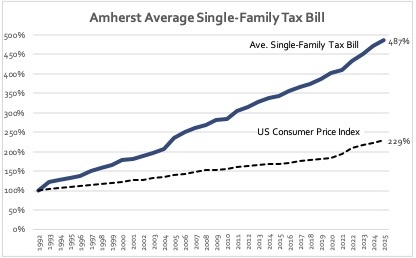
The average tax bill is about to top $10,000. And when taxes rise so much faster than inflation (and wages, which have struggled to keep up with inflation) it puts a burden on everyone. The burden is especially heavy for some of our most vulnerable populations: older residents whose property values have increased but whose incomes have not; long-time families struggling to stay in their community; renters who see tax hikes passed on to their monthly payments; younger families already facing high housing and mortgage costs.
The Hampshire opportunity is the first time in generations — and perhaps the last we will see — to meaningfully change this equation by expanding our revenue base. The point here is not to generate revenue for its own sake; it’s that Amherst habitually spends more than its durable revenue base, and we’re running out of fiscal runway. Satisfying our desires — for housing, for public education, for sound infrastructure and effective services — relies on steady income that we do not have. Creating a broader revenue base makes everything else possible.
This is the time to secure our community’s fiscal future.
Four Basic Principles
In that context I suggest four basic principles we should apply to every idea for the Hampshire opportunity:
- The community, through zoning or other mechanisms, should exercise its effective control over the campus wisely and with a focus primarily on the future.
- Any costs associated with the campus should not compete with existing services and obligations.
- Uses of the resource, of whatever kind, must make a lasting net contribution to local revenue (through property tax payments, negotiated PILOTs, ground leases, or other mechanisms), and preference should be given to uses making the greatest contributions.
- Uses of the resource must also advance established community spending priorities. This is a time for coming up with budgetary solutions, not additional obligations.
Some Ideas
Are these impossible conditions to meet? I don’t think so. Here are two illustrations of uses that could be considered; others are sure to be suggested:
Senior Housing. Right now, much of the town’s single-family housing stock is occupied by older residents (like me) who want to stay in town but do not see attractive options other than rattling around in the family homestead. Many of these folks could opt in to an attractive development at market rates; those who cannot could benefit from mixed-rate requirements stipulated by the town. This could reduce the tax burden for many older residents plus free up homes in existing neighborhoods. Such housing would pay taxes while imposing very little draw on town services.
Green Energy. Right now, the Hampshire campus generates substantial solar energy which was used to operate the campus. The existing supply could be used to provide low-cost, sustainable energy to senior housing or other projects. Moreover, there is capacity for much more PV generation. Right now, forty Massachusetts communities operate their own local power utilities (so-called “Municipal Light Plants,” including Holyoke, South Hadley and Westfield). Could Amherst become the 41st? The Massachusetts Municipal Wholesale Electric Company helps MLP communities plan and operate their utilities, and could be an important resource. The former Fort Devens in central Massachusetts provides cheap solar power to attract and sustain local businesses (such as Little Leaf Farms lettuce). A green energy future for the Hampshire campus would certainly be a fitting legacy, and could also help reset the town’s revenue base.
These are just ideas, of course, but they illustrate the kind of thinking that we ought to be stimulating as we seek to honor the opportunity the Hampshire campus offers. This is the time to secure our community’s fiscal future.
Bryan Harvey served on the Amherst Selectboard from 1991-2001 and on the Amherst Finance Committee from 1981 to 1991, and chaired the 2001-03 Amherst Charter Commission. He retired from UMass Amherst as associate chancellor and chief planning officer. He is married to Town Councilor Lynn Griesemer. This post reflects his own perspective.
Discover more from THE AMHERST CURRENT
Subscribe to get the latest posts sent to your email.
 THE AMHERST CURRENT
I agree . The Town should zone this in a way that produces revenue to the Town. Hampshire could be to Amherst, what route 9 is to Hadley.
Over the years, the Town of Hadley’s Planning Board has expertly managed Route 9, being aware of the revenue that it generates to the town .
This project would go a long way to diminishing our “ Density “ chant …
LikeLike
Well said Bryan!
Whatever happens at Hampshire we must find ways to generate revenue. Personally, I believe that we must have a mix of uses. This opportunity is too big for one single use. Single family homes, senior housing, market rate apartments, starter homes, mixed use, and affordable housing all can be built at Hampshire without sacrificing the bucolic setting and peaceful nature of the area.
Every new building built should have solar panels to add more sustainable energy into the already substantial amount that you mentioned in your piece.
All of this could be done on the current central campus with the farm and other outlying portions of the campus remaining as they are. Also, the town could get the pickleball courts that were proposed to CPA!
LikeLike
Thanks for writing this Bryan. I think you are spot on about this as reset opportunity. I believe that it is important for taxpayers to let Town Government know that we are concerned with creating vibrancy and dynamism while generating more tax revenue – and revenue that would be a net gain for all. I would encourage the Town to engage entities such as the Regional Economic Development Council as well as raising this issue with our legislators and the Commonwealth. I have reached out myself to suggest this to our officials, and urge others to do the same.
LikeLike