
By Jack Jemsek
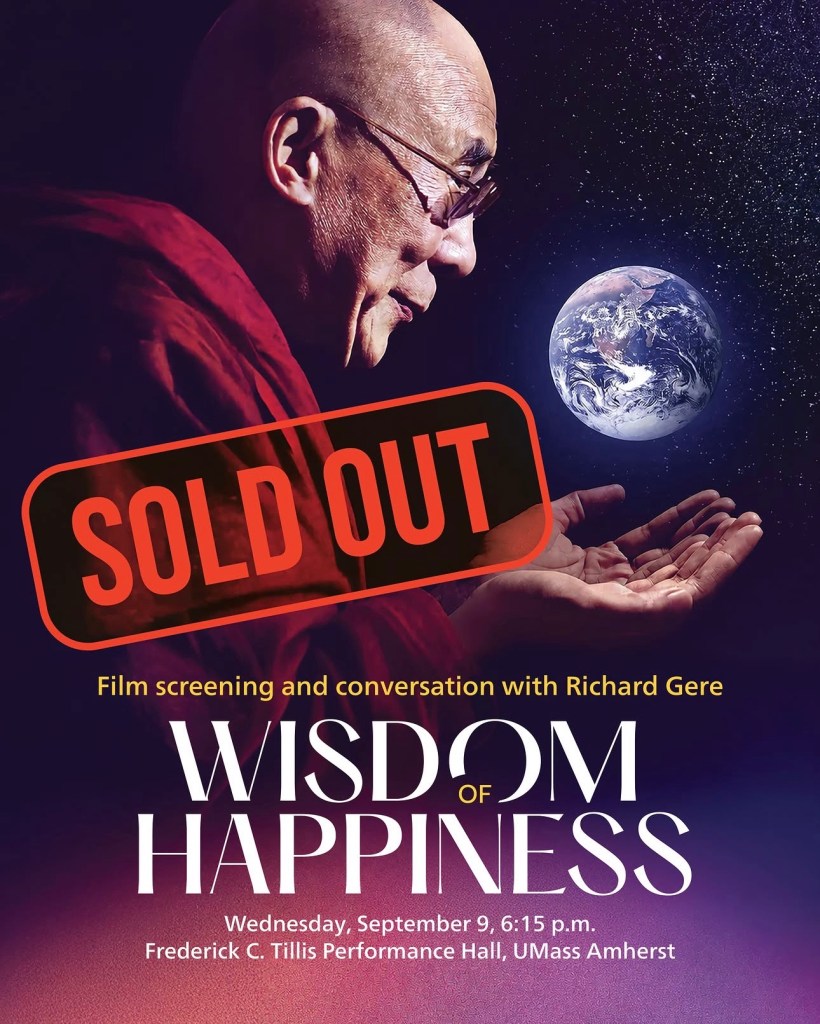
Last week, a capacity crowd of 2,000 people filled the Frederick C. Tillis Performance Hall at UMass to view Wisdom of Happiness, a 2024 documentary featuring an extended interview with His Holiness, the 14th Dalai Lama. A highlight was actor Richard Gere, the film’s executive producer and a UMass alum. Gere was moved by the screening, saying it was the largest audience with which he’s screened the film.
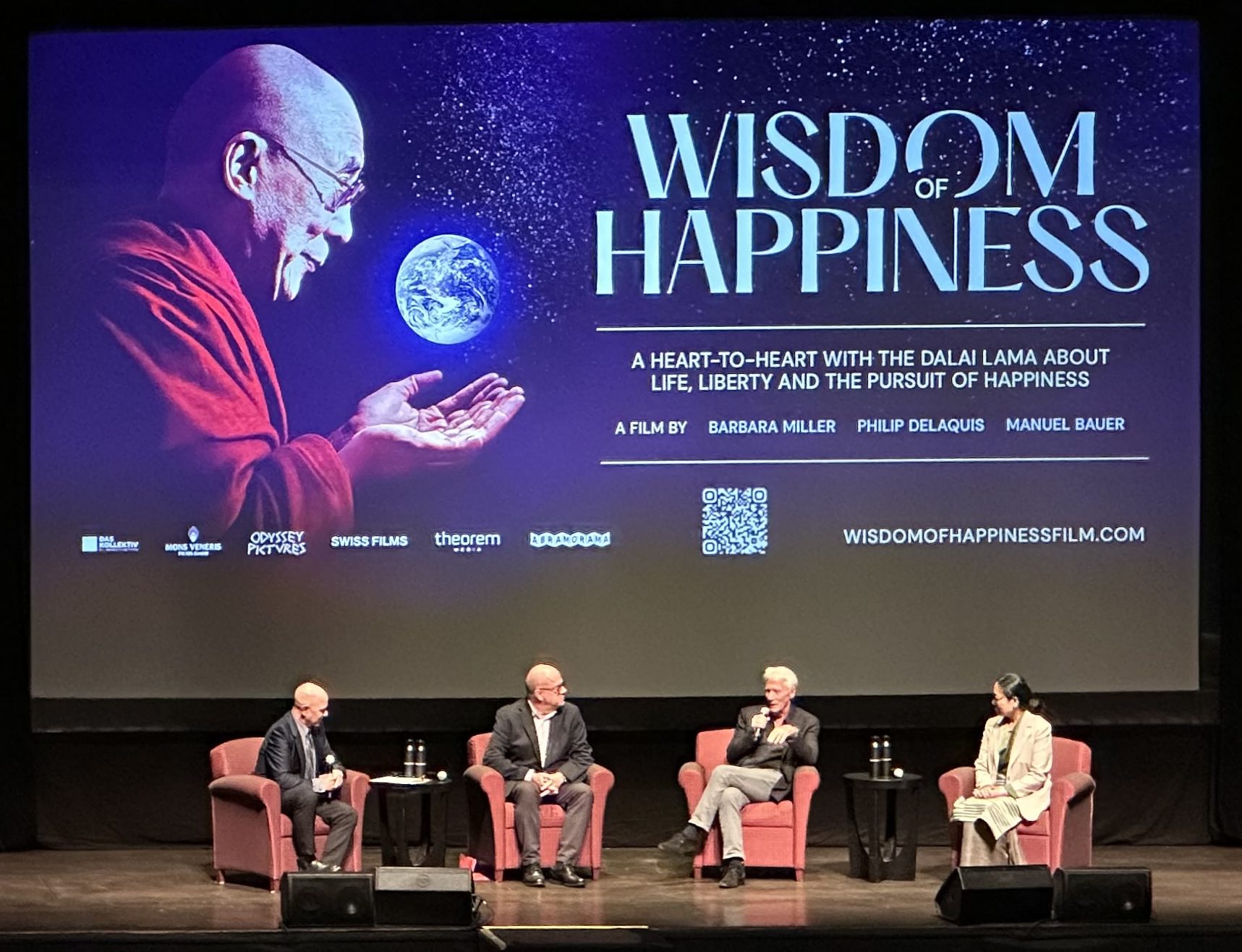
Dhardon Sharling emceed the event, with opening words from UMass Chancellor Javier Reyes. The screening was followed by a panel discussion moderated by Monte Belmonte of New England Public Media’s The Fabulous 413, featuring Gere, U.S. Representative Jim McGovern, and Tencho Gyatso, president of the International Campaign for Tibet and the Dalai Lama’s niece. Credit also goes to Thondup Tsering and the local Tibetan community for helping bring the film to Amherst.
The film centers on a single, intimate conversation between the Dalai Lama and director Barbara Miller. Cinematographer Manuel Bauer shot the film and has documented the Dalai Lama for over three decades.
A message built around compassion
Across the film and the panel, one word kept surfacing: compassion. Rather than participating in quiet meditation and prayer for its own sake, the Dalai Lama’s key message was that compassion is better when shared and put into action. The Dalai Lama described happiness and inner peace as the purpose of human life, which is achieved only through disciplined inner work. He acknowledged that the biggest challenge is detaching from human emotions and external circumstances that have fueled destructive impulses worldwide.
His Holiness is grounded by daily meditative practice, which typically begins at 3:30 AM and includes what he calls “analytical meditation.” It’s a habit he’s kept up for decades alongside an equally long-running dialogue with scientists on the mind and consciousness, work that helped give rise to the Mind & Life Institute.
The Dalai Lama spoke of his mother’s influence and voiced strong support for women in leadership, at one point raising the possibility that his own successor could be a woman. He connected the same “big we” thinking to the climate crisis, calling on people to set aside the reflex to divide the world into us versus them, and to instead care for the planet as inseparable from care for one another.
Tibet, China, and an unexpected memory
Some of the film’s most striking moments came from the Dalai Lama’s own recollections of the Chinese invasion of Tibet, which began when he was fifteen; he assumed full political leadership of his country at sixteen. He recalled having regarded Mao almost as a mentor figure in those early years, before events forced him into exile in India, where he has lived for nearly seven decades.
During the post-film discussion, Tencho Gyatso clarified that what Tibetans are actually asking for is not independence from China, but the freedom to preserve their language, culture, and religious practice while remaining part of the country. Gyatso described what she called one of the alarming facts about the Chinese occupation is that close to a million Tibetan children are forced to attend state boarding schools, separated from their families and their language, while Tibetan-language schools are closed. She also noted that Chinese President Xi Jinping is scheduled to make a state visit to Washington on September 24th — his first visit to the White House in more than a decade, at President Trump’s invitation — a trip likely to draw significant protest activity around Tibet and human rights.
Gere, who has advocated for Tibetan rights for decades, was blunt about the reach of Chinese state pressure inside the U.S., describing a network of operatives who monitor and, he said, sometimes intimidate Chinese nationals here into silence on criticism of Beijing — for example, by having relatives still living in China suffer repercussions. Gere stressed that the reality of Chinese government spies operating here “was no joke.”
A UMass homecoming
For Gere, the night doubled as a homecoming. He attended UMass for two years on a gymnastics scholarship, competing on the pommel horse and rings, and has said the experience opened up new creative directions for him — he wrote his first screenplay drafts and made his first short films while studying philosophy at UMass before turning to acting full time.
Representative McGovern briefly discussed a past trip to Tibet with then-Speaker Nancy Pelosi, and his commitment to stand up for the human rights of Tibetans. He’s a co-sponsor of the bipartisan Assuring the Future of Tibet Act, which would commit the U.S. to keep engaging directly with the Tibetan people and their elected leadership, including the eventual successor to the current Dalai Lama. In a follow-up social media post, McGovern credited the evening’s discussion of the Dalai Lama’s message, amid so much division in the world, with giving him “so much hope.” Gere paid McGovern an unsolicited compliment, stating that “He’s honest, he delivers” for his constituents.
Where to go from here
Local mindfulness educator Shalini Bahl Milne wrote a detailed reflection on the evening for her Substack, Sama Life, describing the film’s unusually direct, face-to-camera style and the emotional weight of hearing the Dalai Lama’s story firsthand when she met His Holiness earlier this year. As she put it, his approach to Tibet’s occupiers distills to a hard but clarifying rule: oppose the action fiercely, but don’t turn the person into an enemy. Shalini’s article also rounds up several concrete ways to act — from contacting Congress about the Tibet Act to supporting organizations working on Tibetan human rights and environmental protection.
Some actions you can do now, prior to Xi’s September 24th visit, is to consider signing the following petitions supporting Tibetan causes: Support Tibetan Democracy, Protect Tibet’s Children, Bring Pastor Cao Home, Save Uighur regarding ending the concentration camps in East Turkistan, and Stand Up for Tibet’s Environment.
You can watch the trailer for Wisdom of Happiness here. The film is currently available to stream on Apple TV and Amazon Prime Video for anyone who missed the Amherst screening.
Discover more from THE AMHERST CURRENT
Subscribe to get the latest posts sent to your email.

