
Opinion By Evan Naismith
Drive down Taylor Street or past Newell Court, and you can watch Amherst’s housing shortage take physical form. Every accessory dwelling unit going up behind a single-family house is a symptom of our failure to plan for our own residents: somebody needed a place to live in this town and could not find one. Had Amherst built the housing its population actually requires, few residents would put a cottage in their backyards.
We should treat this moment as a reckoning. Instead, we are refusing to swallow the medicine the state prescribed.
One town, two positions, same backyard.
The Amherst Affordable Housing Trust just announced it will enthusiastically promote accessory dwelling units as a tool for ameliorating Amherst’s housing crisis. Why? Because ADUs are generally built by small-scale contractors, and are environmentally-friendly. They offer a uniquely affordable path to homeownership: year-round residents can use them to generate income, or provide housing for a loved one. Best yet, the state is offering extraordinary financial assistance via 0% deferred loans. This means you can finance part of an ADU interest-free, and you don’t have to pay the loan until you sell or refinance.
Our Affordable Housing Trust wants you to know about this program. But our Planning Board isn’t so sure.
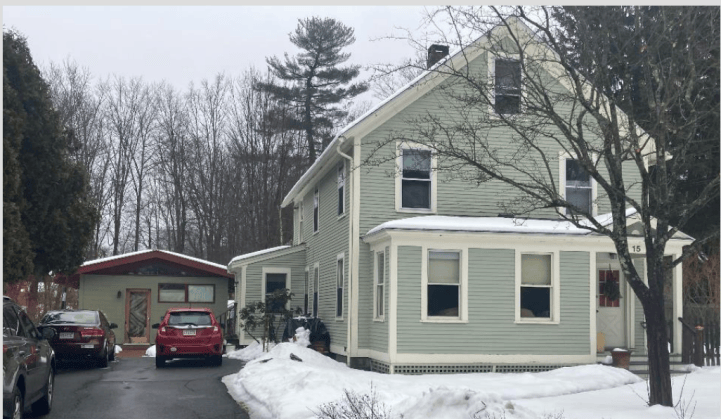
At its September 2 meeting, Planning Board member Jesse Mager discussed asking the Commonwealth to exempt Amherst from the by-right ADU requirement altogether, on the stated premise that “the point of this law is not student housing.”
Same town. Same building type. Same lot, same setbacks, same septic load, same car in the same driveway. One town body is working to get these built, and another is asking Beacon Hill for permission to stop them.
So what separates the good ADU from the bad one? Not the structure. Not the density. Not the infrastructure. The Board told us itself. The only variable is who might sleep inside.
Students deserve equal treatment.
Students are counted in the census that drives our Chapter 90 apportionment and our formula grants. Their apartments pay taxes 365 days a year. Our district maps are drawn as if they were full-fledged residents. If they come to a Town Council meeting, they get three whole minutes of public comment time. They are Amherst residents. Period.
Private residents may hold whatever opinion they like about students. Public servants, however, are a different case. When someone accepts a seat on one of this town’s boards, they give up the right to pick favorites and take on an obligation to represent all of the town’s residents. Voter and nonvoter. Republican and Democrat. Student and non-student.
Student status is not a protected class. It should not have to be. Mayor Zohran Mamdani is a die-hard Mets fan; nobody imagines that entitles Mets fans to better housing vouchers. Even Yankee fans are owed equal representation. The same holds for students. The Planning Board is potentially seeking exemption from a state affordable housing law simply because the disfavored residents are benefitting.
We are not an exception.
There is no textual or moral basis for the exemption. Chapter 40A protects accessory dwelling units by right and says nothing whatsoever about who may occupy one. The regulation specifically forbids towns from discriminating against occupants based on “enrollment in an educational institution.” Our Planning Board is asking the Commonwealth to bless the precise thing the Commonwealth wrote the law to forbid.
And the law exists because of towns like ours. Amherst spent sixty years making small, cheap housing illegal — excessive lot minimums, layers upon layers of review, and prohibiting duplexes in 98% of Amherst — and then professed shock at the price of rent.
Governor Healey concluded that towns would never legalize inexpensive housing on their own. She was right about us. We passed the narrowest version of the law the statute permits, and now we want to be excused from that. Amherst is not an exception to the condition the state set out to treat. We are patient zero, a prime example of why the Massachusetts Legislature is admirably and methodically stripping Town Councils’ veto power over affordable housing.
Amherst filled in the pool.
In The Sum of Us, Heather McGhee tells the story of the grand public swimming pools that American towns built in the 1930s and 40s — resort-sized, nearly free, genuine civic monuments. Then the courts ordered them integrated. Rather than share, some towns drained the pools, filled them with concrete, and paved them over.
The families who backed that did not get a better pool. They got no pool. Their own children swam in a backyard or did not swim at all. That is McGhee’s lesson, and it is the truest thing in Amherst politics: the cost of exclusion is never paid only by the excluded.
Amherst has a drained pool. It is our housing market.
The reforms we refuse are not radical. ADUs by right. An end to single-family-only zoning. Real density near campus. Each of these reforms is unquestionably progressive, since they would lower the cost of living for year-round renters. But they’d benefit students, too.
So we fill in the pool. We refuse to implement even the most tepid zoning reforms. While progressive Planning Boards elsewhere are orchestrating a renaissance of affordability, some members of ours are literally seeking ways to block affordable housing.
And look who else is left on the outside looking in. The year-round resident who wants to downsize and stay on her street. The town employee commuting in from Ware. The young family that would have bought the starter home it was never legal to build. Above all, the low-income renter, now bidding against a graduate student for the same scarce apartment — a competition we manufactured by overregulating small-scale affordable housing like ADUs and duplexes.
We paved over the pool, and we all suffer the consequences.
Build it.
Credit where it is due: at that same September 2 meeting, Chair Doug Marshall proposed rezoning parcels near UMass for larger residential buildings, and colleagues offered corridors of their own. That is the real answer, and it deserved far more of the meeting than the exemption did. Build the housing where it belongs, at the scale the demand requires, and put it on the tax rolls.
Evan Naismith is a five-year resident of Amherst and a graduate from the Commonwealth Honors College at UMass Amherst. He is the VP of the American Constitution Society at UConn Law School, where he specializes in public interest law.
Discover more from THE AMHERST CURRENT
Subscribe to get the latest posts sent to your email.


No person or government body in Amherst is resisting construction of 900 square foot ADUs, or 1200 square foot ADUs, if either the ADU or main house is owner occupied. The current problem with it is that there is problematic wording in the state bylaw that overwrote Amherst’s ADU bylaw. The state agency that wrote the state bylaw opined that Amherst’s wording misses the intent, to create incremental housing, and so an attic is a part of a house that is unfinished, not a “bonus” bedroom/bath/entry. That is the logical logic followed by the Zoning Board of Appeals. The discussion in that board meeting persuaded 2 members- including the chair who had first expressed a strong view to approve this and other 1200 foot (actually 1199 sq ft) ADUs by one owner, who occupies a large home in Hadley. The Zoning Board of Appeals strongly suggested that Amherst’s new bylaw (imposed by the state) be more carefully reworded to avoid that future hack. Please also note that before this contrivance, ADU permits in Amherst and surrounding towns were super low. After the contrivance, other towns stayed very low, only Amherst had a sudden spike of permit applications that would allow what we call a Local ADU (1200 sf with owner occupancy in either building) without the owner occupancy. More facts here: https://www.amherstma.gov/DocumentCenter/View/79676/8e-ADU-Zoning-Amendment-5-21-2025
LikeLike
Ira,
You’re right about the attic. The ZBA’s reading is reasonable, and I’d support fixing the definition. But this debate isn’t really about dimensional standards. It’s about whether our town boards treat students as equal residents.
Your own op-ed made it clear that local ADU opposition is about students, not code compliance per se. It mentioned students six times and warned of landlords “targeting single-family neighborhoods to build high-yield mini-dorms.” When a Planning Board member pushed for an owner-occupancy requirement, he said it was “not anti-student, but pro-permanent resident.” That’s wrong, though. A rule designed to favor one group of residents over another disfavors the other group.
Owner-occupancy requirements have virtually no health/safety/welfare justification. They merely ensure that students can’t rent both the house and the ADU. The state decided that isn’t a legitimate basis for zoning, and Amherst shouldn’t ask to be excused.
The lasting fix is the one I keep coming back to: the Olympia Place model. Taxable, efficient housing a stone’s throw from campus adds supply where demand is greatest and eases pressure on every renter in town. Build enough of it, and neither of us will need to write another op-ed about Amherst’s housing crunch.
LikeLike
(1) YOU: Owner-occupancy requirements have virtually no health/safety/welfare justification. They merely ensure that students can’t rent both the house and the ADU. The state decided that isn’t a legitimate basis for zoning, and Amherst shouldn’t ask to be excused. ME: They stop someone from building ELEVEN oversized ADUs that he’s supposed to OCCUPY, so that he can’t put 8+ students plus cars on a half acre lot. That skirts the intent of the bylaw – even Michael Pill says so!
(2) The town leaders need to get tougher about not allowing UMass to sign service agreements with private housing developers on campus. UMass needs to realize they are supposed to be stewards of their land grant university, including being good neighbors that pay their way.
(3) The state should start paying reasonable PILOT payments to the dozens of Mass towns and cities that have state land that has costs and no property tax income. Amherst is an extreme example, also having numerous tax exempt buildings on that tax exempt land. Housing students is not an educational purpose, and PPP arrangements should not be tools for property tax avoidance. UMass should cover its costs as a member of this community – its donations are comparatively puny, compared to comparable schools.
LikeLike
Ira,
(1) The Legislature specifically heard the argument you’re making (Amendment #117) and rejected it. Local coverage is available here: https://recorder.com/2024/07/17/pushback-norman-55986677/
(2) & (3) There is no possible combination of words that anybody in Amherst could say to compel UMass to allow taxation of P3s. Mindy Domb and Jo Comerford are saints, but they can’t perform miracles. Outside parties cannot alter the terms of a contract that is already signed. We may get a small PILOT payment, but I’m not holding my breath. I strongly agree with you that it’s unfair, but Amherst officials need to accept reality and fight back with the only tool available to us: off-campus development.
The Town Council has just two options (mind you, these have always been the only two options, but they’re starting to realize it now):
(A) Sit on their hands and watch the biggest tax-exemption in W.Mass history transpire; or
(B) Fund our schools for generations by preempting Blackstone and building out the perimeter of campus with taxable student apartments.
There are no other options. And the more we keep beating that “UMass should…” drum, the more likely it is that option A will occur. If they don’t fast-track off-campus development, our budget will suffer for generations. Period.
LikeLike