
Opinion By Evan Naismith
Lowell asked UMass for jobs and tax revenue. Amherst asked for more dorms on campus. Both are getting exactly what they asked for.
UMass Lowell’s new public-private partnership is projected to bring Lowell about $5 million a year in new tax revenue. UMass Amherst’s is structured to bring Amherst $0 in property taxes.

On October 6, Gov. Maura Healey, UMass President Marty Meehan, and Lowell Mayor Erik Gitschier lifted ceremonial shovels in Lowell’s Hamilton Canal Innovation District. They were breaking ground on Draper’s new microelectronics center, the latest piece of the Lowell Innovation Network Corridor, or LINC: an $800 million partnership among UMass Lowell, the city, and private developers. A UMass Donahue Institute estimate puts the city’s take at $4 million to $6 million a year in new tax revenue.
Amherst has its own UMass partnership. American Campus Communities, a Blackstone subsidiary, will help UMass Amherst replace and renovate its dorms, about 80 percent of which opened before 1971. After town leaders met with university officials in September, District 1 Councilor Cathy Schoen reported that the new buildings “will be structured so they will not be taxable.”
Same university system. Same building authority. Same president. Different host.
It’s tempting to blame UMass for the gap, or to wave Lowell off as a bigger city with lab space to sell. But the real difference is what each community asked for. Lowell asked the university for a long-term partnership that would bring middle-class jobs and new tax revenue. Amherst’s loudest voices asked UMass to house more students on campus. UMass said yes to both.
How Lowell got to yes.
Lowell didn’t start out as a model of town-gown harmony. When Marty Meehan was UMass Lowell’s chancellor (yes, the same Marty Meehan), the university grew fast, and his successor, Jacquie Moloney, kept up the pace. UMass Lowell bought parcel after parcel around campus, and eventually an apartment complex on Perkins Street. Each purchase took property off the city’s tax rolls, and some city councilors fought back hard. The relationship froze. Lowell historian Richard Howe compared the city and the university to a couple headed for divorce court, and he has written that something like LINC could have arrived a decade sooner “but for the vehement anti-UMass Lowell attitude of City Councilors.”
Sound familiar?
Eventually, Lowell changed course. In 2022, its City Council unanimously sold LeLacheur Park to UMass Lowell for $1 million, shedding millions of dollars in deferred maintenance. LINC took shape as a joint venture of the city, the university, and private developers, with plans for lab and manufacturing space, a new residence hall, and nearly 500 apartments for recent graduates and young professionals.
Then the city did the unglamorous work of getting things built. Last year, the council granted 15-year tax-increment breaks to get 270 market-rate apartments built in the Hamilton Canal district, trading some tax revenue now for more later. This March, it unanimously sold a city-owned lot, the old National Park visitor center parking lot, to LINC’s developer for $1.5 million. Councilors asked tough questions about truck traffic and noise. They got answers, and they voted yes.
At last month’s groundbreaking, Mayor Gitschier spoke on the council’s behalf: “We welcome this investment.”
The payoff is real. Alongside millions in new tax revenue, LINC projects 2,000 permanent jobs. And by Howe’s account, many of the critics who once fought UMass Lowell’s expansion have become the project’s boosters. Lowell learned its lesson.
Amherst asked for something different.
Amherst’s relationship with UMass has followed a different script. Here, much of the public conversation about the university starts from the premise that UMass causes the town’s housing and budget problems, and that the fix is to move more students onto campus. If you’d like to play Town Councilor for a day, you can model the financial implications of off-campus student housing here.
This spring, former Town Councilor Darcy DuMont helped compile a letter, signed by about 400 residents and published in the Amherst Indy, urging Umass Amherst Chancellor Javier Reyes to commit to housing significantly more students on campus. UMass Amherst is already among the top five public universities in the country for the share of students it houses on campus. Still, the letter assured the chancellor that the old obstacles had eased, because “public–private partnerships are permitted.” She even suggested they’d be taxable, writing, “And in addition to negotiating a good deal on the PILOT payments, we can use our leverage to ensure that any public private partnerships built on UMass land are taxable, benefiting the town.”
About six weeks later, UMass Amherst announced its partnership with American Campus Communities. Amherst got the on-campus, privately built dorms its loudest voices asked for, along with the tax exemption that comes with them. Off campus, the same advocates have pushed to halt taxable development. Last fall, DuMont also helped present a citizen petition for a yearlong moratorium on new downtown apartment buildings. To its credit, the Planning Board recommended against the measure, and the Town Council shelved it, warning that the proposal would dramatically defund our public services.
Our zoning code has long treated students as a problem rather than a financial asset, and the local economy suffers for it:
- Our rents have risen at roughly double the rate of student-friendly towns;
- Our average tax bill now exceeds $10,000 because so few residents live in taxable housing; and
- Amherst builders pull ADU permits at 1.6 times Lowell’s per-capita rate, a symptom of unmet demand for off-campus student housing.
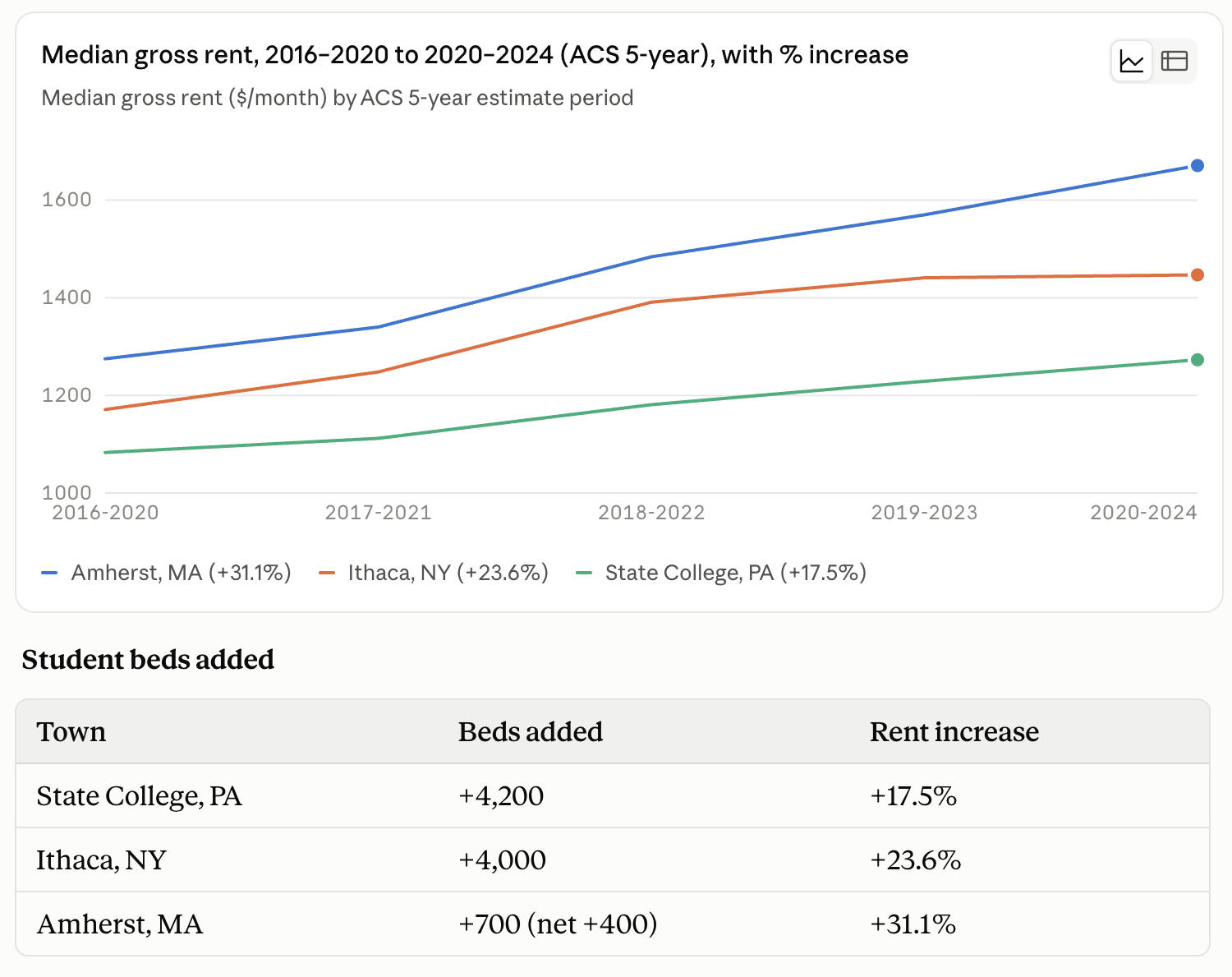
What do we have to show for it? A regional housing crisis. Proposed layoffs for public school educators. And a $500-per-home property tax increase on Amherst residents.
Be careful what you ask for.
Notice the trap we built. For years, the town’s most vocal UMass critics have insisted that more students belong on campus. In March, they told the chancellor that public-private partnerships made it possible. UMass Amherst agreed. Now town leaders are asking the same university to make up revenue that those on-campus beds will never pay.
That’s a tough ask to make from where we’re standing. UMass has spent years hearing from Amherst that it is the problem. So, when town leaders asked for revenue in September, why would the university go out of its way to help? UMass has offered us a wellspring of potential revenue, and we have declined to drink from it. That’s on us, not them.
These choices land hardest on the kids in our public schools. Amherst parents host bake sales, pledge dollars to fundraisers, and show up to Save Our Schools events. We work hard for every dollar of school funding. Shouldn’t our housing policy work just as hard?
The groundbreaking that could have been.
Picture an alternate Amherst, one that spent the last decade acting like Lowell. In that town’s groundbreaking photo, Council President Mandi Jo Hanneke and Vice President Ellisha Walker stand in hard hats beside Gov. Healey, ceremonial shovels in hand. (And yes, dignitaries often get to keep the shovels.) Every councilor now pushing for more UMass money for the schools would proudly declare victory: a deal like Lowell’s would be the largest-ever increase in school funding in Amherst’s history. That council would be remembered for generations for its economic stewardship.
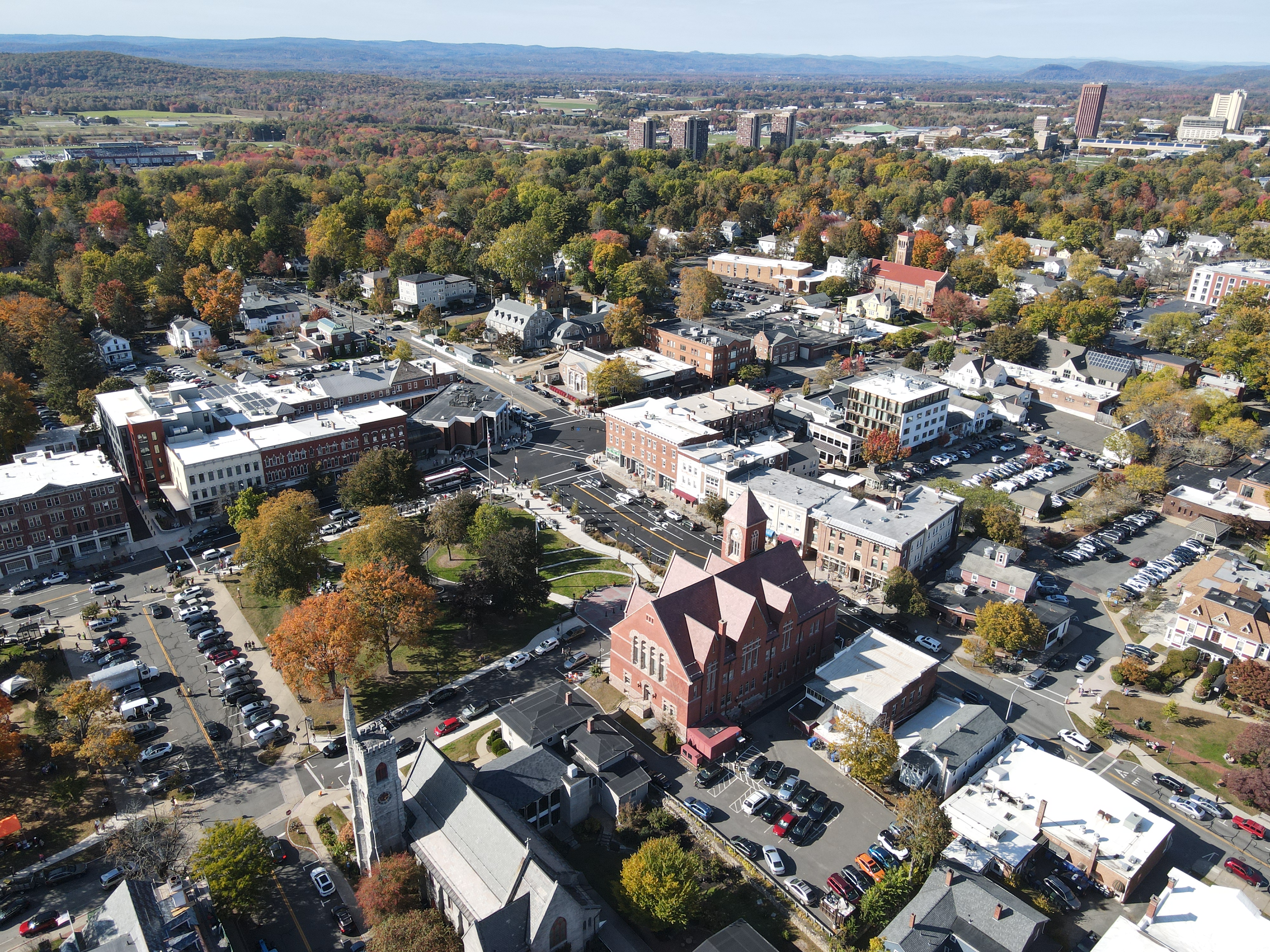
Instead, our future looks lean. In their recent presentation to the Town Council, Amherst’s economic development and finance directors described what slow housing growth is costing us: delayed projects, teacher layoffs, and upcoming overrides. They noted that Amherst struggles to provide level services with half of our population living in tax-exempt housing. The subtext was hard to miss: our fiscal future depends on decreasing the share of students who live on campus, not increasing it.
A better ask.
We can still change course. Our strategic partnership agreement with UMass expires in June 2027, and negotiations are expected to start next month. District 5 Councilor Sam MacLeod struck the right note in September, calling the university a boon to the town and its students the engine of the local economy. That’s the kind of posture that keeps teachers in ARPS classrooms.
Here is what humility and elbow grease would look like.
First, zone the campus perimeter for taxable student housing now, so the next wave of beds gets built on land that pays taxes.
Second, use the state’s tax-increment financing program, as Lowell has, to get mixed-income apartments built downtown.
Third, bring an offer to the table instead of a grievance: tie UMass’s payments to Amherst’s housing production, so both sides win when homes get built. Our state legislators, Mindy Domb and Jo Comerford, could file legislation to authorize or codify that kind of agreement and put the new revenue on solid footing.
President Meehan has already watched one host community go from adversary to partner. There’s no reason Amherst can’t be the second.
None of this requires UMass to change. It requires us to. Lowell decided its university was an asset, and it stands to collect millions. Amherst has treated its university as a liability, and it stands to collect nothing. UMass isn’t the source of our fiscal problems; it’s our best way out of them.
Negotiations start next month. Call your councilor and tell them to bring an offer, not a grievance.
Evan Naismith is a third-year law student and District 5 homeowner who writes about housing for the Amherst Current.
Discover more from THE AMHERST CURRENT
Subscribe to get the latest posts sent to your email.


The dominant paradigm is “you can grow or you can shrink”, very few communities remain the same over time.
LikeLike
Evan, you’ve got it right – please keep beating the drum. If Amherst doesn’t start NOW to treat its colleges as the economic engines they should be, we will increasingly see our citizens leave (as is already happening) under the unsustainable burdens of higher taxes and decreased public funding for schools and services.
LikeLike
It is not accurate for Evan to claim that the PILOT issue is simply because Amherst never asked. And in fact this “Ask” has been voiced by residents and town officials for years! In the last 10 years there are numerous Northeastern colleges that have significantly and historically increased their PILOT contributions while our 4 local colleges have not. Right or wrong. I wrote an op-ed in 2024 detailing all of these payments. And this is not to mention Mayor Menino’s Boston 25% PILOT Program which has been a great success. But none of these contributions are here. And the issue of campus or off campus housing contains many reasonable and civic concerns so to conflate that issue with PILOTs is apples and oranges. No student struggling to pay for their college education should have to pay $25,000 per year or more to live in a corporate private equity dorm.
LikeLike