
By Allison McDonald
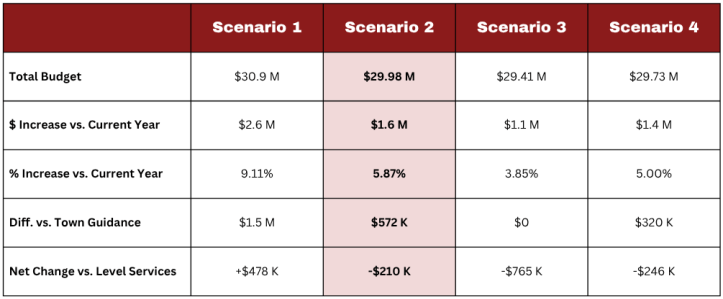
The Amherst School Committee, meeting in a special one-topic session on Tuesday, debated four different budget “scenarios” for the FY27 Amherst elementary schools before ultimately unanimously approving a package that maintains specials teachers and interventionists while trimming central office costs. The nearly $30 million budget, a 5.87% increase over the current year, is $572 thousand higher than the Town Council guidance, setting up another contentious process to develop a final town-wide budget by June.
Four Scenarios Considered
Committee members and Superintendent Dr. E. Xiomara Herman opened by reviewing four budget scenarios:
- Scenario 1: Described as “level services,” though several members argued it was really “level staffing plus an increase,” not a true reallocation of funds to reflect consolidation and new needs.
- Scenario 2: Maintains specials teachers and interventionists and reduces central administration by 1% from level services.
- Scenario 3: Aligned with the Town Council guidance
- Scenario 4: Proposed by Committee Chair Deb Leonard, maintains specials and interventionists while shifting cuts elsewhere.
Dr. Herman expressed concern that a school committee member had developed scenarios “outside of the administration” without sufficient opportunity for her team to review them, and warning that defining the programmatic details in the budget scenario is beyond the committee’s scope of authority:
“If we’re going to be asked to implement something that has gone this depth into district operations, [we] would like to know what the school committee’s perspective is as they have ventured within the administrative purview of programmatic implementation.”
Some committee members also were uneasy about Scenario 4 for process reasons. Sarah Marshall said she would not call it “a school committee product,” but “the product some school committee members have generated,” and pointed out that it did not lay out cost centers clearly enough for a legal vote.
Laura Jane Hunter initially pushed to “just be asking for level services,” as in Scenario 1, so students and educators “are not harmed in any way,” noting that the Town Council can only reduce the School Committee budget request, not increase it.
However, she also acknowledged the political and fiscal realities at Town Hall and ultimately signaled she could consider Scenario 2, saying she still wanted to be on record supporting level services (Scenario 1) even if she was “on an island.”
Bridget Hynes argued that so‑called level services of Scenario 1 did not actually make a lot of sense in light of the elementary school consolidation. She emphasized that consolidation had already “done a lot of the heavy lifting” in closing a previously much larger budget gap and that some cost efficiencies should now be assumed.
Marshall added another pragmatic concern: that requesting too high a number could backfire if the Town Council simply cut the budget back down to 3.85% in June, potentially complicating staffing and reduction-in-force timelines.
The most passionate comments focused on specials teachers (art, music, librarians) and interventionists, particularly at the new Amethyst Brook school.
Hynes praised Scenario 2 and similar options because they protect these roles: “Parts of Scenario 2 that I really appreciated [are] that it doesn’t ask key staff at Amethyst Brook to do the job of two people. The librarians, the music [and] the art teachers, 30 classes a week… Those positions are essential. I can’t pass a budget that cuts them.”
She cited community testimony about interventionists helping students move from far below grade level to reading on grade level within a year, and referenced district data showing persistent equity gaps in reading and math that start in the elementary grades.
The committee first took up a vote on Scenario 1, the so‑called level services budget. That motion failed on a 1–4 vote, with Hunter the only vote in favor.
The Committee then voted on Scenario 2, which passed unanimously.
Next Steps
The School Committee needed to submit its budget to the Town Manager by April 1, who in turn must present a consolidated town-wide budget to the Town Council by May 1. The Finance Committee will conduct an in-depth review of the proposed budget and make its recommendation to the Town Council in June.
The public will have the opportunity to weigh in at budget hearings in May or June and the Council must approve a final budget by June 30. Read more about the Town budget development process on the Town website.
An artificial-intelligence tool assisted in the making of this article by summarizing a recording of the meeting which was reviewed and adapted by the writer.
Discover more from THE AMHERST CURRENT
Subscribe to get the latest posts sent to your email.

