
By Jack Jemsek
Amherst residents got their first detailed look last week at the Hampshire College Campus Zoning Study, a planning effort that could reshape roughly 200 acres of the ~800-acre college campus. At the July 21 virtual public forum, town officials and planning consultants laid out the zoning study’s scope, shared early data on where development might make sense, fielded questions, and collected feedback from community attendees on their sentiment toward zoning changes for the campus.
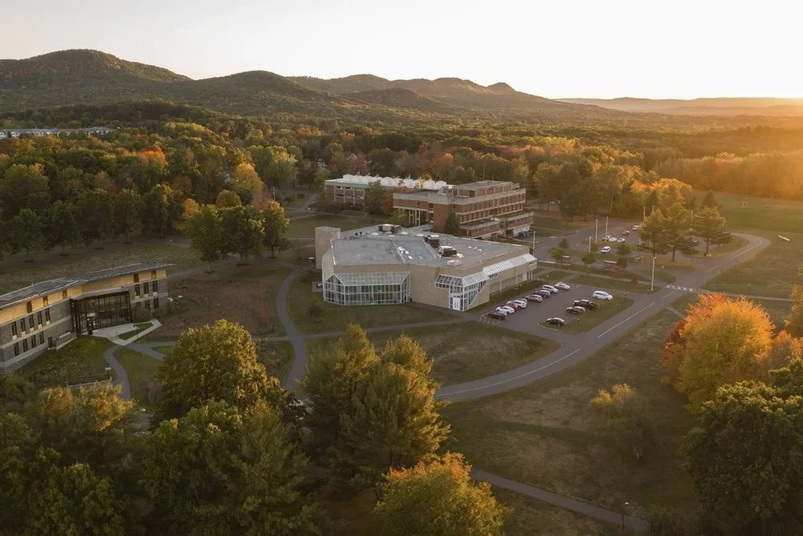
The zoning study is an effort to get ahead of the eventual sale of the campus land after Hampshire College closes in December 2026. The land is currently zoned as a tax-exempt Educational District (ED), which restricts land use to higher education.
Amherst Planning Director Jeff Bagg explained why the town is conducting the zoning study now instead of after the land is sold. “If [the property] goes to an educational institution, it’s easier. But if it sells for non-educational use, then immediate solutions to zoning problems would be needed, and we would need a runway to incorporate the goals of the community in zoning.”
In June, the Town Council outlined priorities for the property’s future, prioritizing the campus’s buildable land for housing, small business development, and other tax-revenue-generating uses, while preserving sensitive habitat, farming, and other resource areas within any redevelopment.
Town Manager Paul Bockelman, who moderated the forum, connected the priorities to the town’s structural budget gap, noting that expenses are growing around 5% each year while revenue growth is coming in at about 3-3 ½%. “So that’s a structural gap that we’re going to be trying to address.” He added “This is a unique opportunity for the community to realize some tax benefits from land, a considerable amount of land that has not been on the tax rolls for some time.”
Bockelman stressed that the Hampshire College Board of Trustees, as the property owner, will make all decisions about marketing and sale of the property. He noted that the town’s zoning work will not dictate what future owners do with the land, but will expand the choices available to them. Bagg added “we’re going through this process to create a menu of potential options that could exist on the campus.”
Not everything on the property is up for consideration. Three independent entities tied to Hampshire’s campus – the Eric Carle Museum, the Yiddish Book Center, and Hitchcock Center for the Environment – will remain as-is and are not part of the zoning study’s scope. However, the Red Barn, a campus building, currently relies on the site’s ED zoning designation and cannot continue in its current use without a zoning change.
Amherst is working with multiple consultants to complete the zoning study, all funded through a grant from MassDevelopment. Horsley-Witten Group is advising on environment, infrastructure, and regulatory reform, Dodson & Flinker is providing support with site analysis, design, and community engagement, and U3 Advisors is consulting on market and real estate analysis. (Dodson & Flinker was recently hired by the town to complete Downtown Design Standards.) Representatives of each gave brief presentations during the meeting.
Site Conditions and Constraints
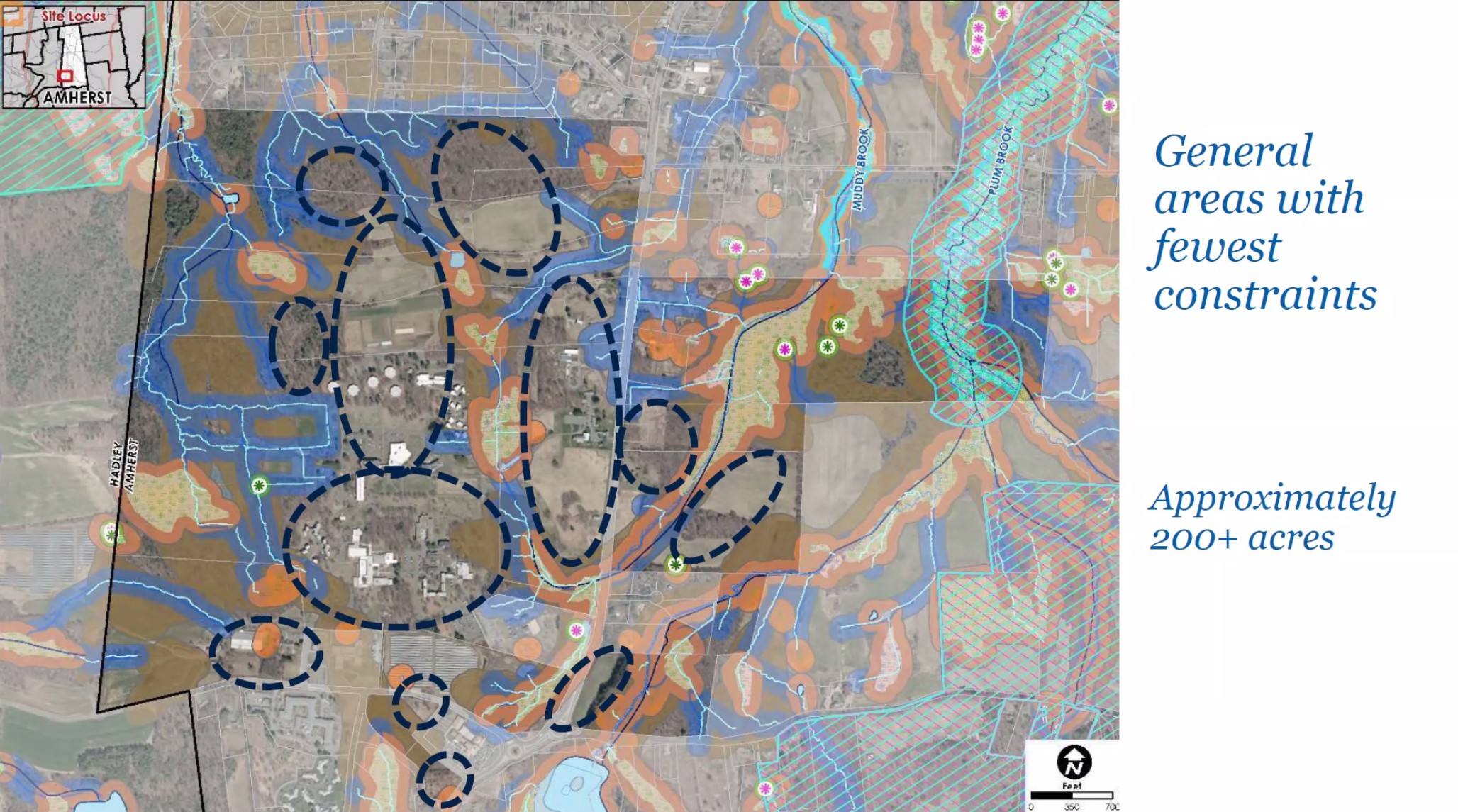
Peter Flinker (Dodson & Flinker) walked through the physical and environmental context, emphasizing that much of the 800-acre property is cut by streams and wetlands, but there is still substantial developable area.
The property has a fair number of protected water resources such as streams and wetlands, which have an associated 100-foot buffer zone where activity is limited by the Conservation Commission. Areas with hydric soils also exist and are likely to qualify as wetlands with buffer zones as well. Features that fall under the state’s Natural Heritage and Endangered Species Program protections for sensitive habitat are limited, and occur mainly within areas already mapped within stream and wetland buffer zones.
Flinker stressed that wetland and habitat maps are preliminary, and part of the zoning study will more clearly define the property’s developable areas. He noted “We don’t know where the actual wetland’s edge is. Until soil scientists and wetland scientists go out to the site… we can use these maps to make an estimate, but it’s only an estimate.”
In total, roughly 200 acres are estimated to have relatively few permitting constraints and could support future development with appropriate zoning changes.
A Vision for Housing Growth
U3 Advisors presented an early, high-level view of what the campus could hold if zoning allowed housing. The consultants spoke to the factors that affect housing capacity at the site, including the history of housing production in the region and documented housing needs identified in the town’s Housing Production Plan.
The housing needs span from residents aging in place, to students, to working households. The type and density of housing that could be distributed across the campus was discussed, with early estimates suggesting the site could ultimately support up to 2,400 housing units, assuming a moderate density of 12 dwelling units per acre and using the estimate of 200 buildable acres.
The consultants stated that a full fiscal impact analysis – covering capital improvements, utilities, roadways, and school enrollment impacts – has not yet been undertaken and remains a critical next step in the study. Water and sewer service is available to the site and appears to have adequate capacity for potential development scenarios. Roads surrounding the campus were also described as having good capacity.
Consultants emphasized that any future housing on the site should reflect how household composition has changed. Family sizes have shrunk notably over the past 20 years, driving demand for one- and two-bedroom units and so-called “missing middle” housing types that fall between single-family homes and large apartment buildings.
Zoning changes could also be structured to incentivize affordable or low-income housing. Bockelman noted that higher density tends to lend itself to greater affordability: “The way you typically gain that kind of affordability is through density, and that’s going to be the sort of question and conversation the town will need to struggle with.”
One of the ideas floated for the site’s long-term character would be a walkable village center, rather than a purely residential subdivision model.
The topic of development of a large-scale data center came up. While some municipalities have banned them, Amherst has not taken an official position. Bagg said that a data center isn’t currently allowed and “it’s not a highly preferred use and it doesn’t meet any of the town’s general goals.”
Community Engagement
Around 155 people turned out for the forum, the first public engagement event at this early-stage of the planning process. Organizers polled attendees about their support for zoning changes at the site at the beginning and ending of the event. In the first poll, 55% of attendees were supportive of rezoning, 8% opposed, and about 37% were unsure. By the time a second poll was taken at the end of the meeting, with approximately 125 participants still present, 64% of attendees supported rezoning, 30% were still unsure, and 6% were opposed.
What’s Next
Public participation isn’t over. An intensive public engagement phase is planned for this September-October, including a multi-day community charette to explore different ideas for land use, kinds of housing, and housing locations. (A charette is an intensive, collaborative design or planning workshop that brings together stakeholders, designers, and experts to quickly brainstorm, debate, and build actionable consensus.) There is also a website where future meeting dates and materials are available: HampshireCampusZoningStudy.com.
The goal is to complete a draft zoning proposal and final report for the Town Council to consider in January 2027. This timeline is critical with Hampshire College officially closing in December 2026, and debt payments coming due soon after.
Jack Jemsek is a consulting hydrogeologist and he and his family have been Amherst residents since 2000. He has served on the Water Supply Protection Committee since 2018, the Pioneer Valley Planning Commission Executive Committee since 2020, the Board of Health since 2024 and the Planning Board from 2016 through 2022.
Discover more from THE AMHERST CURRENT
Subscribe to get the latest posts sent to your email.


https://www.nepm.org/regional-news/2026-09-03/with-philanthropic-loan-hampshire-college-no-longer-in-bank-debt-will-deliberately-think-about-sale
Update on the urgency of the sale given the recent philanthropic loan this summer.
LikeLike