
By Freke Ette
A curated list of upcoming cultural events and a collection of brief reviews of recent events.
UPCOMING EVENTS
Yokai! Songs of the Japanese Supernatural
Wednesday, October 21 at 7:30 PM at Bezanson Recital Hall | Yokai! Songs of the Japanese Supernatural is a unique jazz project by bassist Fumi Tomita featuring songs inspired by Yokai and other supernatural spirits. Yokai are derived from Japanese folklore and come in human, animal, or even inanimate forms, sometimes at the same time!
Celebrating the Legacy of Dr. Yusef Lateef
Thursday, October 22, 4:30-6:00 PM at Aliki Perroti & Seth Frank Lyceum, Amherst College | This panel discussion celebrates the legacy of Dr. Yusef Lateef, a master of African American autophysiopsychic music. Dr. Lateef (1920-2013) received his Ph.D. in 1975 from the University of Massachusetts, Amherst, eventually becoming a Five College Professor.
Beethoven Sonatas Series, Concert #1
Thursday, October 22, 7:30 PM at Bezanson Recital Hall, UMass | The first program in the cycle of Beethoven’s piano sonatas traces the extraordinary evolution of his compositional language—from his first published sonata to the heroic “Waldstein” and finally to the “Hammerklavier,” the definitive, hard-earned breakthrough to his late style. Pianist Gilles Vonsattel is performing all of Beethoven’s Piano Sonatas in series at UMass Amherst.
Thursday, October 22, 9:00-11:00 PM at the Ginsburg Theater of the Ford Student Center, Amherst College | Enjoy the third in a fall semester series of four FREE Thursday evening performances in the popular series. The featured group is TBD.
UMass Amherst Symphony Orchestra
Friday, October 23, 7:30 PM at Tillis Performance Hall, UMass | Enjoy a concert featuring Dmitri Shostakovich’s Symphony No. 5, plus the premiere of a new trombone concerto by Annika Socolofsky, commissioned by Gonzalo Hidalgo Ardila and trombone professor Gregory Spiridopoulos. The concert begins with Beethoven’s Coriolan Overture, Op. 62.
REVIEWS IN BRIEF
“Some Like It Hot,” with introductory lecture by Nina Kleinberg
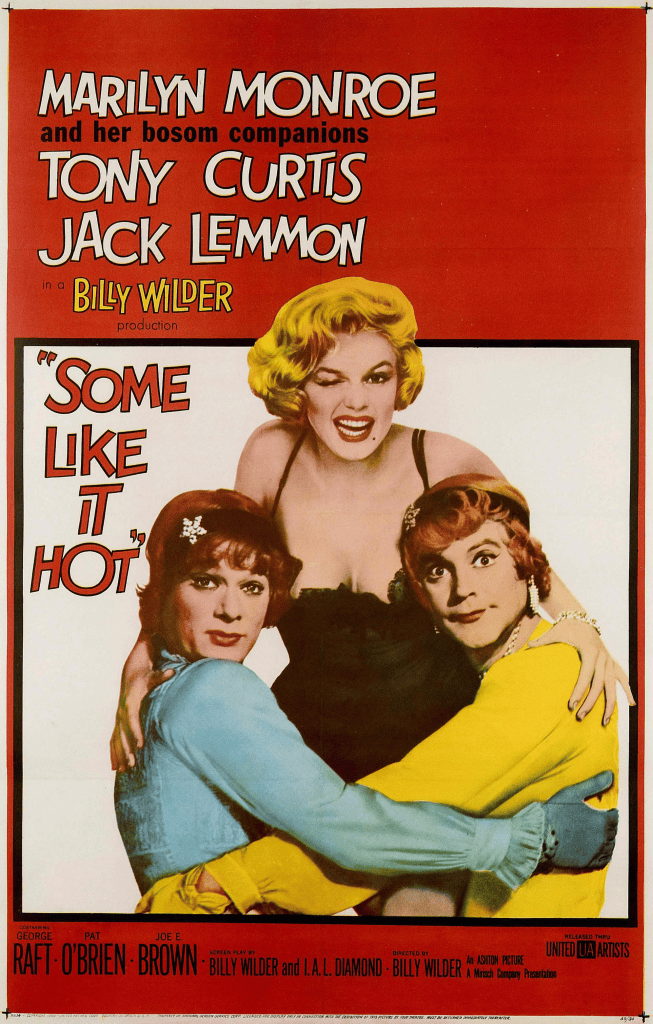
Amherst Cinema’s screen 1 was sold out Monday night, October 6, for a screening of the 1959 classic, “Some Like It Hot.”
The event was the first in a fall film series celebrating famed director Billy Wilder (1906-2002). Nina Kleinberg introduced the film, offering a survey of Wilder’s journey from his childhood in the Austro-Hungarian Empire to the pinnacle of success in Hollywood.
Kleinberg, a USC Film School graduate and former film editor, drew on anecdotes, short video clips and screenshots of Wilder’s early newspaper articles, to offer a profile of the director. The second half of her talk focused on “Some Like It Hot.”
She explained that during an informal poll she conducted on notable directors, Wilder’s name regularly popped up. Usually, with a smile on the respondent’s face.
According to Kleinberg, Wilder, more comfortable as a screenwriter, took on directorial roles to prevent the bowdlerizing of his scripts.
He went on to direct acclaimed films like “Sunset Boulevard,” “The Seven Year Itch,” and “Ace in the Hole,’ among numerous others.
“Some Like It Hot,” combines B-gangster energy with a delightful romantic comedy. Josephine (Tony Curtis) and Daphne (Jack Lemmon) are jazz club musicians forced to don female disguises as they flee from a Chicago crime boss. Marilyn Monroe also stars as Sugar Kane, Josephine’s love interest and a soused ukulele player in an all-women band.
Chockfull of superb performances from a cast who fully buy into its absurd scenarios, more than 50 years later, “Some Like It Hot” has lost none of its comic grandeur, adult humor and subversive gender sexual politics.
The next film and lecture in the Billy Wilder series, “Witness for the Prosecution,” will be screened on Monday, November 9.
Craig Taborn Trio
The Craig Taborn Trio stopped by UMass’ Bowker auditorium for an electrifying performance on Tuesday, October 7.
The Trio, featuring Taborn on piano, Thomas Morgan on upright bass and Tim Angulo on drums, were in town as the opening act for this season’s UMass Fine Art Center’s Jazz series.
The performance lasted slightly over an hour, with 5 original Taborn compositions from an earlier album, ending with an encore of Geri Allen’s “When Kabuya Dances.”
The trio was in sync, the band played confidently and was in control of the musical energy. On the first piece, Taborn started out on right side of the piano, tiptoeing towards the lower notes on the left. As he tap-danced on the keys, accompanied by Angulo’s propulsive rat-tat-tat machine-gun drumming, Morgan’s bass ever present in the background pulled everyone back to orbit.
The third piece reminded me of a Pentecostal revival, an unintelligible, unholy cacophony of tongues leaping in harmony.
Taborn didn’t have much to say about the night’s setlist. For those lucky enough to be in the audience, all the talk needed was found in the music.
The next entry in the Jazz series will be on Thursday, October 22, with a concert performance by Christian McBride and Ursa Major.
The Apple Hill String Quartet
Despite the wet, chilly Sunday, October 11, a packed house of classical musical lovers gathered at The Drake for a brisk sampling of chamber music pieces courtesy of the Apple Hill String Quartet.
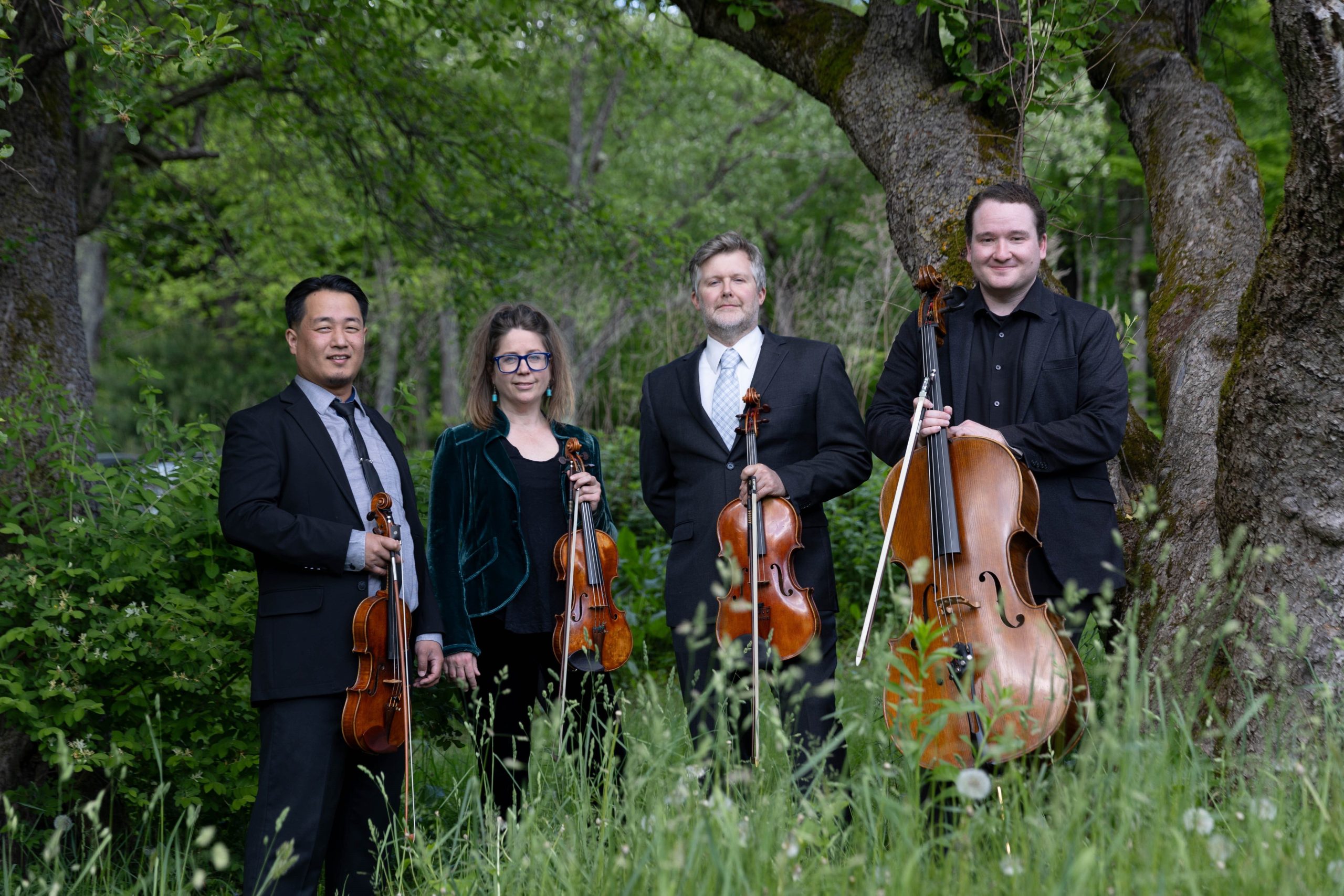
The Quartet, resident musicians at New Hampshire’s Apple Hill Center for Chamber Music, are this month’s featured artistes in the 26-27 Chamber Music at the Drake series. The group comprises Elise Kuder and Jesse McDonald on violin, Mike Kelley on viola and Jacob MacKay on cello.
The evening’s program leaned heavily on contemporary musical offerings, including a theme from Hayao Miyazaki’s film, “Spirited Away,” string quartet pieces by Swedish composer Andrea Tarrodi and violinist Cenovia Cummins, who was in attendance for the MA premiere of her String Quartet no. 1.
The program ended with Beethoven’s String Quartet no. 5 in A major.
Each member took turns introducing items from the program, pointing out salient passages for the audience. Besides being skilled musicians, the Quartet are also enthusiastic educators.
One highlight of the concert was the first movement of Cummins String Quartet no. 1, titled “here.” I was transported to an apple orchard in autumn, with the wind blowing through the trees, unsettling the leaves—a vigorous stillness.
November’s entry in the Chamber@theDrake series will feature a solo piano performance by Jiayan Sun on Sunday, November 22.
THIS WEEK
NAZA
Through October 22 at Amherst Cinema
After a rapturous reception at Venice Film Festival last month, the documentary film NAZA arrives stateside this week and can now be seen at Amherst Cinema.
At a brisk 77 minutes, NAZA, directed by Yuval Abraham and Rachel Szor and produced by The Guardian, packs a wallop out of proportion to its swift running time.
A major chunk of the film consists of interviews with unnamed, unidentifiable Israel Defense Force soldiers and intelligence officers speaking on deep background. The conversations focus on the use and abuse of emerging technologies and total surveillance in the ongoing Israel-Palestine conflict.
The wholesale adoption of advanced technologies by the IDF has contributed to a considerable increase in the loss of human lives caught in the crossfire. Indeed, the expression NAZA is a colloquial military term for collateral damage.
The filmmakers display a considerable restraint, which gives the film an unmistakable power, but was a frustrating watch because it is obvious the omissions are deliberate aesthetic and moral choices.
The film relies on a series of contrasts. Of metropolitan Tel Aviv and disheveled Gaza, of invisible Palestinians and surveilled Israelis, of peaceful nighttime and hideous daylight, of the calm rooftops on high-rises and the noisy depths of explosions and rubble. The list could go on.
However, the effectiveness of these contrasts depends on the viewer’s prior knowledge. Essentially, what one takes away from NAZA depends on what one comes with in the theater.
A paradox of warfare in the 21st century is that with greater visibility has come less understanding of its logic. Even though a larger part of the global population has access to images from conflicts around the world, the numbers of those directly involved in conflicts, whether as victims or combatants, continue to plummet. The film would have benefited from an interview with a military leader, one who would have had to justify their decisions in the fog of war on camera.
NAZA deserves to be seen because it presents an opportunity for a broader conversation about topics of grave importance: the ubiquity of surveillance technology, the amorality of algorithms, the soldered nexus of industry, military and mass media, the hollowing out of political representation, the aesthetics of suffering in the social media age, and the dearth of empathy for those embroiled in military conflicts around the world.
NAZA is playing at Amherst Cinema through Thursday, October 22.
Discover more from THE AMHERST CURRENT
Subscribe to get the latest posts sent to your email.

