
By Jack Jemsek
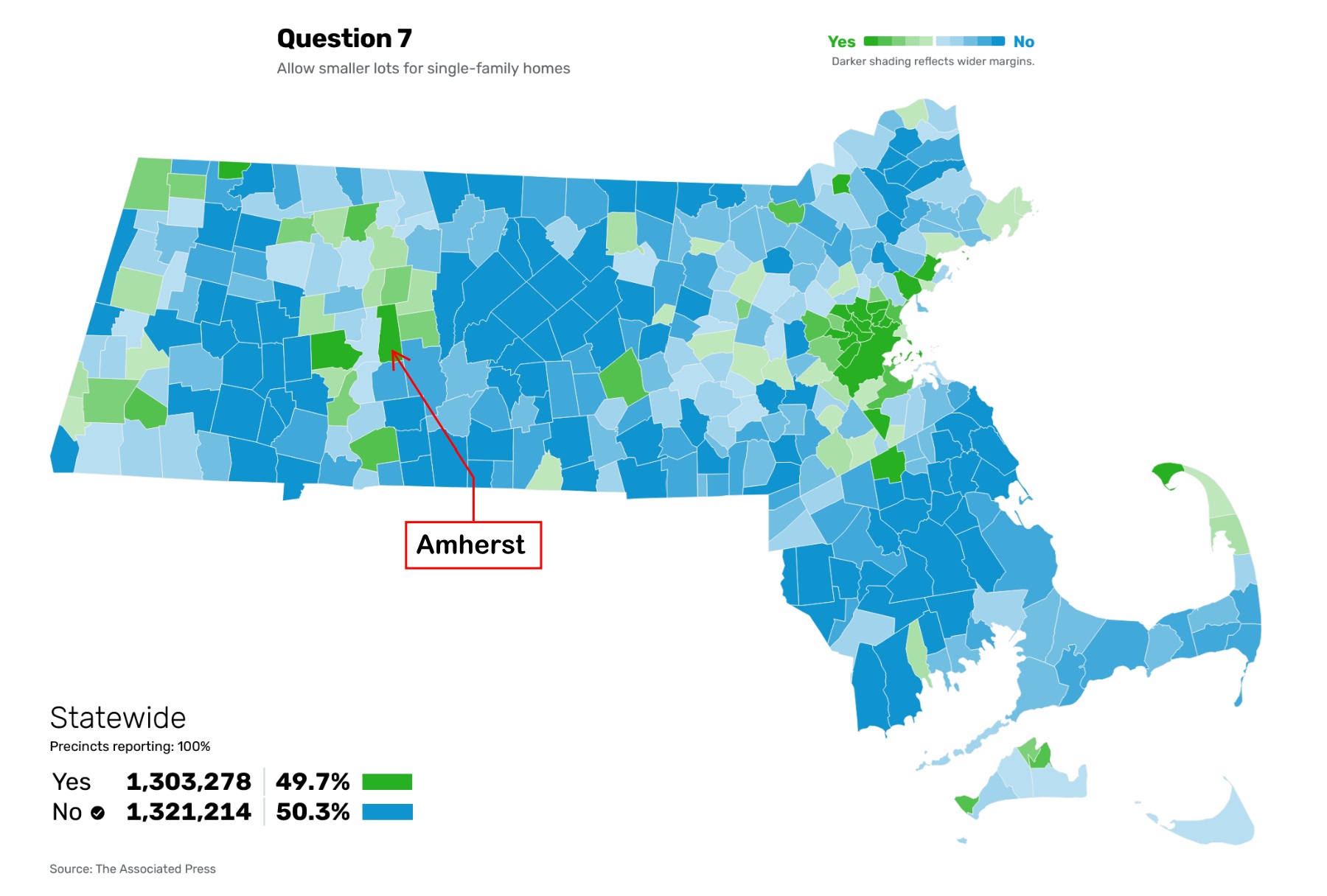
In the recent State election, Massachusetts voters narrowly rejected Question 7, the ballot measure that would have allowed single-family homes on lots as small as 5,000 square feet (SF) wherever public water and sewer are available. But in Amherst, 64% voted ‘Yes,’ compared with 49% statewide. Analysis of statewide results suggests that towns with more renters voted more strongly in favor of the measure.
Unofficial results published by the Town show Amherst voters backing the measure 4,995 to 2,811. The 64% ‘Yes’ vote was the strongest in Western Massachusetts alongside Northampton, which voted 63% ‘Yes,’ while voters in neighboring towns were cooler: just under 50% of Hadley voters and only 40% of Belchertown and Granby voters voted in favor of the measure. Precinct-level results in Amherst show that Question 7 won in all ten precincts, with ‘Yes’ votes ranging from 59% to 73% of the total. No single neighborhood carried the result, regardless of Amherst’s renter/homeowner demographics.
The Backdrop for Lot Size Requirements
Minimum lot sizes vary because they serve different purposes in different places. Where homes rely on private wells and septic systems, large lots, often an acre or more, help protect groundwater and keep systems apart. Where public water and sewer exist, that concern eases and smaller lots become feasible. Other rules shape lot size too: minimum frontage ensures road and emergency-vehicle access, and setbacks and lot-coverage limits keep buildings apart for fire safety, light and drainage. Many minimums also reflect the density a neighborhood already had when zoning was adopted, and some towns raise them to limit growth. In Amherst, the General Residence district has a 12,000 SF minimum, and most single-family residential lots in Town fall in a general range of 15,000 SF to 30,000 SF.
Amherst has long acknowledged a housing shortage but has struggled to agree on a remedy. Some residents view large, multi-story, mixed-use buildings as off-campus dorms in all but name. Last fall, a citizen petition called for a one-year moratorium on new downtown apartment buildings. As Evan Naismith recounted in the Current, the Planning Board recommended against the moratorium, and the Town Council shelved the petition. Before that, Connie Kruger reported that Town Councilors Hanneke and DeAngelis submitted a 2023 proposal to ease rules for duplexes, triplexes, and accessory dwelling units (ADUs), but withdrew it after concerns that students and out-of-town investors would benefit most.
But in many respects, Amherst can’t be labeled as “anti-growth”. Amherst’s 2020 Master Plan encourages more and a wider range of housing types. The Planning Board has also historically sought zoning changes to add housing. Amherst passed an ADU bylaw in 2021, and amended it in 2025 with a two-tier ADU bylaw. This was before the state’s 2025 Affordable Homes Act mandated ADUs by right statewide.
And then in the State election on November 3, Amherst threw heavy support behind the pro-housing Question 7. In lieu of any exit polls, several possible reasons why are as follows:
Starter homes. Homeownership is slipping out of reach for first-time buyers. In early 2024, Kruger noted that the average single-family home in Amherst was valued at just over $500,000, requiring roughly $130,000 in household income, compared with a local median of $68,427. She pointed to duplexes and ADUs as a major part of the “missing middle” in Amherst housing.
Renters and students. UMass political scientist Raymond La Raja told the Daily Hampshire Gazette that the Question 7 vote most likely splits renters from homeowners. The paper said the pattern held in Hampshire County, where towns with large student populations voted ‘Yes.’ The Current’s analysis of statewide town data also supports a renter-versus-homeowner split.
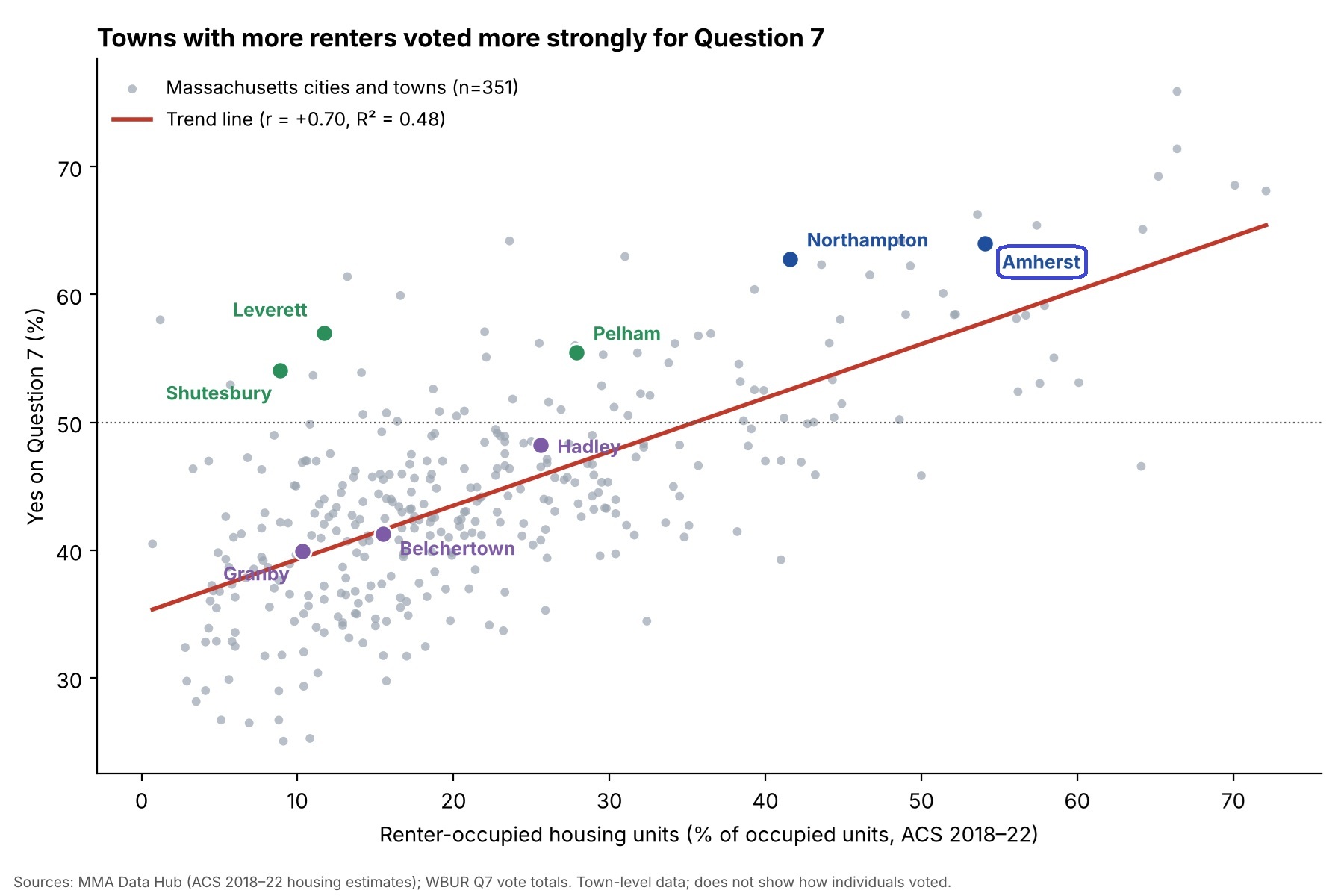
Pairing Massachusetts Municipal Association’s Mass Municipal Data Hub housing estimates with WBUR’s estimated vote totals for 351 cities and towns, the renter share of housing alone explains about half the variation in ‘Yes’ votes with a strong linear correlation of r= 0.70 (a perfect straight line would be r= 1.0). The more homeowners per municipality, the lower the share of ‘Yes’ votes. Population density adds almost nothing once the owner-vs.-renter factor is accounted for, and Amherst voted close to what its renter share trend for ‘Yes’ votes would predict.
Locally, Precinct 4B (largely a historic-district neighborhood) had the lowest share of supporters at 59%, and Precinct 5A (the Amherst College vicinity) had the highest at 73%. Since every precinct in Amherst said ‘Yes’ by at least an 18-point margin, it appears that Question 7 carried with strong support from Amherst homeowners as well as renters.
Revenue. Naismith noted that Town finance officials told the Council that Amherst struggles to maintain existing town services without cutting back services or raising property taxes, largely because half the population lives in tax-exempt housing. Some Town Councilors also said the new buildings in the UMass Amherst-American Campus Communities dorm partnership will not be taxable, so new taxable homes would help.
What the MMA got right, and wrong
The Massachusetts Municipal Association (MMA) urged a ‘no’ vote, saying Question 7 bypasses local zoning, has no affordability requirements, and ignores water and sewer capacity. “A smaller lot does not automatically mean a more affordable home,” its legislative director said.
Backers cited research that smaller lots will likely produce more affordable new homes. Additionally, the MMA’s stated alternatives, easing rules for accessory dwelling units (ADUs) and requiring towns near transit to allow apartment-style zoning, don’t create new lots for first-time buyers.
Would a ‘Yes’ to Q7 move the needle?
Tufts University’s Center for State Policy Analysis estimated 350 to 1,200 net new homes a year statewide, a roughly 5% boost to overall housing development; the campaign’s own analysis claimed 2,200 to 5,700. Tufts expected most of those homes in mid-size towns and Boston-area suburbs. Large parts of Western Massachusetts lack public sewer, and so would have been exempt. Amherst’s 2025 Housing Production Plan (HPP) sets a goal of about 160 new homes a year, and conventional wisdom would have single-family housing production increase with smaller lot size requirements.
How much Question 7 would have changed in Amherst depends on two factors. One is how many lots in sewered neighborhoods are large enough to be split. The other is what gets built on them: modest family homes or student rentals. Northampton’s planning director said the measure probably wouldn’t affect many places there because they already have a minimum lot size of 3,750 SF. Amherst’s larger minimum lot size might matter more here, though the Town has little undeveloped land left. Since Question 7 only covered single-family homes, it would not have allowed the duplexes Kruger describes.
Amherst can still act independently. Planning Board Chair Doug Marshall said at its November 4 meeting that minimum lot size is a bylaw change the town could make on its own. Voters in all ten (10) precincts overwhelmingly supported a resolution that would reduce Amherst’s 12,000 SF minimum to 5,000 SF. The question now is whether the Town Council will act, perhaps quickly, and whether it will also pair the move to smaller lots with allowing duplexes and other “missing-middle” options.
Discover more from THE AMHERST CURRENT
Subscribe to get the latest posts sent to your email.


Thank you, Jack, for a clear, well-sourced piece. I’d like to offer a neighborly counterpoint: Amherst’s 64% “Yes” on Question 7 reflected good intentions more than a close look at what it would have done here.
Start with geometry. Strong Street lots have about 120 feet of frontage. Split one and you get two 50-to-60-foot slivers that keep all the depth, and all the land cost. That isn’t a starter home; it’s an expensive lot too tight for the ADU a builder would also want. In District 4, closest to downtown, where lots are already small, the squeeze would be worse.
The burden wouldn’t fall evenly. For a household in Amherst Woods, voting “Yes” was low-stakes, except that degrading the town you live in is sawing off the branch you sit on.
We should also be honest about capacity. As the article notes, little undeveloped land remains. The lesson of The Limits to Growth is that no system expands forever without costs to water, roads, schools and character.
Nor is Amherst shirking. Our Subsidized Housing Inventory was 11.7% in 2023, above the state’s 10% benchmark, which few Western Mass towns can claim.
Must every UMass student who wants to live in town be able to? That isn’t how it works anywhere. In my 25 years at UMass, very few colleagues lived in Amherst.
The better lever is UMass: build more beds on campus and pay its fair share. Renovating 1970s dorms matters, but not more than adding beds. When Senator Stan Rosenberg fought for public-private partnerships, I doubt he envisioned a “service concession” letting a private developer collect market rents on state land while paying Amherst nothing. The Current has reported that Fieldstone, built off campus, would pay about $3.9 million a year in property taxes. A good neighbor would reconsider.
Finally, the state should stop imposing blunt rules on 351 very different communities; not every town has Nantucket’s legal budget to push back. Question 7’s statewide defeat held a quiet wisdom. I’m humbly confident Amherst’s “win” rested on misunderstood consequences. Let us decide, carefully, for ourselves.
Ira Bryck
LikeLike
The cost of running a Town grows faster than 2.5% That sets up an interesting dynamic. Either increase the number of new homes, decrease the services provided, or vote to over-ride Prop 2.5.
Raw land is a limited resources, increasing housing production means “going up” or “decreasing lot size”. Neither of those options is an easy sell.
Shrinking Government is next to impossible. Growing the tax base without impacting the school aged population means going Commercial ….that’s what Hadley did.
Who in Amherst wants to start a Mall War?
LikeLike